
What comes to mind when we think about fashion and the 1960s? Almost certainly it is the miniskirt for women and brightly patterned shirts for men. Gone were the demure skirts and suits of the 1950s: sixties fashion was for young swingers!
Without a doubt, most people looking back on the 1960s will remember the mini skirt, that scandalously short skirt (or dress) cut several inches above the knee. At first it was a fashion choice of young women and girls, but by the end of the decade older women’s skirts were often cut on or just above the knee. Even the Queen wore her skirts cut above the knee by the late 1960s!
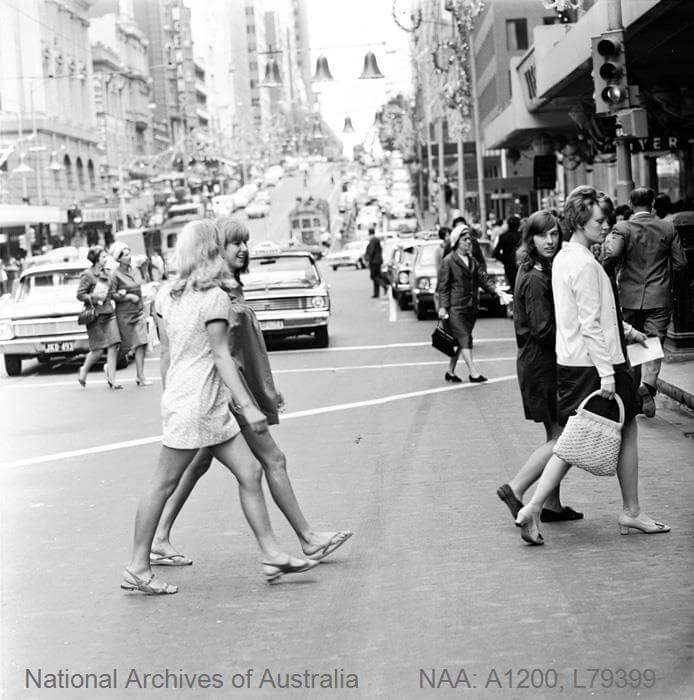
Miniskirts in Melbourne 1969
National Archives of Australia
This photograph of Melbourne women captured on film in 1969 shows skirts worn at various lengths, but almost all were either on or above the knee.
It was a fashion style that evolved gradually from the early-1960s. In 1960-61 women’s dress was still alternating between the full-skirted fashions of the post-war ‘New Look’, and slimmer silhouettes, with so-called ‘pencil’ skirts that hugged waist and hips.
In 1961 Flinders Lane was still the centre of the ‘rag trade’, with dress shops and fashion houses lining the street, although that would not be the case for much longer. Traffic congestion and overcrowding in the city soon made deliveries too time-consuming and many clothing workshops looked for sites in the outer suburbs, eventually leaving Flinders Lane semi-deserted.
For smart or business wear the recommended look was the chic little suit, with Chanel-style jacket and slimline skirt, a style popularised by US First Lady Jacqueline Kennedy amongst others. It was exemplified in illustrations like these, featured on the front cover of the Australian Women’s Weekly in August 1963. Hats and gloves were still de rigueur.
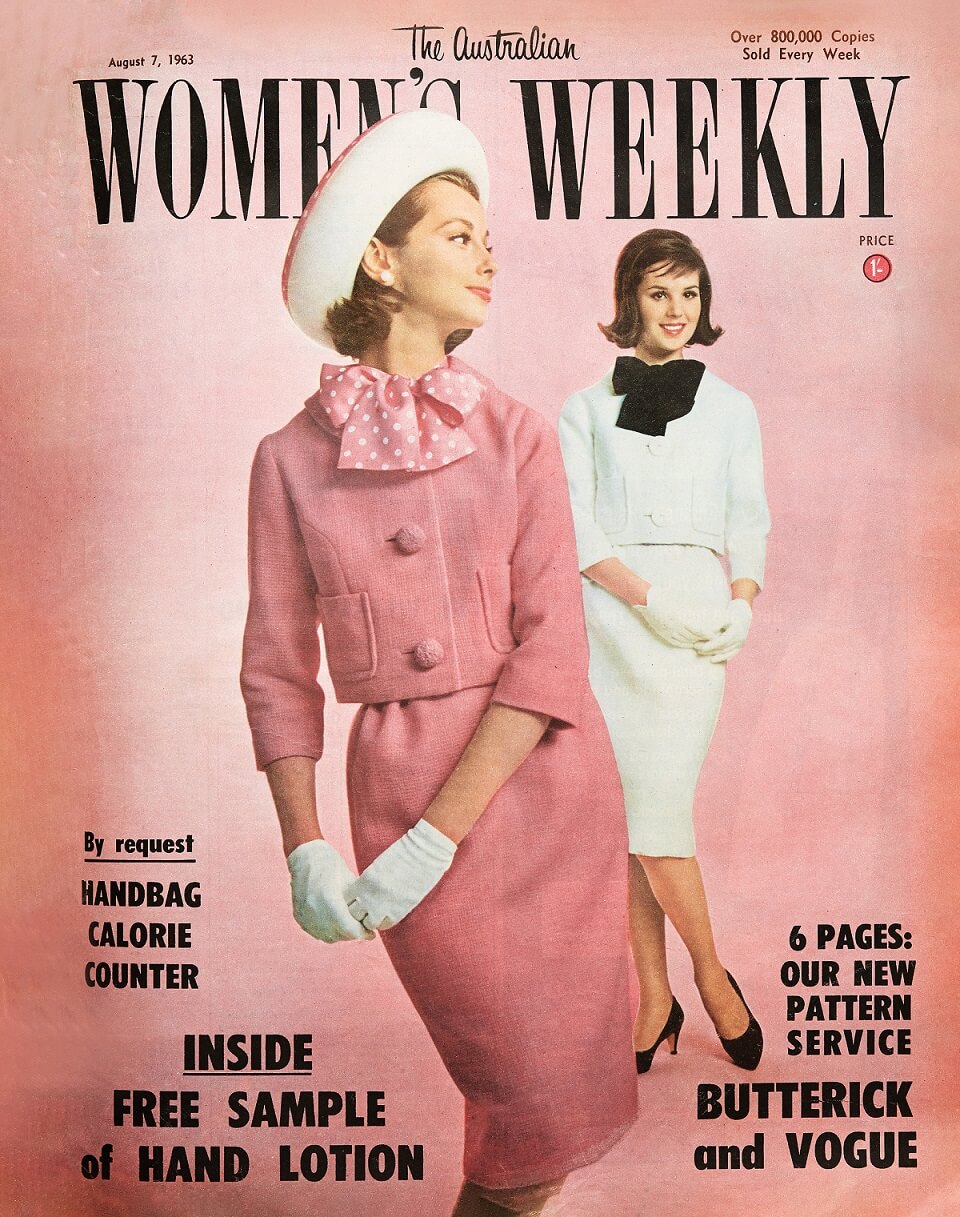
The Australian Women’s Weekly 7 August 1963
National Library of Australia
This was still the case in 1964, as demonstrated by these relatively demure outfits entered in the annual Wool Awards run by the Australian Wool Board at the Showgrounds.
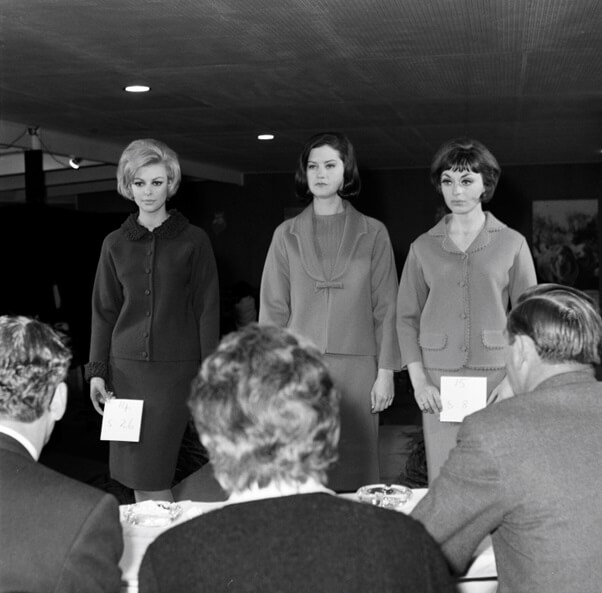
Australian Wool Board, Wool Awards judging at Showgrounds Melbourne, September 1964
Photographer Henry Talbot
State Library Victoria
But in the late-fifties and early sixties a fashion revolution was underway in London, led by young fashion designers like Mary Quant, who sold ready-to-wear fashion from small boutiques. Their target market was young women, and their pinafores and A-line dresses were designed for comfort and freedom of movement. ‘I hated the clothes the way they were’, Quant later claimed. ‘I wanted clothes that were much more for life, much more for real people, much more for being young and alive in.’ She also maintained that her clothing was designed for all young women, regardless of class. ‘Snobbery has gone out of fashion’, she wrote, ‘and in our shops you will find duchesses jostling with typists to buy the same dresses.’ Even at the time this was recognized as an optimistic claim, while historians now point out that Quant’s fashions were always too expensive for most ordinary working girls to buy. Her clients were mainly wealthy young women from privileged backgrounds, who could afford to shop in her boutiques. Historian Dominic Sandbrook points out that super-model Twiggy, (Leslie Hornby) was fashion-mad, but never owned a Quant outfit, which was far beyond her means before she became famous herself. ‘Bazaar in Kings Road [one of Quant’s boutiques] was for rich girls’, Twiggy recalled.
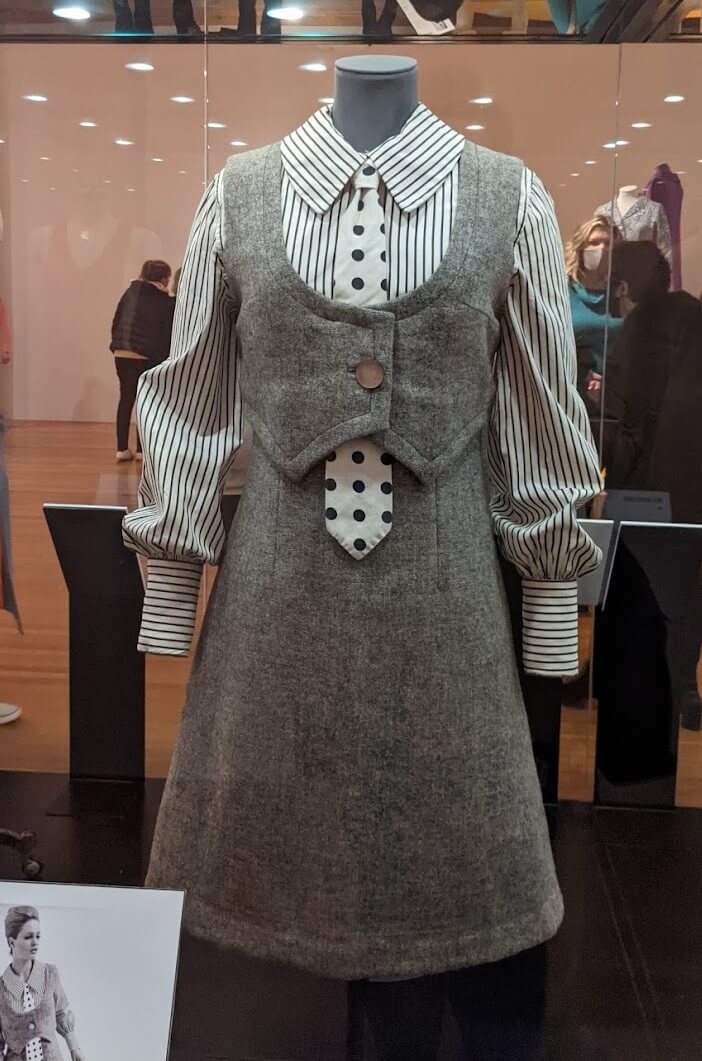
Mary Quant pinafore dress photographed at the 'Mary Quant: Fashion Revolutionary' exhibition at Bendigo Art Gallery, 2021
Private Collection
Exit corsets?
Nevertheless, the simplicity, comfort and freedom of movement promised by these clothes did prompt another clothing revolution — the demise of the corset, at least for the young and slim. In the post-war period women had continued to wear corsets, especially to assist with the nipped-in waist of the ‘New Look’. Corsets might be longline affairs, like the example shown here from Museums Victoria’s collections, or the smaller girdle shown below it. Both are boned but also use elastic to flatten the stomach, while still allowing some freedom of movement. It was common for teenage girls to be introduced to wearing a corset with a smaller, lightweight ‘panty girdle’. But the new A-line and pinafore style dresses did away with all that. If the aim was for freedom and fluidity, then encasing the body in a rigid carapace was completely inconsistent and young women cast off their girdles with enthusiasm. Older women probably continued to wear corsets for a bit longer, but by the 1970s they were on the way out.
Of course, corsets and girdles had served another function, that of attaching the stockings and they all featured suspenders for that purpose. This was soon fixed by replacing the corset with a (much smaller and lighter) suspender belt, which had first appeared in the 1920s — that other period when fashionable dress was relatively loose-fitting.
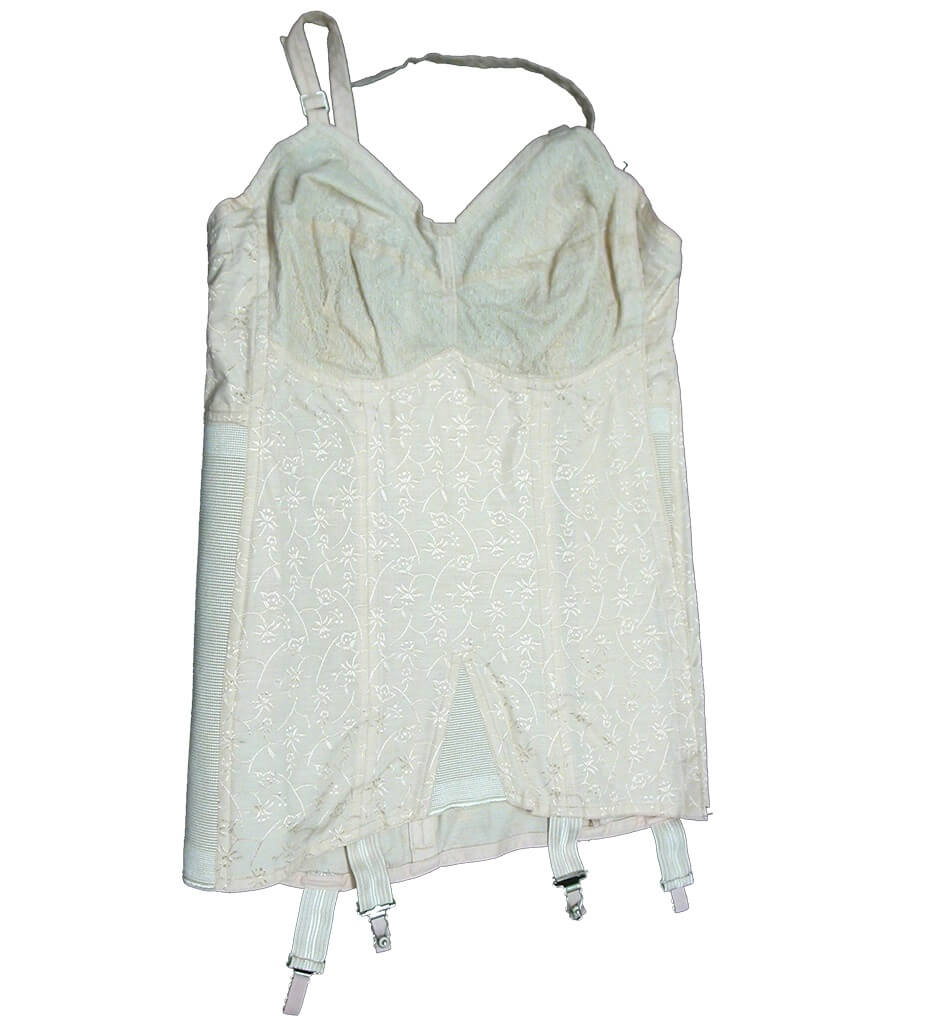
Corset DebUForm Foundations c. 1950-65
From Steinberg’s Drapery Elgin Street Carlton
Museums Victoria
Pink cotton, size 44. The corset has several boned panels and elastic inserts at front and back. Fastens with hooks and eyes at front left and has four suspenders to attach to stockings.
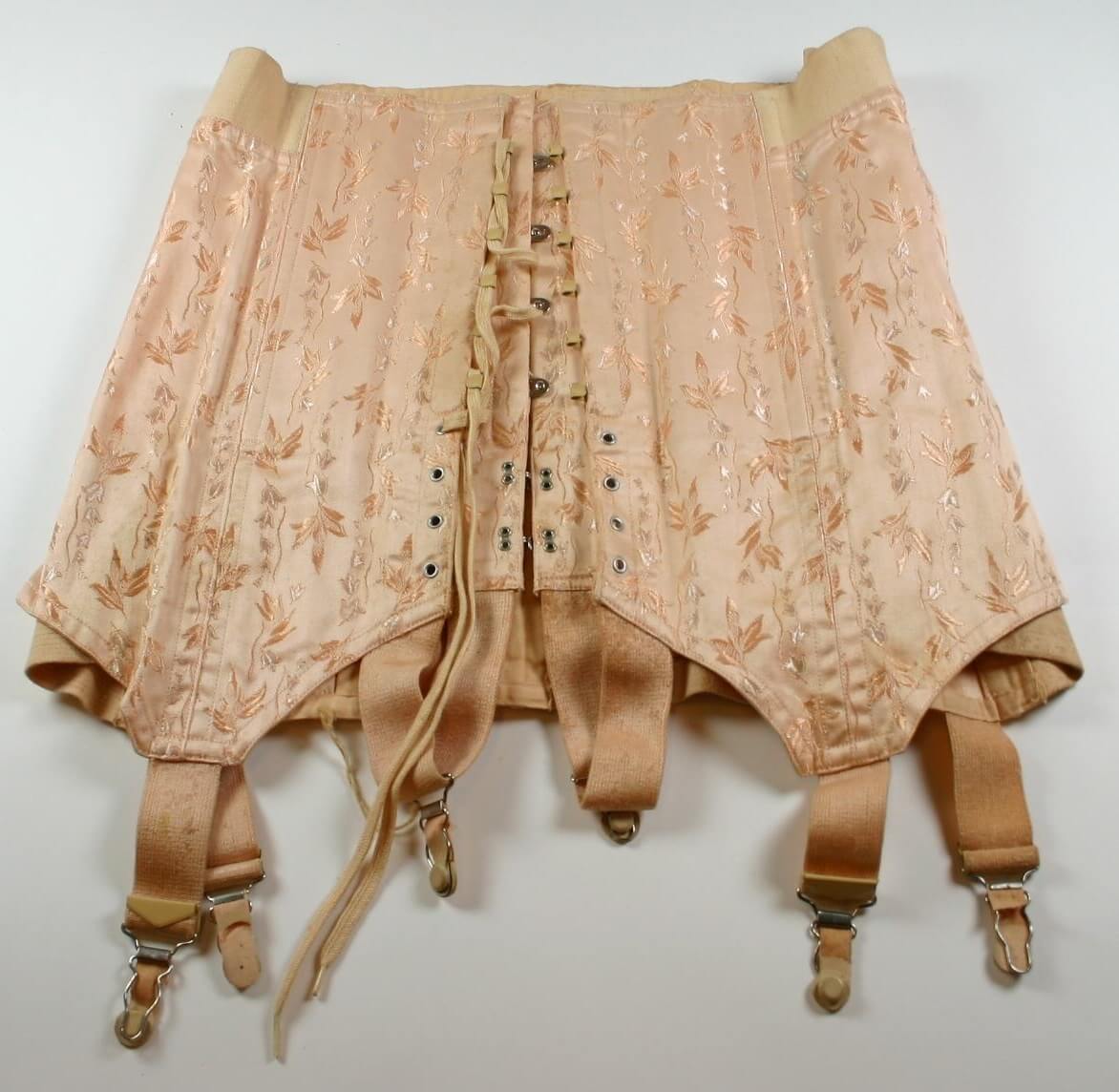
Girdle, salmon pink brocade with elastic panels c. 1940-60
Museums Victoria
Although more comfortable than their nineteenth century counterparts, such corsets still encased the body to below the thigh and continued to be boned. Elastic insertions allowed some movement.
The Youthquake in Melbourne
It was not long before the example of ‘Swinging London’ was emulated in Melbourne. Young fashion designers like Norma Tullo and then Prue Acton followed the trend of designing clothes for young women and teenage girls, selling ready-to-wear garments in short runs from small boutiques, rather than established department stores. Creating styles in short runs enabled them to respond to new fashion trends quickly, which was the essence of fashion in the 1960s. Tullo began designing and making clothes for friends before opening her first business in 1956. She was a strong supporter of Australian wool, which featured in many of her designs, including in these winter coats, modelled in 1966.
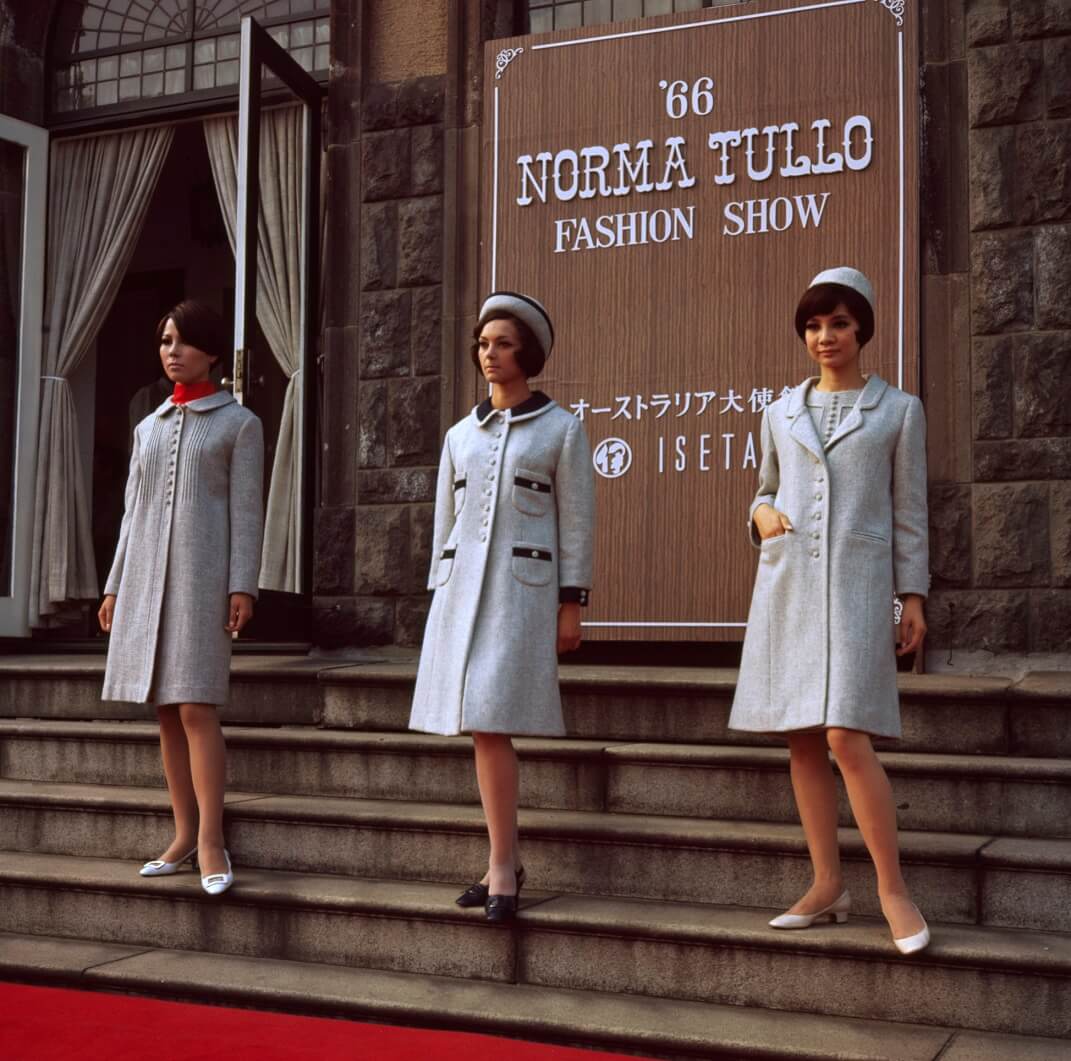
Norma Tullo Fashion Show preview August 1966
National Library of Australia
Another very successful Melbourne designer was Prue Acton. Acton established her first boutique in Flinders Lane in 1963 when she was aged just 19. Her clothes were bright, youthful and affordable and, like those of Quant and Tullo, were bought off the rack. Very soon her designs were also stocked by another newcomer on the boutique scene, Sportsgirl, the youth franchise created by the older, established Sportscraft business.
Along with her staple ‘little black (or navy) A-line dress, Acton experimented with the bright colours and synthetic fabrics popular in the sixties. Several of her outfits were shown in the Swinging 60s exhibition, from the collection of Acton fashion held by Museums Victoria. They included the little black dress shown below, a version of the dress she modelled in 1967.
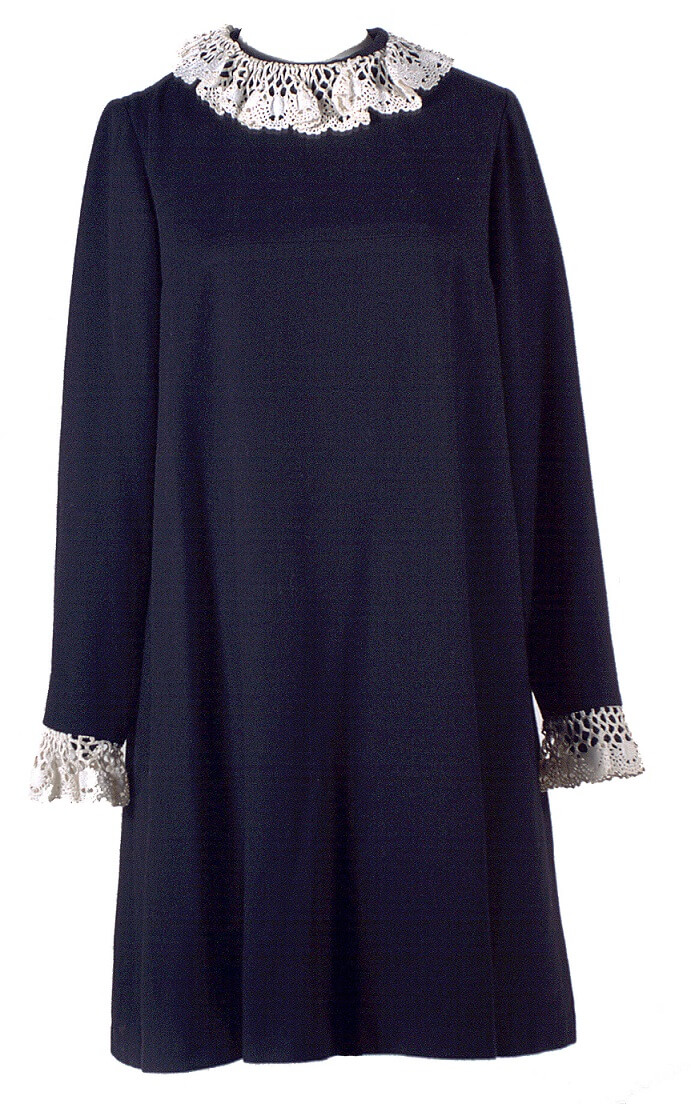
Other designs were more daring, like the vibrant hot pink and orange striped mini shown below.
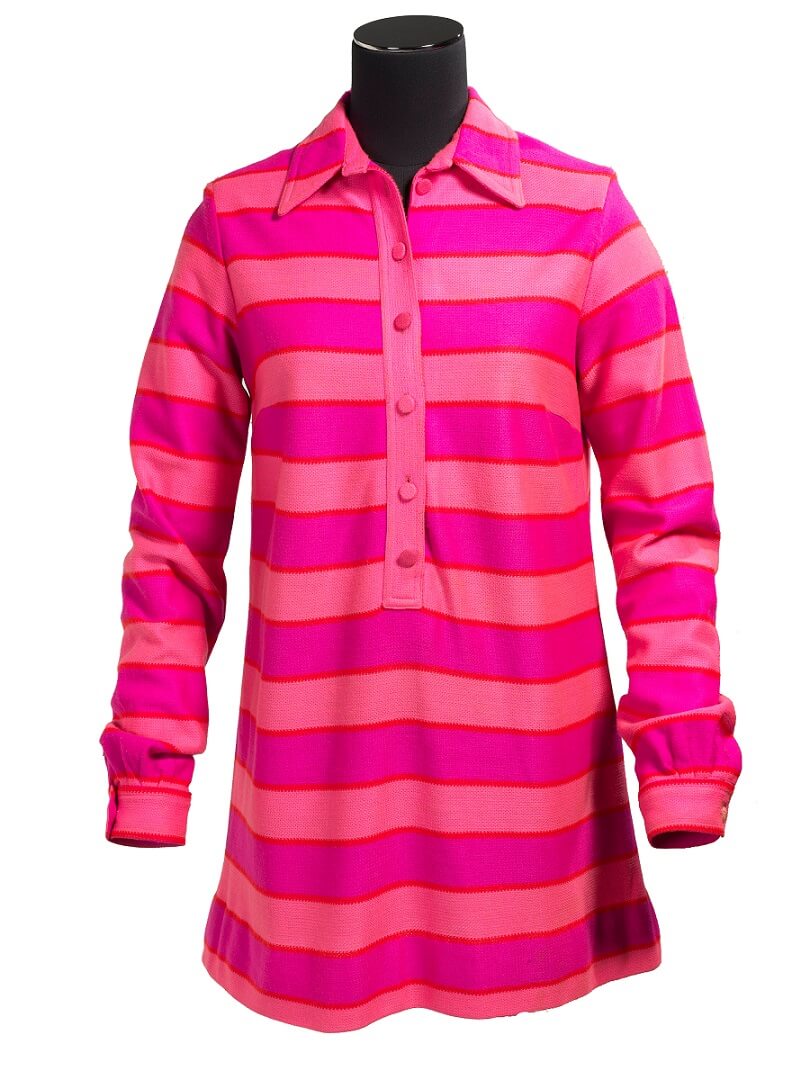
Acton promoted her designs through regular features in fashion magazines, like the ‘Teenagers Weekly’ section created by the Australian Women’s Weekly to reach younger readers. Although their traditional target audience was the mature woman, the Weekly soon realized that it needed to appeal to young women as well. Acton’s teen styles included informal pants suits and shorts, alongside dresses obviously intended as party frocks. The fabrics illustrated included bright and cheerful patterns, while the sub-heading ‘Clothes to be gay and gorgeous in’ underlined the general impression of relaxed fun.
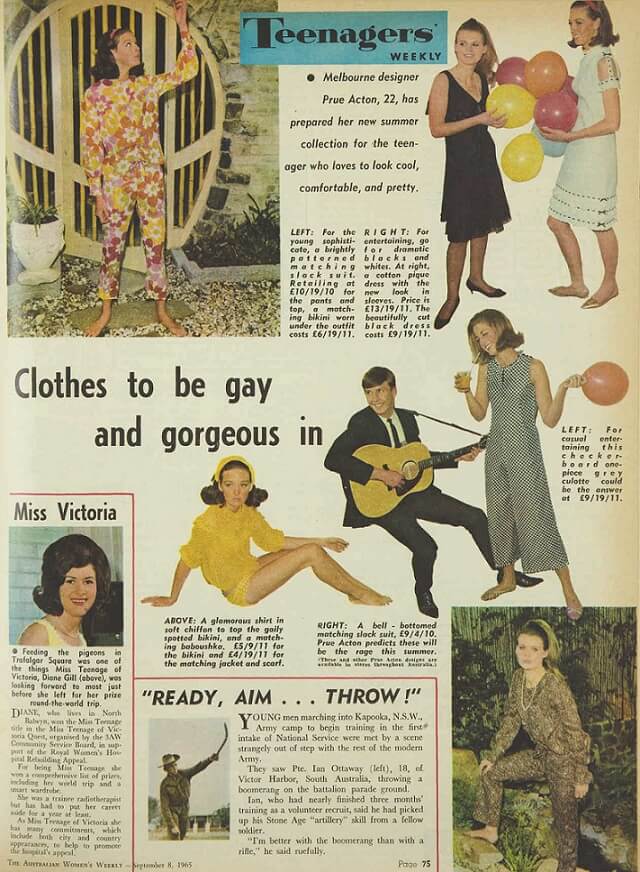
Prue Acton’s designs in ‘Teenagers’ Weekly’
The Australian Women’s Weekly, 8 September 1965
National Library of Australia
Teen magazines like Go-Set, launched in February 1966, also featured articles on fashion alongside their pop music columns and Prue Acton contributed regular columns from the magazine’s inception.
Enter the miniskirt!
The dresses shown in ‘Teenagers’ Weekly’ from September 1965 suggest that skirts were still cut just above the knee, but an event at the end of that year would see them shorten dramatically. The event in question was the appearance of super-model Jean Shrimpton at Flemington Racecourse on Derby Day on 30 October, and the photograph of her appearance made headlines around the world. It has become one of the iconic images of the 1960s.
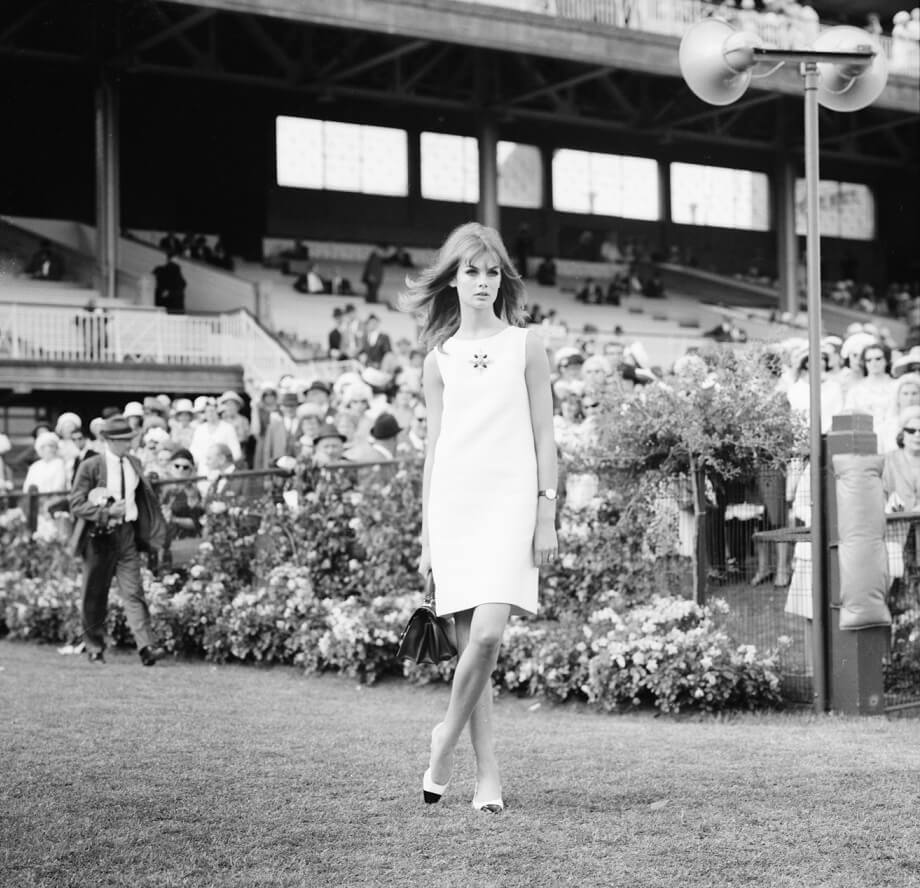
Jean Shrimpton on Derby Day 1965
Photograph Clive Mackinnon.
The Age Archives
Jean Shrimpton was the first of the so-called ‘super-models’, described by Elle magazine as ‘the most beautiful girl in the world’ in 1963. Her partnership with fashion photographer David Bailey made her a household name on both sides of the Atlantic and in Australia. In late 1965 she was offered a two-week modelling assignment in Melbourne, promoting a new synthetic fabric, Orlon, at the Spring Racing Carnival. She was paid the extraordinary sum of £2,000 for this assignment. Just by way of comparison, The Beatles earned £1,500 between them for their six concerts the year before. Such was the fame attached to the Shrimp as she was known in 1965. Shrimpton was provided with fabric and designed the famous shift dress herself, but the story goes that DuPont, manufacturers of Orlon, had slightly miscalculated and did not send her quite enough material, so she was forced to shorten the skirt to a daring four (or five depending on who was counting) inches above the knee.
Accounts of what happened next vary in the sources, but it seems that Shrimpton and her then boyfriend, the actor Terence Stamp, arrived in Melbourne much later than expected, due to international scheduling errors. There was barely time to whisk her to Flemington straight from Essendon Airport. Whether she was briefed on the dress requirements of the members’ enclosure is not clear, but certainly she arrived wearing neither hat, gloves nor stockings. It was (for once) a blisteringly hot day, and Shrimpton might simply have decided to go without, but if so, her decision caused outrage amongst the matrons of Flemington, who regarded it as a flagrant flouting of the rules. The resulting furore made headlines in both Australia and in the UK. Not all were critical. Local Sun reporter Barrie Watts wrote admiringly:
There she was, the world’s highest paid fashion model, snubbing the iron-clad conventions of fashionable Flemington with a dress five inches above the knee. NO hat, NO gloves and NO stockings! For my money, she looked tremendous — but Flemington was not amused.
Sun News Pictorial, 1 November 1965
In glee the English press reported the fuss as just another example of Melbourne’s small-town dowdiness in the face of Swinging London, describing Shrimpton as ‘shining like a petunia in an onion patch’. For her part, Shrimpton was both embarrassed and affronted by the controversy, while her sponsors, DuPont, scurried around and found her a hat and stockings to wear with her (more demure) suit on Melbourne Cup Day. This later outfit can be seen here and certainly contrasts with the informality of the white shift dress. Those looking on also seem to approve. As you can see, the hemlines amongst the spectators were similar to Shrimpton’s.
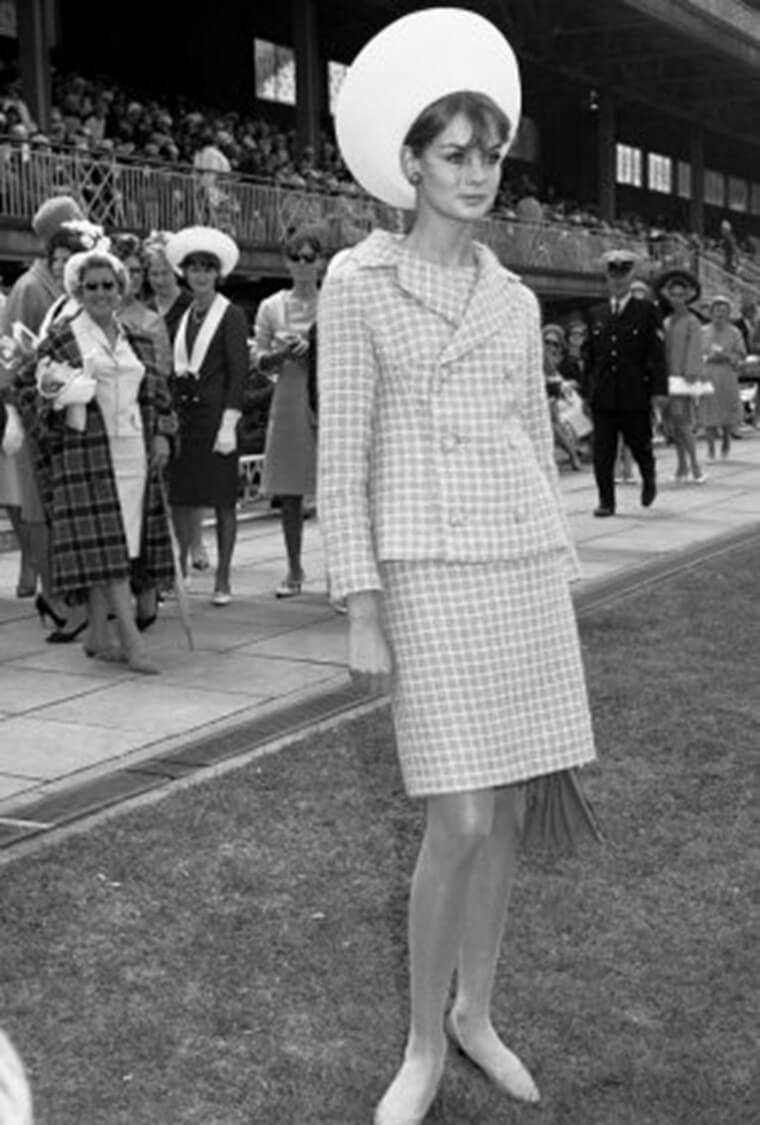
A demure Jean Shrimpton at the Melbourne Cup 1965
The Age Archives
The fuss may have died down, but the impact of Shrimpton’s shift dress was immediate and lasting, both in Melbourne and apparently in London. In an interview later Prue Acton recalled that young women came into her shop immediately asking for skirts to be cut shorter.
All the kids who I was supplying, all the 18-20 year olds, said: “That’s what I wanna look like.” And overnight we were cutting the skirts. We were cutting two inches off, and the next week, another two and anther two. By Christmas we were up to something quite disgusting.
Flair, p.12
It is an interesting example of consumer demand leading fashion design! Once embarked on their ascent, skirts rose higher and higher, until by the end of the decade designers referred to ‘micro-minis’ — skirts so short that they barely covered the crotch. It was almost impossible to bend over or sit in these skirts without revealing what was underneath! Meanwhile this photograph from Flemington in 1969 shows how far times had changed, although admittedly these women are wearing hats and stockings! Most of the women in the background also wear skirts some inches above the knee.
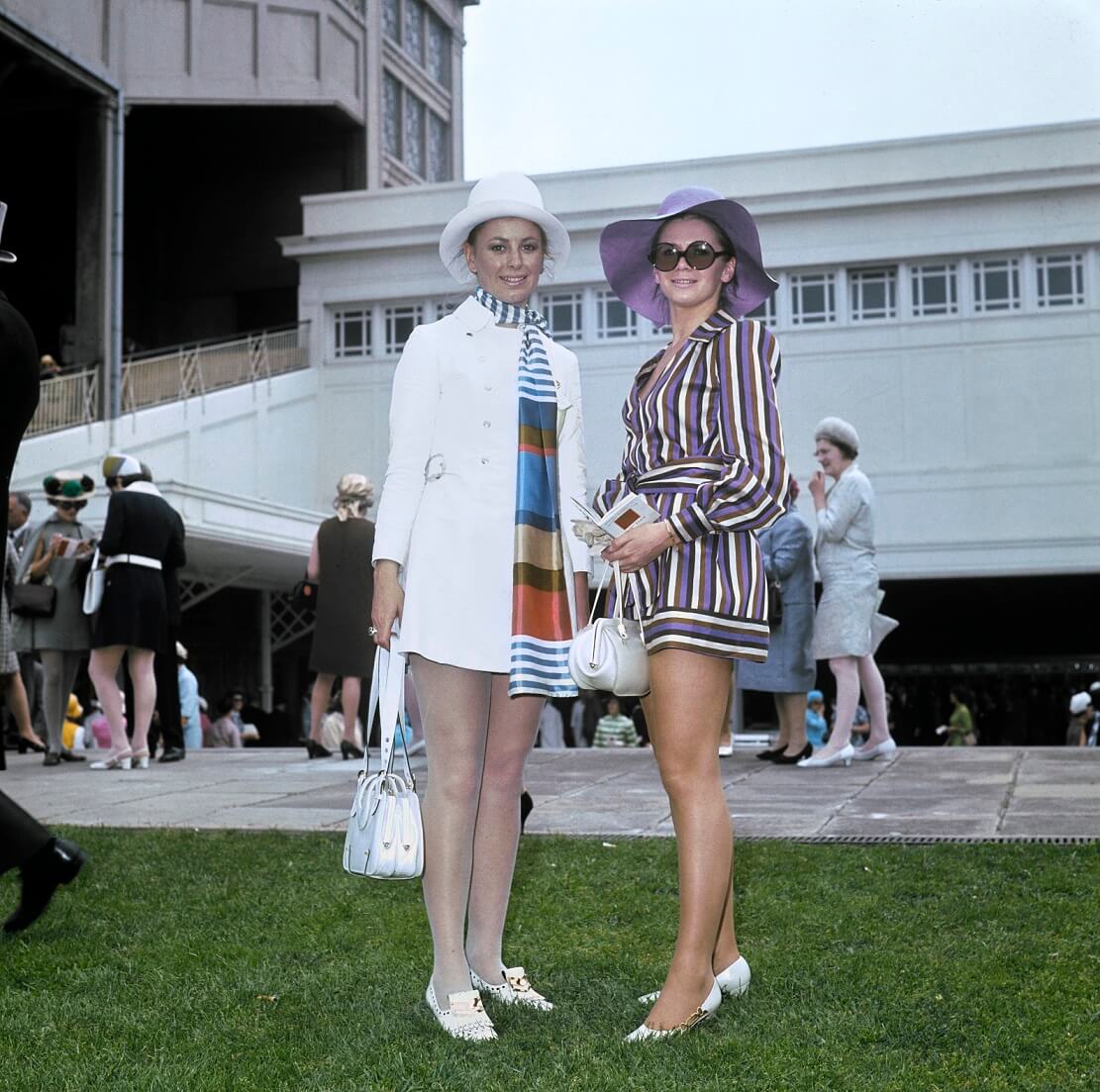
Scene at Flemington during the 1969 Melbourne Cup
Photographer possibly Henry Talbot
National Archives of Australia
Now interestingly enough, it is Mary Quant who is usually credited with inventing the miniskirt, although the V & A’s most recent exhibition on sixties fashion was at pains to credit the contribution of other fashion designers (notably André Courrèges) as well. But if Acton’s recollections are accurate, it seems that the miniskirt may well have emerged simultaneously in Melbourne and London at the end of 1965. The V & A maintained that the true miniskirt did not appear until 1966, but Acton’s account suggests otherwise. Other very short styles, like these Prue Acton hot pants, were also popular, sometimes worn with a longer, ‘maxi-length’ coat. In fact, by the late-sixties skirts alternated between mini and maxi length, with brightly patterned maxi-length skirts and dresses equally popular. These Acton hot pants were also shown in the exhibition.
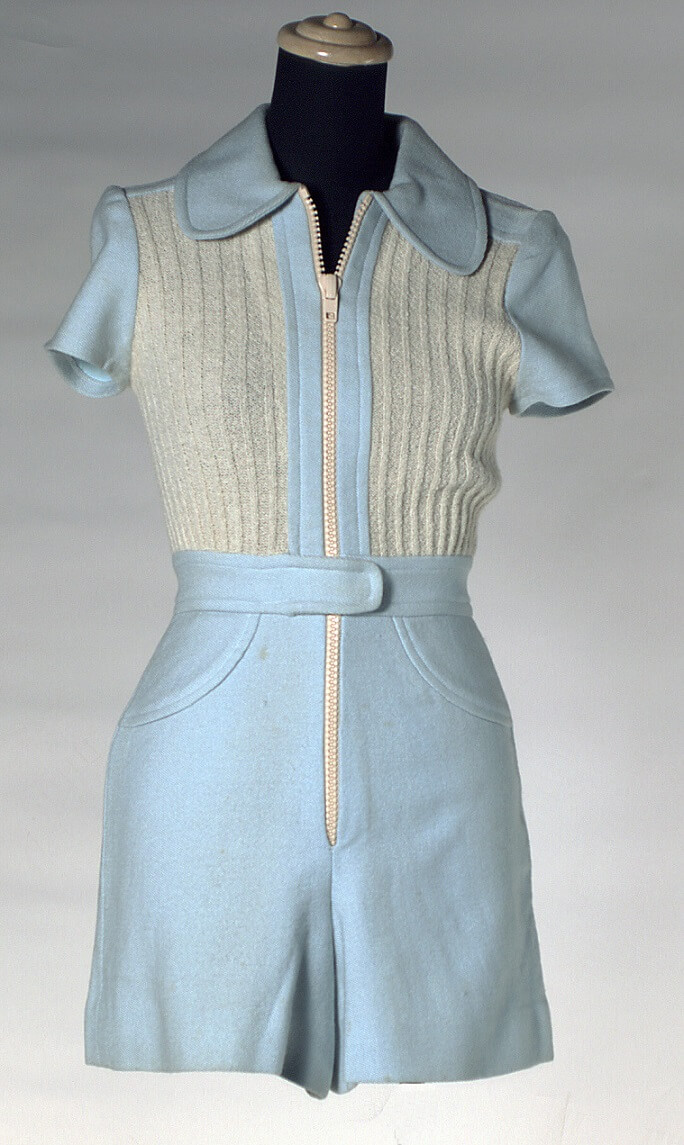
Hotpants by Prue Acton, c.1969
Prue Acton & Museums Victoria
Both minis and hot pants were often worn with boots.
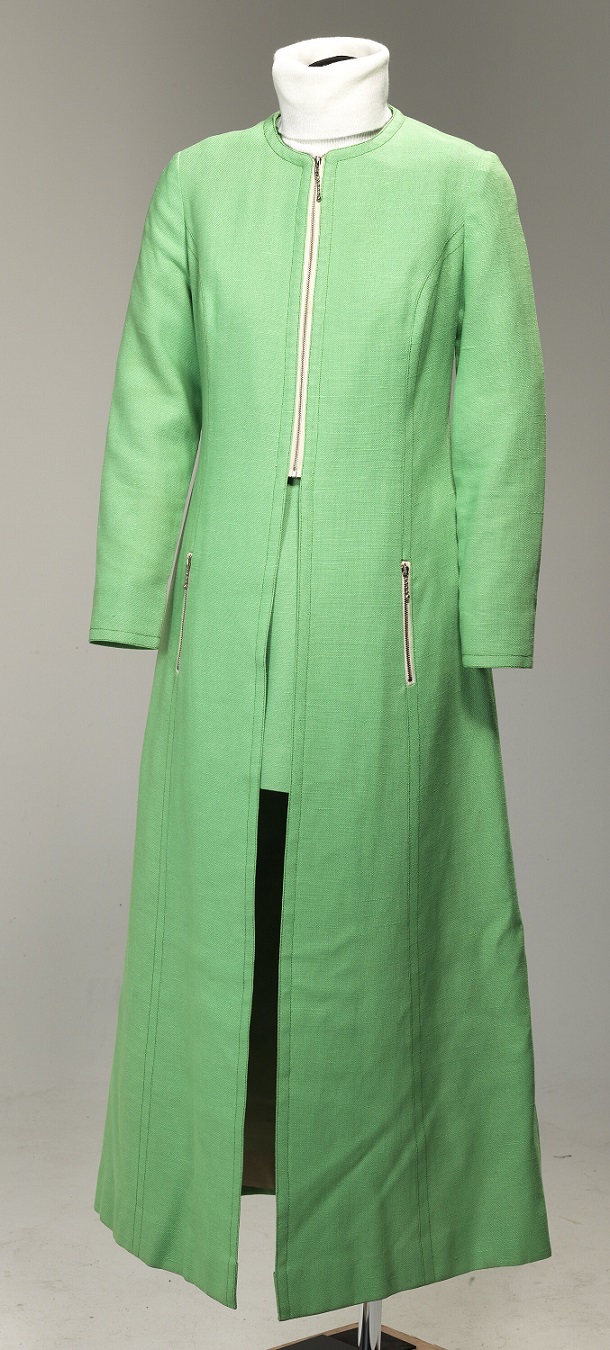
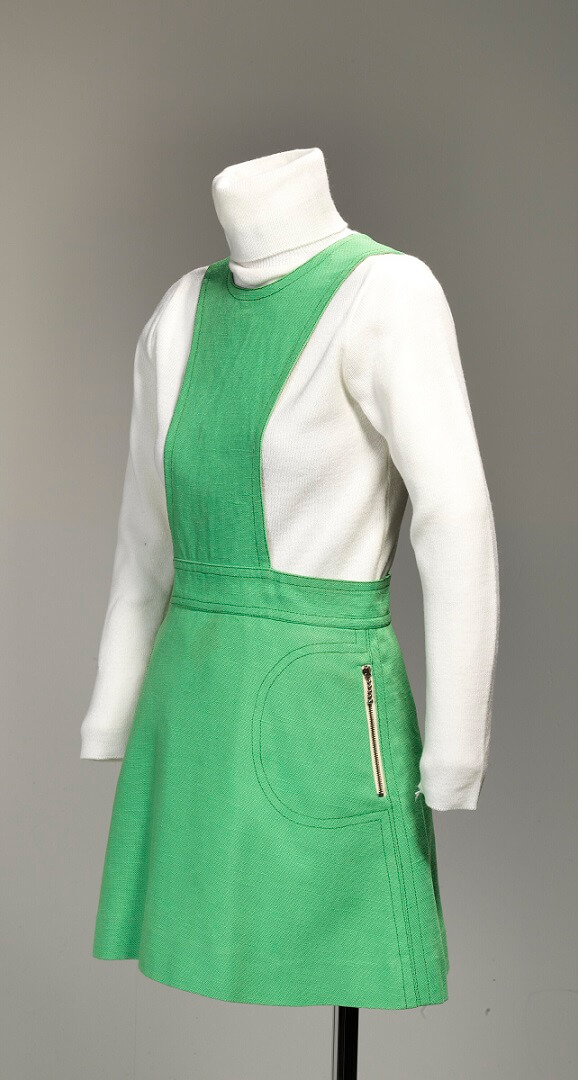
Lime linen maxi coat, originally worn with linen mini pinafore and white acrylic jumper by Prue Acton, c.1969
Prue Acton & Museums Victoria
The simple A-line dresses and pinafores, what Mary Quant called ‘The Look’, were very different from the fashions then worn by older women and drew their initial inspiration from clothing worn by young girls. Quant maintained that she designed clothes that were comfortable and ‘free’ but also acknowledged that she aimed for an adolescent look, what some have described as the ‘dolly bird’ look. The ‘dolly bird’ look combined the new fashions with a bobbed haircut and elaborate eye makeup. According to Quant, young women no longer hoped to pass for thirty. ‘All this is in reverse with a vengeance now. Suddenly every girl with a hope of getting away with it is aiming to look not only under voting age, but under the age of consent.’ Our contemporary awareness of sexual exploitation of minors makes comments like this much more problematic now, but even at the time the androgenous fashions attracted criticism. Fashion models like Jean Shrimpton were certainly slender, but the trend towards models who resembled pre-pubescent girls reached its height with the career of the other super-model of the decade, Lesley Hornby, popularly known as ‘Twiggy’.
Twiggy was just 16 when she shot to stardom in 1966. At 5 feet 6 inches (168cm) and weighing only 41 kg, Twiggy was naturally skinny, her 31-23-32 figure decidedly boyish. She began a trend for fashion models to be impossibly thin, although she personally disapproved of attempts to create this look through extreme dieting. Twiggy’s short modelling career saw a plethora of associated merchandise, including a Twiggy Barbie doll, but also spawned satirical material. Bridget Keenan notes car stickers from the time that read: ‘Forget Oxfam Feed Twiggy’. It is only in recent years that modelling agencies have begun to move away from using extremely thin women as models, in response to public concern at the extent of eating disorders amongst adolescent girls. Most Twiggy images are still in copyright, but a collection from Marie Claire can be accessed here.
Fibre wars
In their search for flexible, liveable fabrics, 1960s fashion designers were assisted by the rapid development of new synthetic fibres. The first semi-synthetic fibre, rayon, was developed in the late-nineteenth century by the chemical modification of cellulose. It was often called artificial silk and rayon fabric mimicked silk in its drape and feel. But arguably it was the creation of nylon, the first all-synthetic fibre, created by the DuPont company in the late-1930s, that would really reshape the fabric industry. DuPont chose to create nylon stockings as their first commercial application of the new fibre, and it proved an instant success. Manufactured from coal, water and air, all commodities in apparently endless supply, nylon could be spun in long threads and knitted to create strong, sheer stockings (along with other fabric applications). In a story that will resonate in these years of geo-political manoeuvring, US manufacturers were seeking an alternative to imports of raw silk from Japan, which in the 1930s was industrialising rapidly and becoming increasingly militaristic. Nylon was the answer and soon ‘nylons’ was the interchangeable term for stockings.
After their successful launch in 1939, nylon stockings were in short supply during the Second World War, as DuPont focussed its energy on military production, but there were enough in circulation for ‘nylons’ to become the chief currency of American G.I.s looking to attract Australian girls. After the war they proliferated and silk stockings all but disappeared. Other synthetic fibres followed — polyester (known as Dacron) in 1946, acrylic (known as Orlon) in 1955, and Lycra (known as spandex) in 1958. In addition to being relatively cheap to manufacture, these fabrics also offered consumers clothing that was ‘wash and wear ‘— crease-resistant and either easy to iron, or non-iron. The new fabrics could also be produced in bright, vibrant colours, all of which appealed to those designing for young people in the 1960s. It would be many years before the harmful impact of synthetic fibre production on the environment would attract attention.
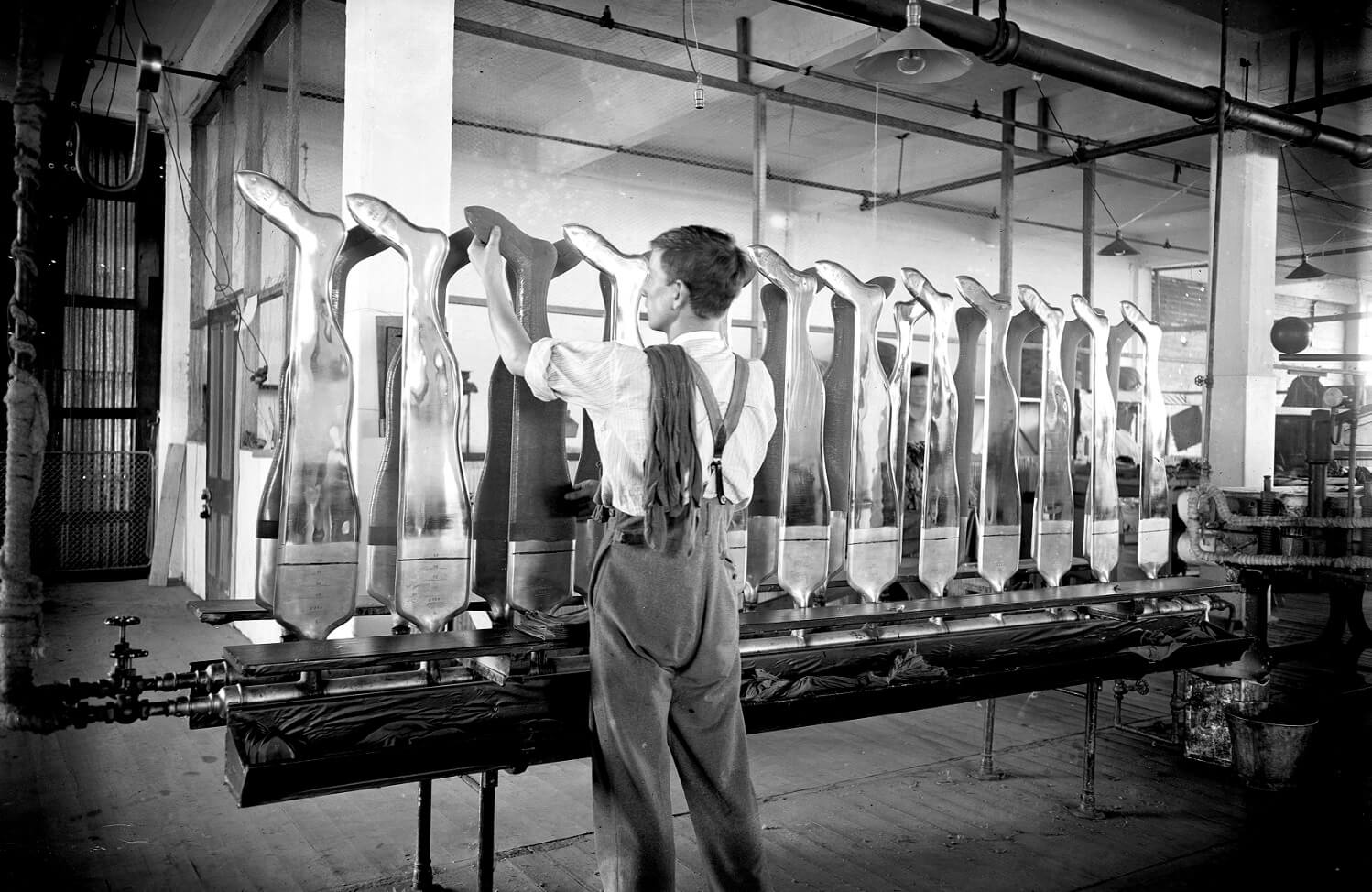
Manufacturing nylon stockings, Melbourne, no date but possibly c.1950s
Public Record Office Victoria
In Australia the Australian Wool Board viewed the rapid development of synthetic fabrics with alarm and moved immediately to increase its promotion of wool. The annual Wool Awards at the showgrounds was one such event, while the Wool Board also sponsored fashion events at the annual racing carnival at Flemington. In the year that Jean Shrimpton shocked racegoers with her Orlon shift dress, rival Parisian model Christine Borge was sponsored by the Wool Board to model haute couture fashions in wool. In general terms the Wool Board worked hard to improve its products, including developing ‘washable’ wool and more light-weight fabrics. Fashionable designers like Norma Tullo were important ambassadors for wool.
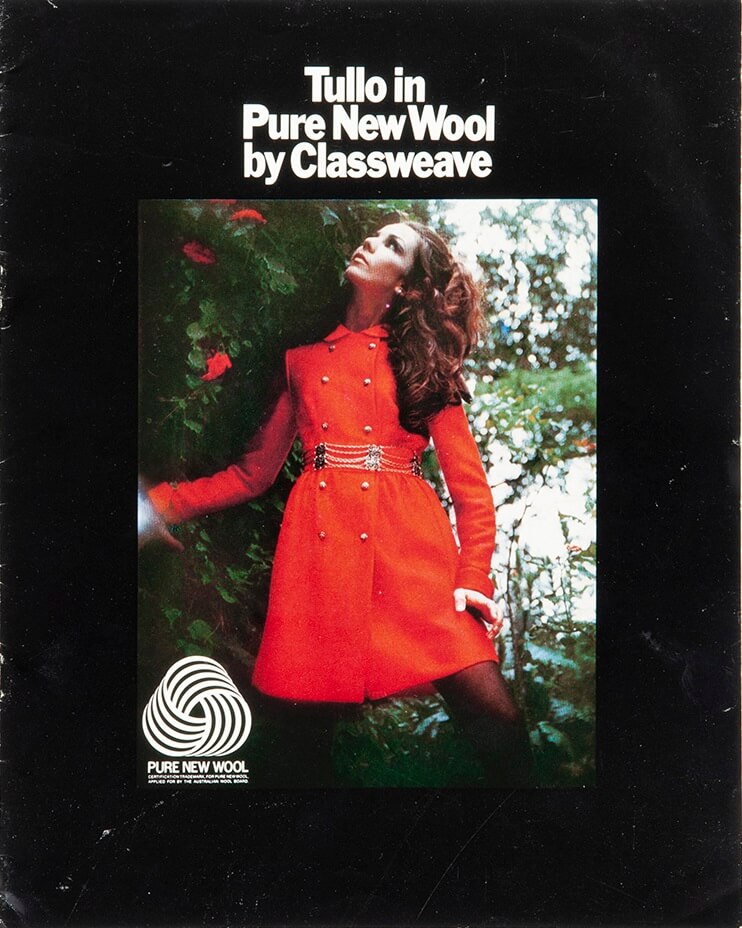
Parade program for 'Tullo in Pure New Wool by Classweave'
Copyright Christopher King
Image courtesy of RMIT Design Archives
Although both Tullo and Acton designed for young women, their creations were still relatively expensive. In a blog post on Instagram on 5 March 2025 RMIT Fashion Archives pointed out that Tullo’s dresses cost from $27 to $54 dollars at a time when the average weekly wage was $59. The post does not make it clear which average weekly wage is referenced here, whether male or female, but regardless, the dresses were at the pricey end for off-the-rack fashions. However, there was an alternative, since many young women were competent dressmakers at this time. Daughters were often taught to sew by their mothers, but sewing was also taught at many schools in the 1960s. It was part of a gendered curriculum that prepared young women for an assumed future as wives and mothers.
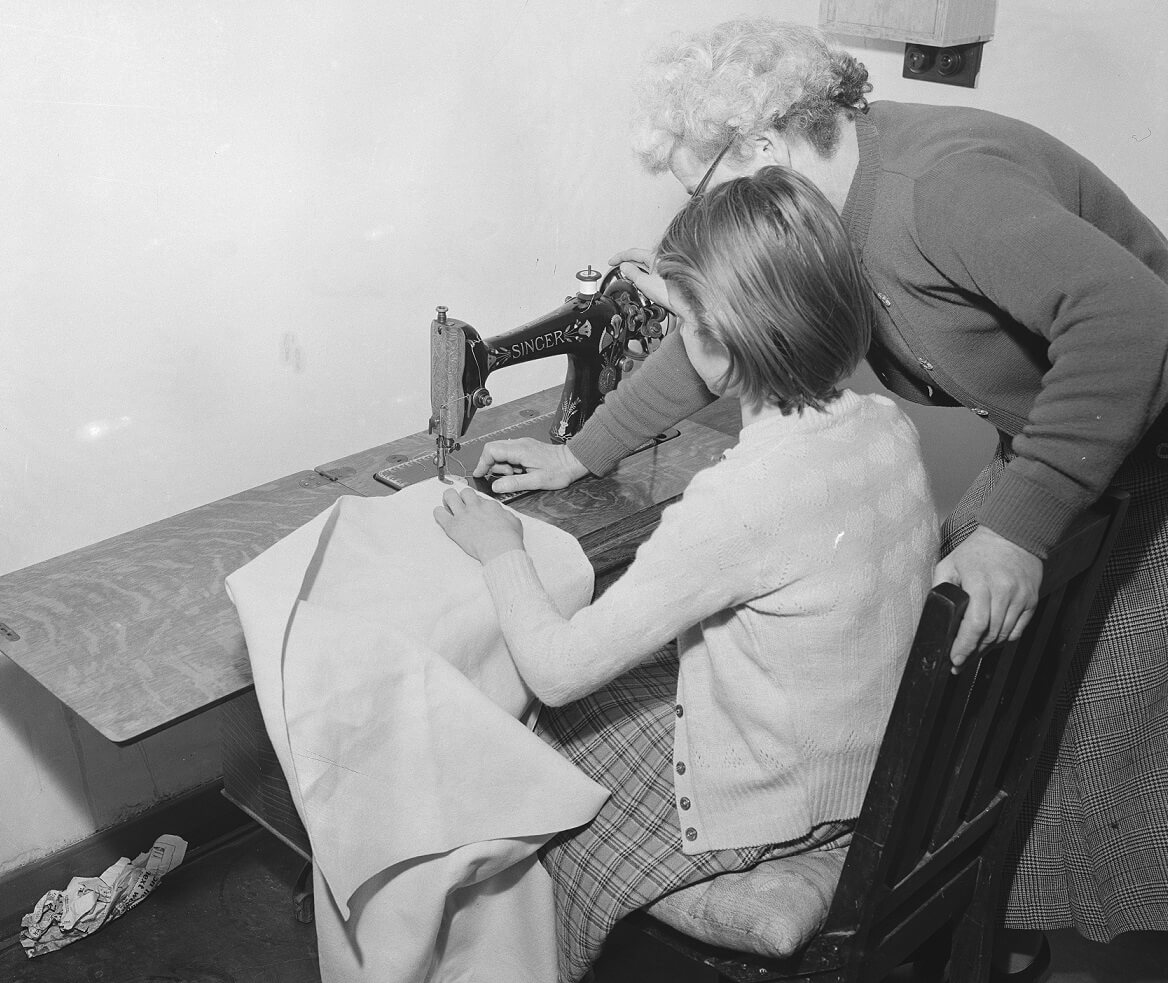
Student and teacher in a sewing class, using a Singer sewing machine, c.1960s
Public Record Office Victoria
Dressmaking supplies were also readily available. Both specialised drapery shops and the large department stores sold fabric by the yard, (or by the metre after 1966,) in haberdashery departments that occupied significant floor space. Women could browse row upon row of bolts of cloth, in varied patterns, fabrics and quality, while the budget conscious could seek out the annual sales for bargains. Most of these departments have now disappeared in the face of cheap clothing imports and declining interest in sewing, but in the 1960s fabric and haberdashery were still integral to the business of the department stores. Luckily for would-be dressmakers, the new A-line and pinafore dresses were relatively simple to make. Miniskirts also used very little fabric, so it was quite possible for young women to make their own up-to-date creations at home quite cheaply. The pattern issued by Simplicity shown here dates from 1967. Simplicity patterns were said to be a little easier to make than alternatives offered by competitors like Vogue and less-experienced dressmakers often began with their patterns. The size 16 skirt illustrated in this pattern required just one yard of 54 inch-wide fabric to make. . Later in the decade as skirt lengths shrunk, the same amount of fabric would make a whole dress.
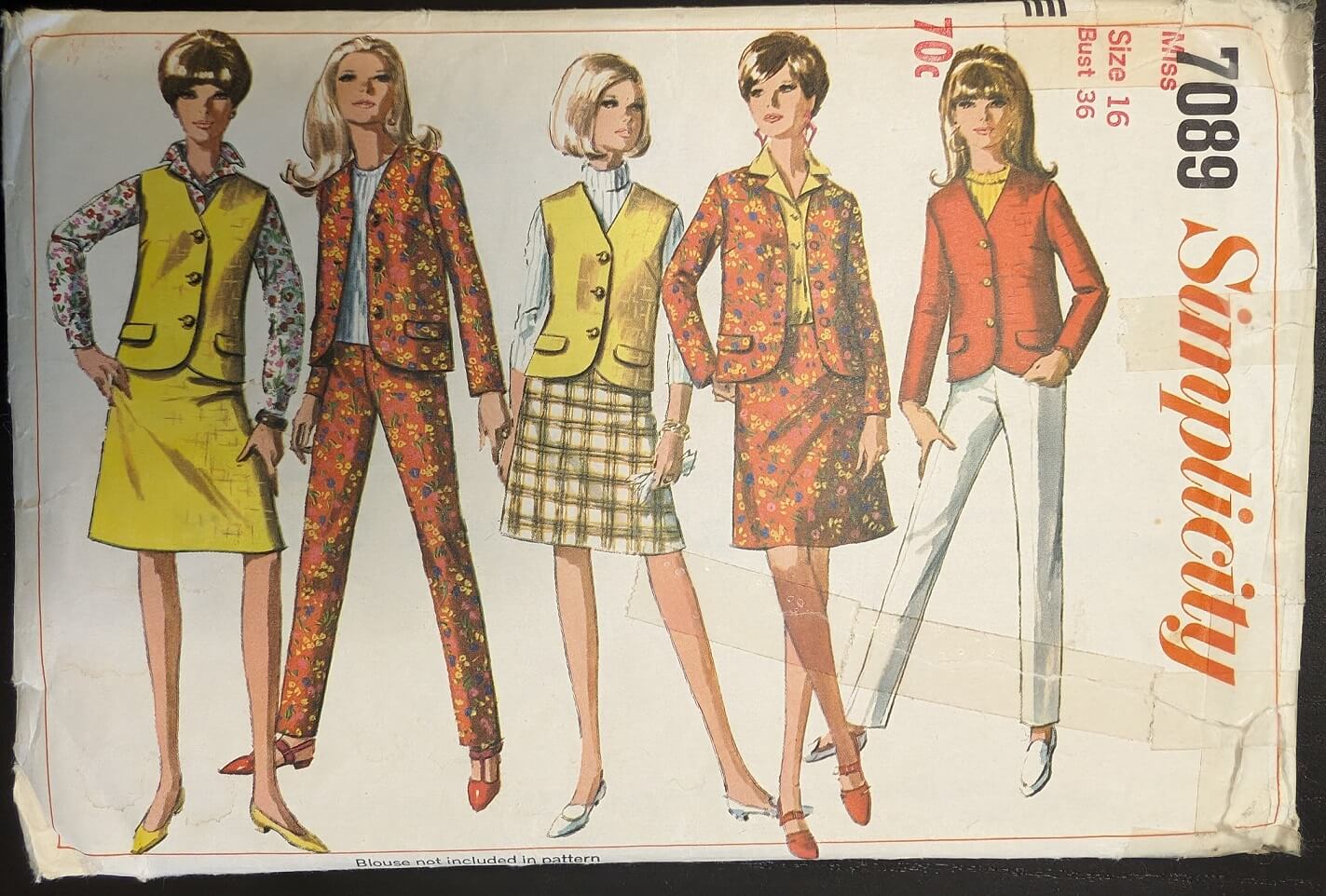
Simplicity dressmaking pattern, 1967
Private collection
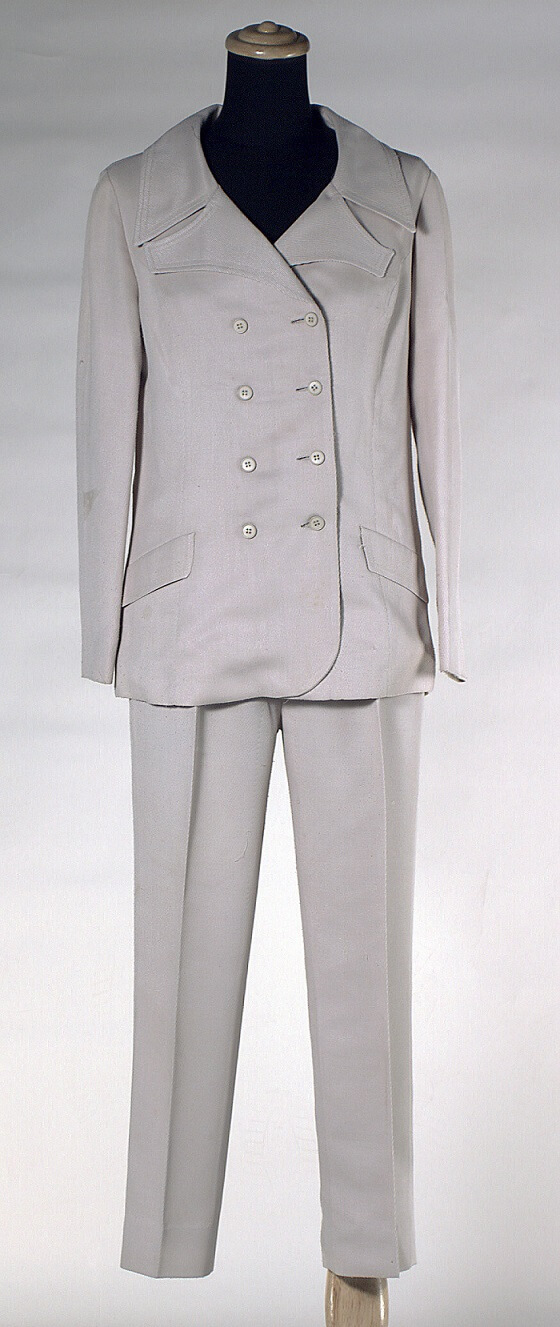
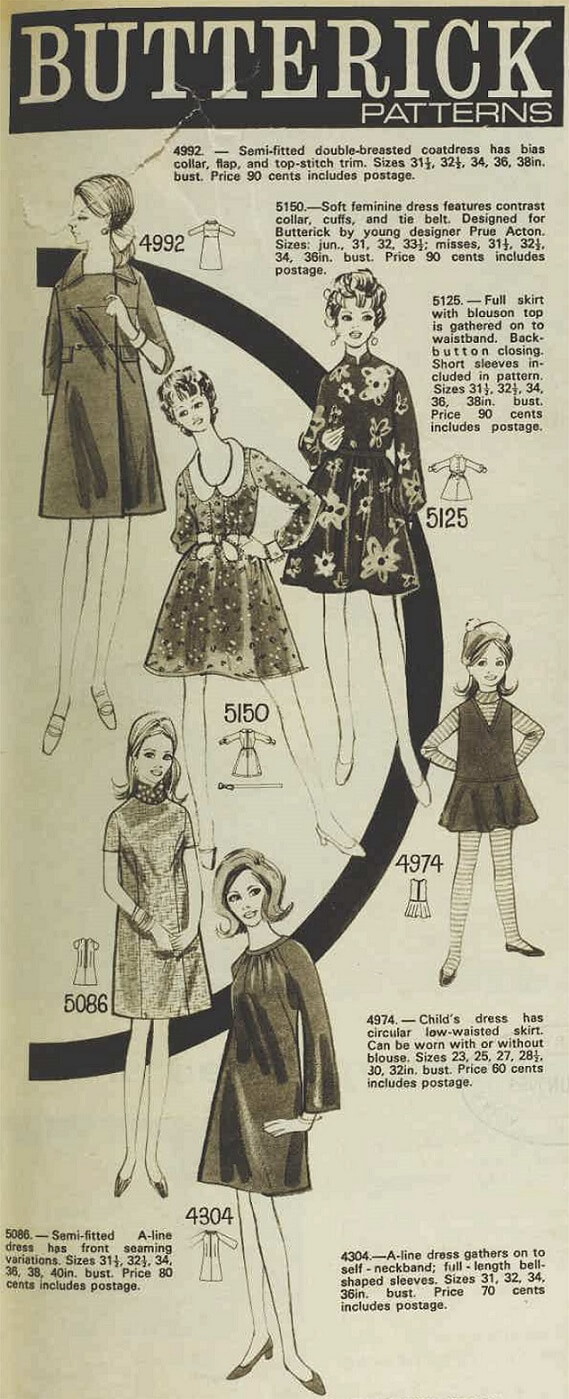
Both Tullo and Acton designed for the creators of paper dressmaking patterns, as this extract from the Australian Women’s Weekly of 18 June 1969 illustrates. Butterick’s pattern number 5150, shown in the centre of the spread, was designed by ‘young designer Prue Acton’. Acton also designed pantsuits, which were beginning to be an alternative to the traditional skirt and jacket. There is a pattern for trousers and a jacket in the Simplicity pattern above. Making jackets and trousers required rather more dressmaking skill than the simple A-line skirts, but many teenage girls were more than equal to the challenge. The Prue Acton pantsuit shown here dates from 1966 and is in the collection of Museums Victoria.
Some also learned pattern drafting at school, which could prove very useful. The story of one young woman’s pattern drafting ability was preserved by her family, along with her first pay packet. In 1971 Helen Griffin was aged just 16 when she got her first holiday job working at Myer. Her mother also worked there. Helen loved Laura Ashley fashions, which were very much in vogue in those years. Ashley’s floral fabrics suited the midi- and maxi romantic rural-style dresses that were an alternate fashion to the mini. Even with her new job however, Helen could not afford the Laura Ashley dress she admired, so persuaded her mother to buy it. She took the dress home, copied the pattern and returned the dress to the shop, then bought Ashley fabric and made the dress herself — a neat solution!
Stockings or tights?
Meanwhile, the ascending skirts created another dilemma for devotees of the miniskirt and that was the problem of what to do about stockings. In the early-1960s most stockings were held in place with suspenders, which typically reached to the mid-thigh. By this time nylon stockings had shed their seams, but they had to be held in place either by garters (which compressed the upper leg), or by suspenders. Both would be visible when wearing the mini. Designers like Quant and Acton partially dealt with this problem by marketing matching tights, but that was an expensive option. Thankfully the hosiery industry had a ready-made solution in the pantyhose, as it is known in Australia. An American invention of the late-fifties, pantyhose really came into their own from the mid-sixties. Expensive at first, they steadily reduced in cost and by the end of the decade had replaced stockings almost entirely. Stockings later made something of a comeback, but tights or pantyhose still dominate the hosiery market. Stockings and suspender belts were increasingly associated with sexy lingerie and illicit sex. The stockings dilemma might, incidentally, suggest another explanation for Shrimpton’s decision to go bare legged to the Derby, although she never suggested this as an explanation.
Come on Barbie, let’s go party!
Much younger girls were educated to take an interest in fashion through a newcomer to the toy range — Barbie, the fashion doll. Barbie was the first departure from the baby doll model, designed to train girls to be mothers. She was a young adult, smart, fashion conscious and with a boyfriend (Ken). She owned her own house, drove her own car and later came in a range showing Barbie dressed for various occupations (doctor, vet, scientist and so on). Introduced to Melbourne in 1964, Barbie quickly became popular. We include a Barbie doll from the 1960s in the exhibition, along with one of the clothing sets sold separately. Our ‘bubble cut’ Barbie (a reference to her bouffant hairstyle,) dates from about 1968. She wears a gold-brocade strapless dress and matching coat, with real fur trim on the cuffs and hat. Historian Pauline Hastings explored the impact of Barbie in a YouTube presentation for the Old Treasury Building.
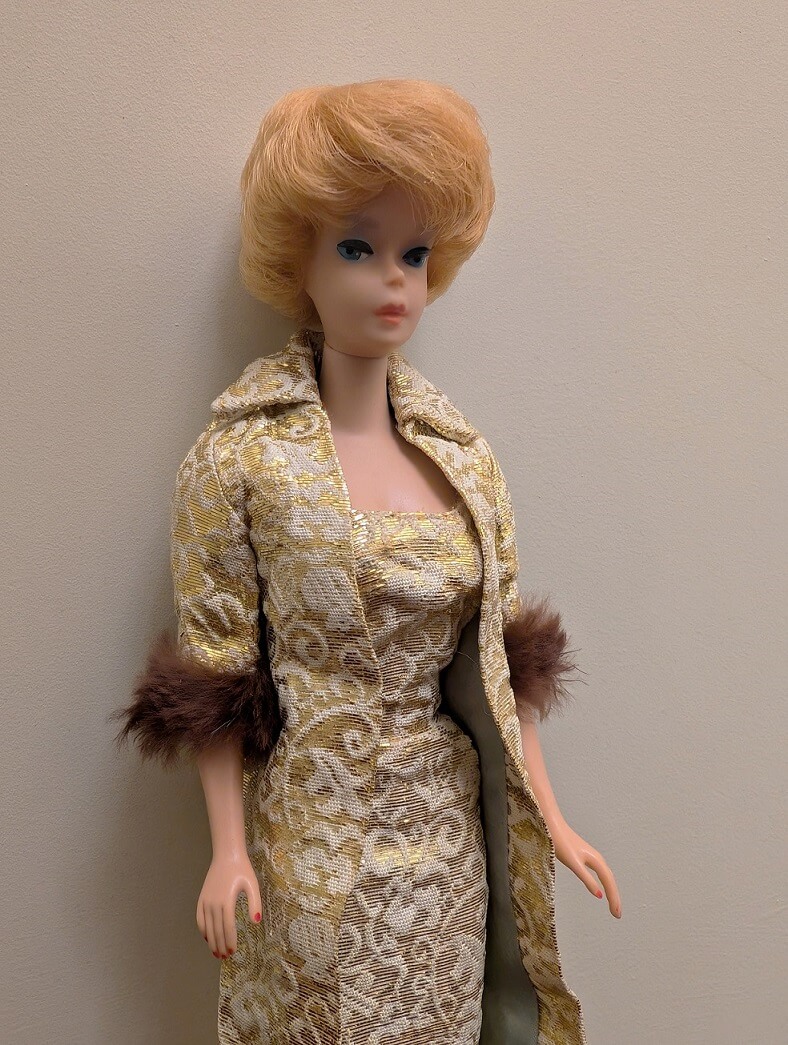
Bubble Cut Barbie, 1960s
Old Treasury Building
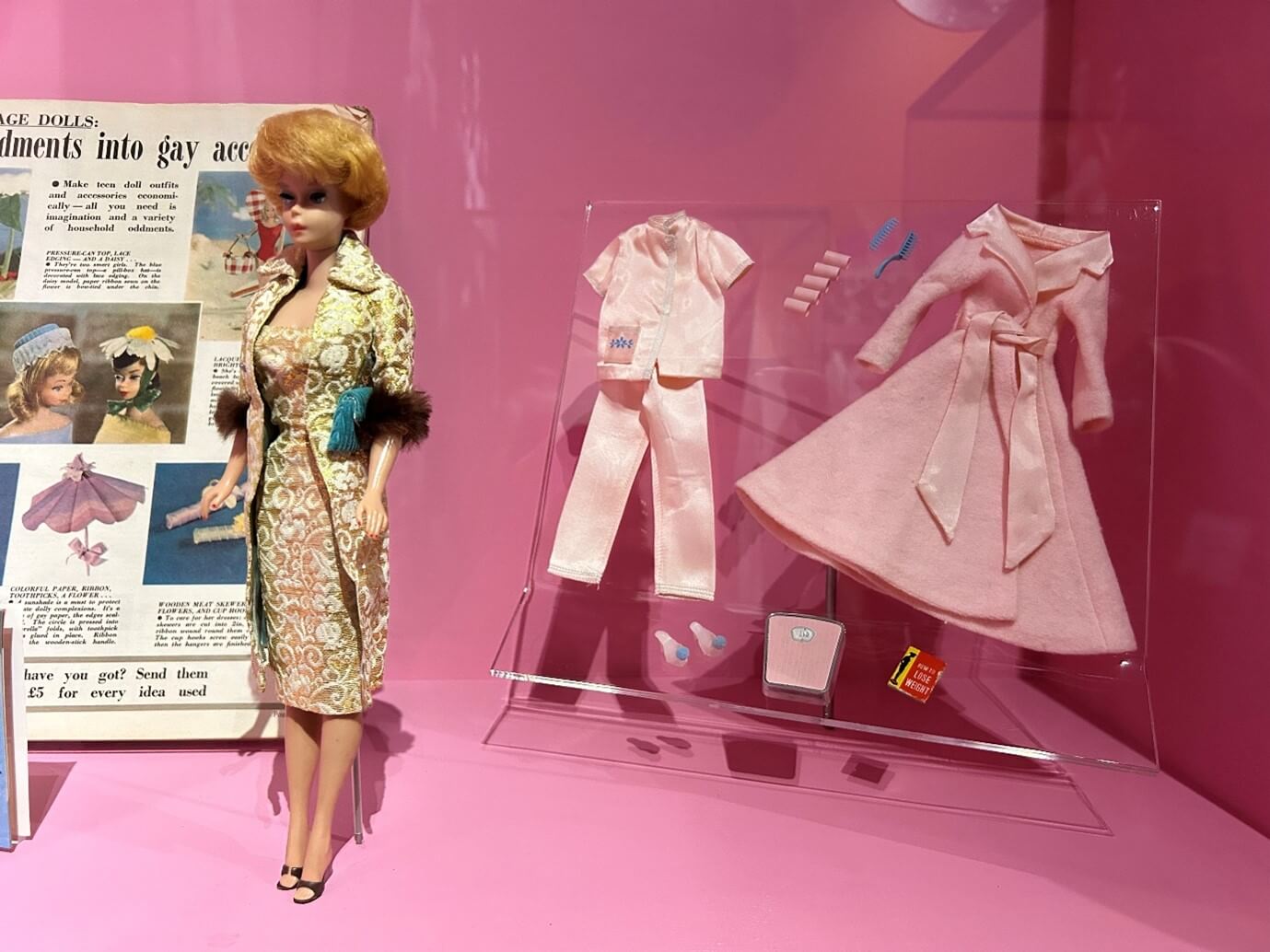
Barbie with a slumber party outfit, 1960s
Old Treasury Building
Rather ominously, the slumber party outfit came with a tiny ‘diet book’, that contained only one piece of advice: ‘Don’t eat’!
The outfit sets available for purchase to add to Barbie’s wardrobe were always quite expensive, but crafty mothers could also make clothes and accessories from fabric remnants. Articles in the Australian Women’s Weekly appeared from time to time giving detailed instructions and even including patterns, although the clothes were always very fiddly to make.
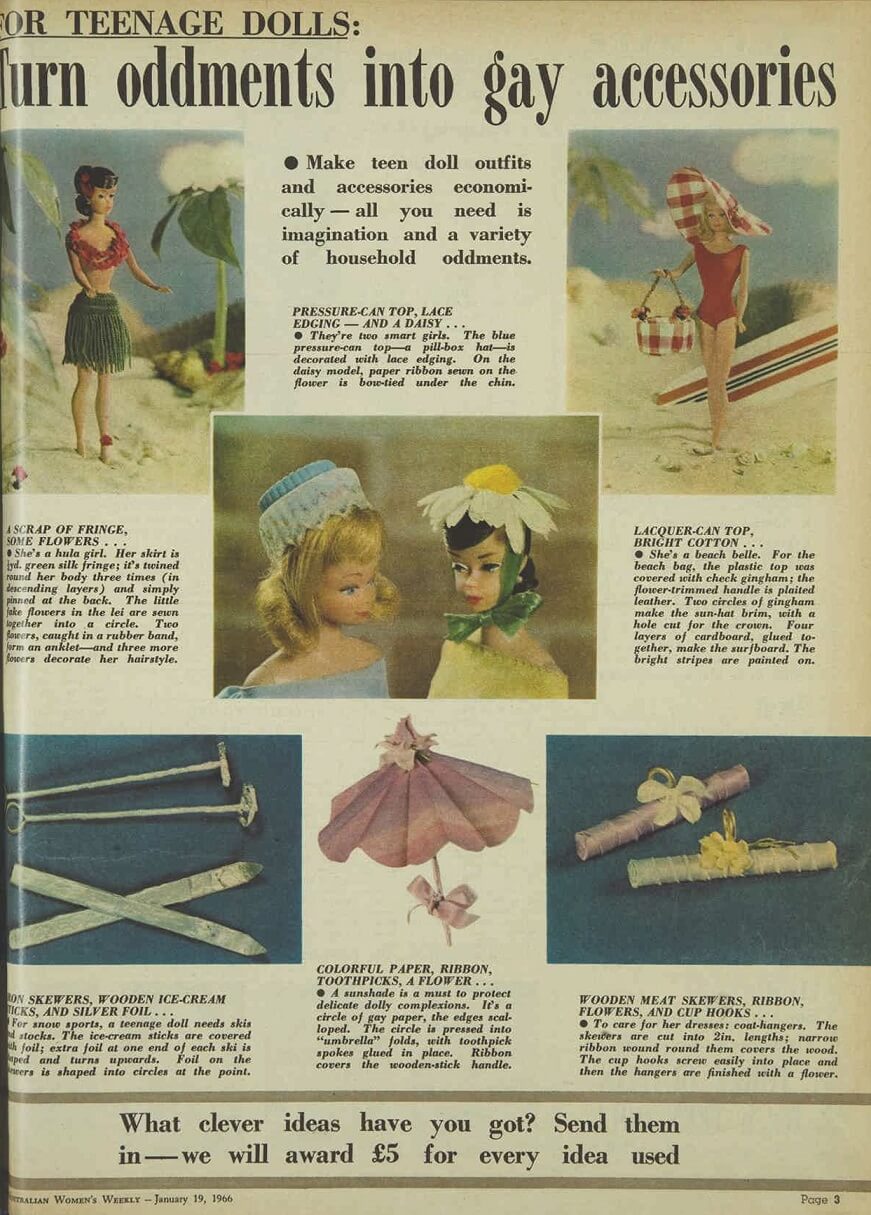
‘For teenage dolls: turn oddments into gay accessories’, Australian Women’s Weekly, 19 January 1966
Private collection
The ‘youthquake’ and the fashion industry
Boutique fashion was all bought ‘off the rack’ and was designed in small runs to enable designers to respond quickly to changes in fashion. The speed with which fashion changed in the 1960s was one of the hallmarks of the decade. Historian Pauline Hastings also argues that it was an important factor in the demise of the Australian fashion industry, which until this time relied on long production runs to make a profit.
Haute couture was available in Melbourne too, mostly based on the latest designs from Paris or London. We only had room to display one haute couture gown from the 1960s in the exhibition, but it was a lovely example of an evening gown from the period. Designed by Ralph Samuel, co-owner of Hartnell of Melbourne, a Flinders Lane fashion house specialising in haute couture, the gown is made in purple silk with magenta silk lining. It is preserved in the collection of the Brighton Historical Society. Although short skirts predominated for day wear, long evening gowns continued to be fashionable throughout the decade. In an interesting observation on the fashion furore caused by Shrimpton’s shift dress, Hastings points out that part of the outrage also reflected the fact that the dress was in a simple design and made from a cheap, synthetic fabric (Orlon) — the kind of dress any competent seamstress could make at home. This was in stark contrast to the usual haute couture outfits worn at Flemington. Indeed, replicas of the shift dress appeared for sale in Sportsgirl within a couple of days of Shrimpton’s appearance.
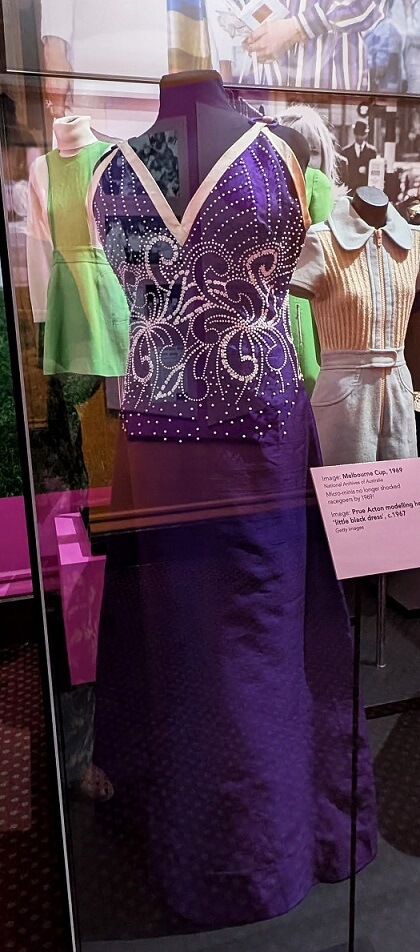
Evening gown, Hartnell of Melbourne, 1960s
Brighton Historical Society
The bikini
In the 1960s young people were more mobile than ever before and many flocked to the beach in the summer. Two-piece bathing suits became increasingly popular during the 1950s and by the 1960s the bikini was the costume of choice for young swingers. We show this bikini from the collection of Brighton Historical Society in the exhibition.
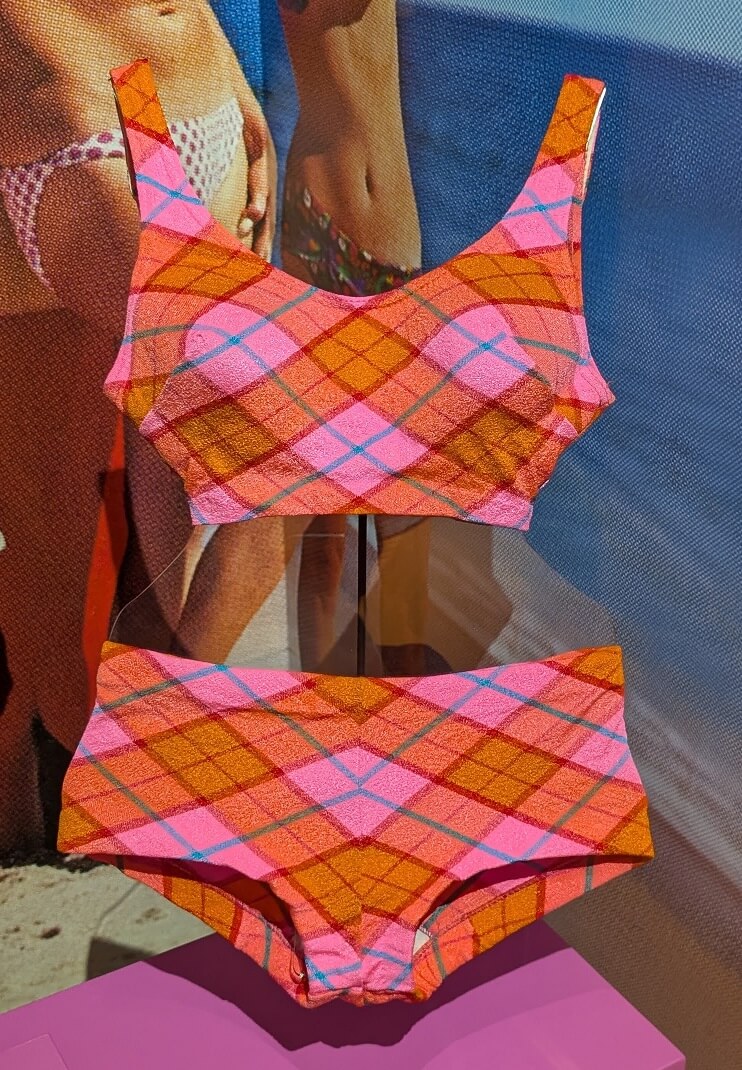
Bikini, 1960s
Brighton Historical Society
Just as minis became shorter during the sixties, so bikinis became briefer. Some argued that the short skirts and brief bikinis reflected women’s freedom: Quant, in particular, argued that her clothes were designed to express women’s new-found sexual assertiveness and independence. Others insisted that the short skirts and brief bikinis further sexualised women, while the ‘dolly bird’ look infantilised them at the same time.
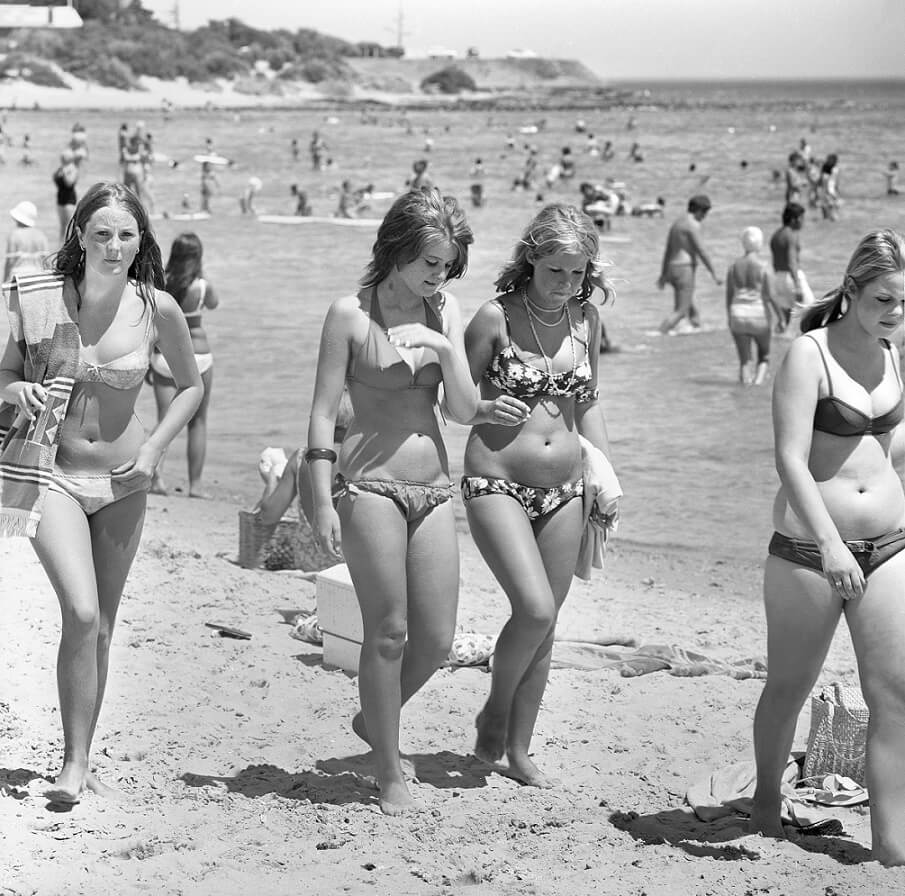
‘Bikini-clad beach girls at Port Phillip Bay’, 1969
National Archives of Australia
What about men?
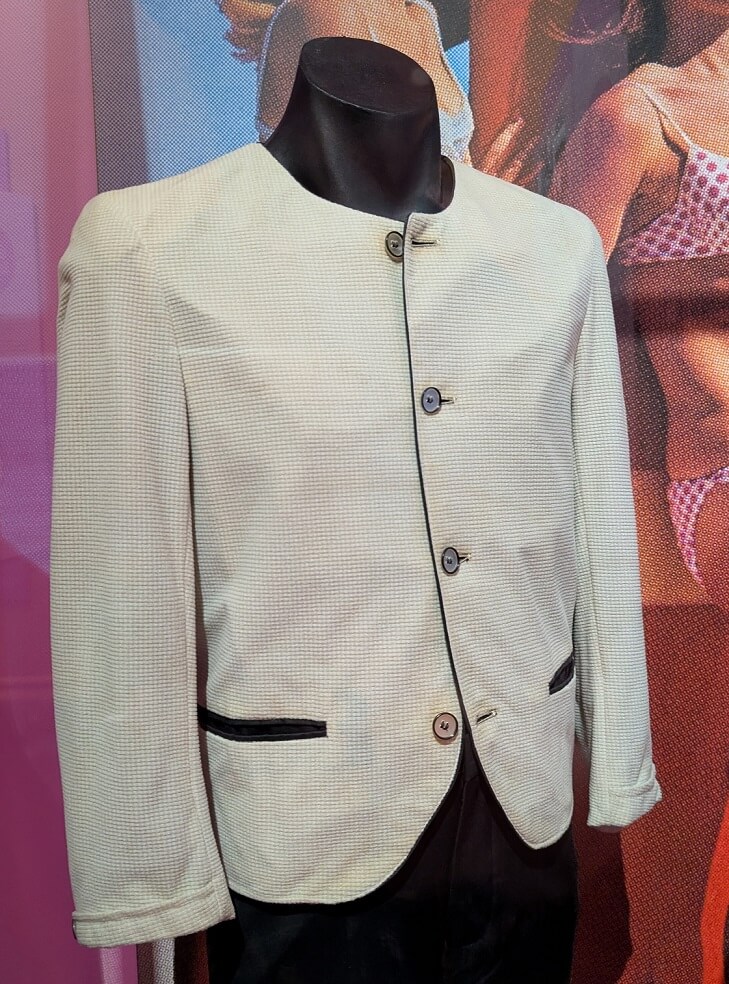
Was the 1960s fashion revolution confined to women? Absolutely not! Young men also embraced a new awareness of fashion, discarding the uniform of the white shirt and dark trousers for plain coloured shirts and then shirts in bright patterns and even psychedelic colours. Fans of The Beatles copied their ‘mod’, collarless jackets, as this jacket from Museums Victoria’s collection makes clear. And it was not only young men from Melbourne who kept up to date. This jacket was bought by a local teenager from a small department store in Rochester in regional Victoria in the mid-1960s. It was made in a textured polyester fabric, with black trim.
Even business attire underwent a (more discrete) transformation, banishing the ubiquitous white shirt and embracing synthetic and blended fabrics in suiting. By the late sixties even my conservative father had branched out into coloured shirts, although restricted to a limited colour palette of blue and yellow. He never managed to extend the colour range to pink! Nor did he take to the gaily patterned shirts and paisley designs of the later-sixties, but he did take the radical step of purchasing a short-sleeved crimplene (a polyester fabric) summer suit in the early 1970s. No doubt he felt very daring!
Young men were also provided with fashion advice, with photo essays showing male models wearing the new slim-line jackets and trousers. Melissa Belanta and Lorinda Cramer argue that fashion magazines like Man: The Australian Magazine for Men, helped men to keep abreast of fashion trends, while providing guidance on the new blended fabrics.
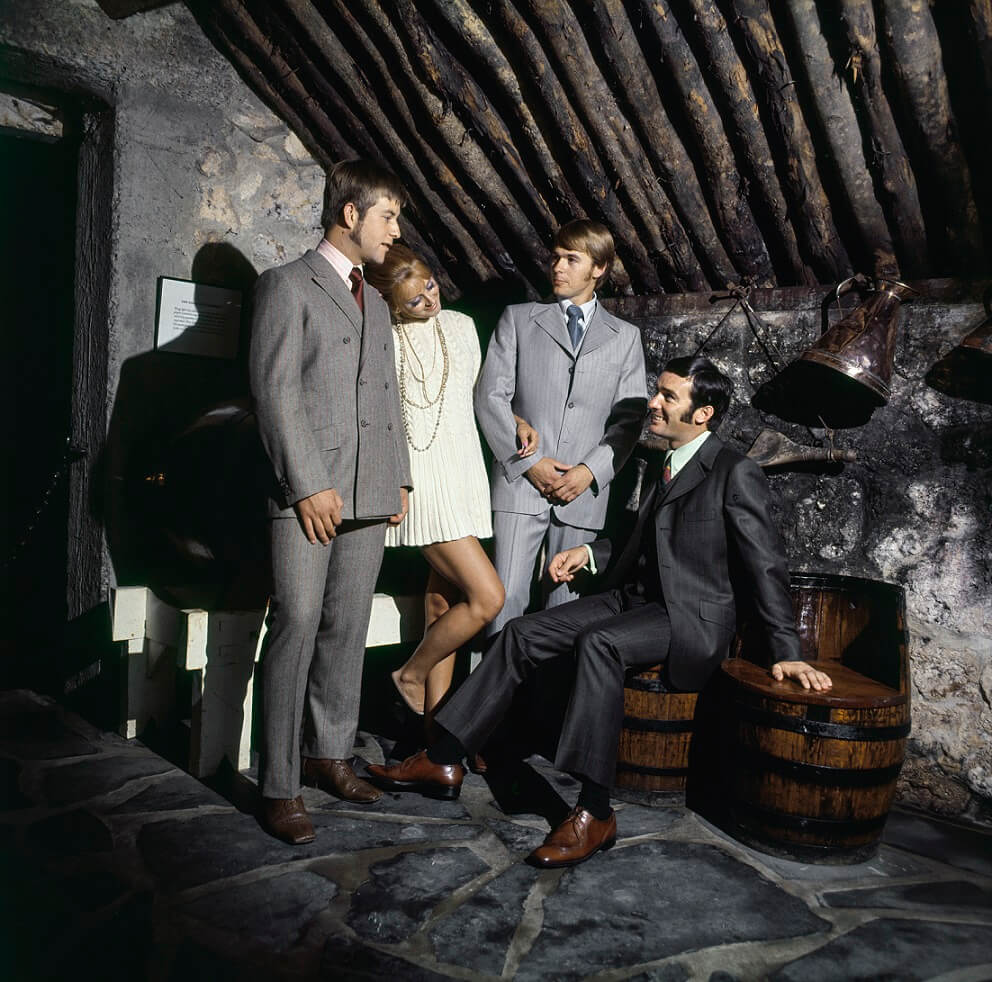
Male fashion shoot, late-1960s
National Archives of Australia
Photographs of celebrities also helped to set trends, then as now. This photograph shows fashion power couple Prue Acton and Mike Treloar in 1967. Treloar’s striped jacket and dark shirt is right on trend, while Acton wears a version of her little black dress.
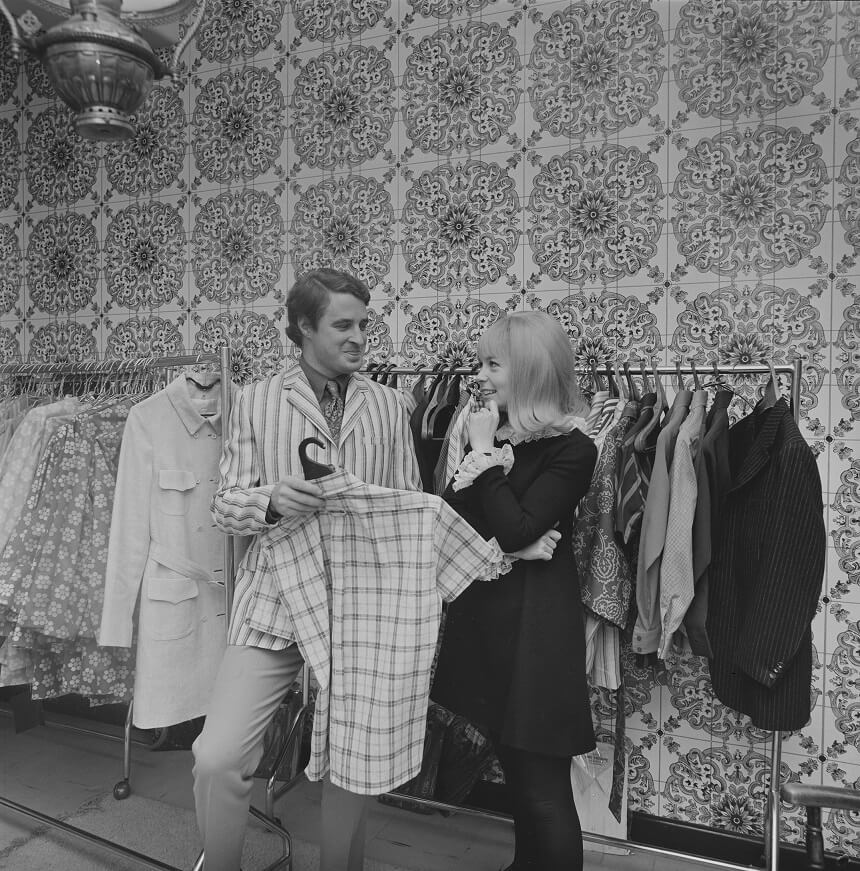
Prue Acton and Mike Treloar, 1967
National Archives of Australia
Even the ABC got into the act, recording fashion programs for schools using psychedelic backgrounds.
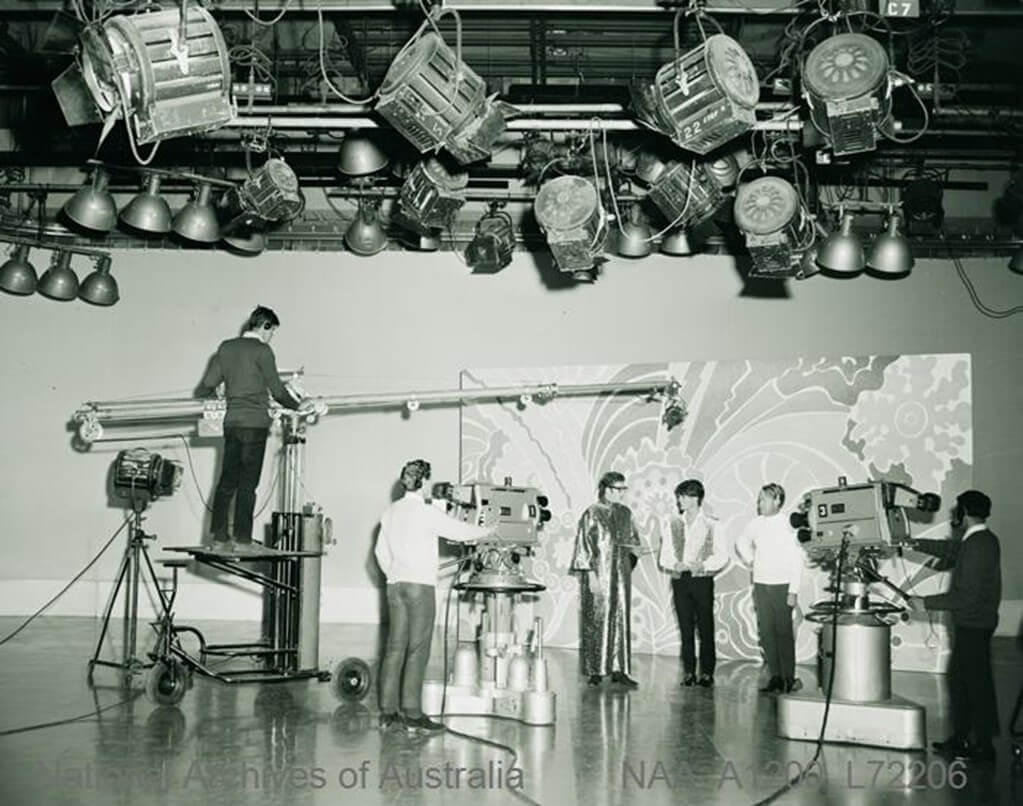
ABC records a fashion program with psychedelic background for schools, 1968
National Archives of Australia
Articles in magazines like Go-Set explored all the newest trends. Such outfits were much in evidence in Melbourne’s discos, as Melissa Bellanta explains in this digital lecture, recorded for the Old Treasury Building.
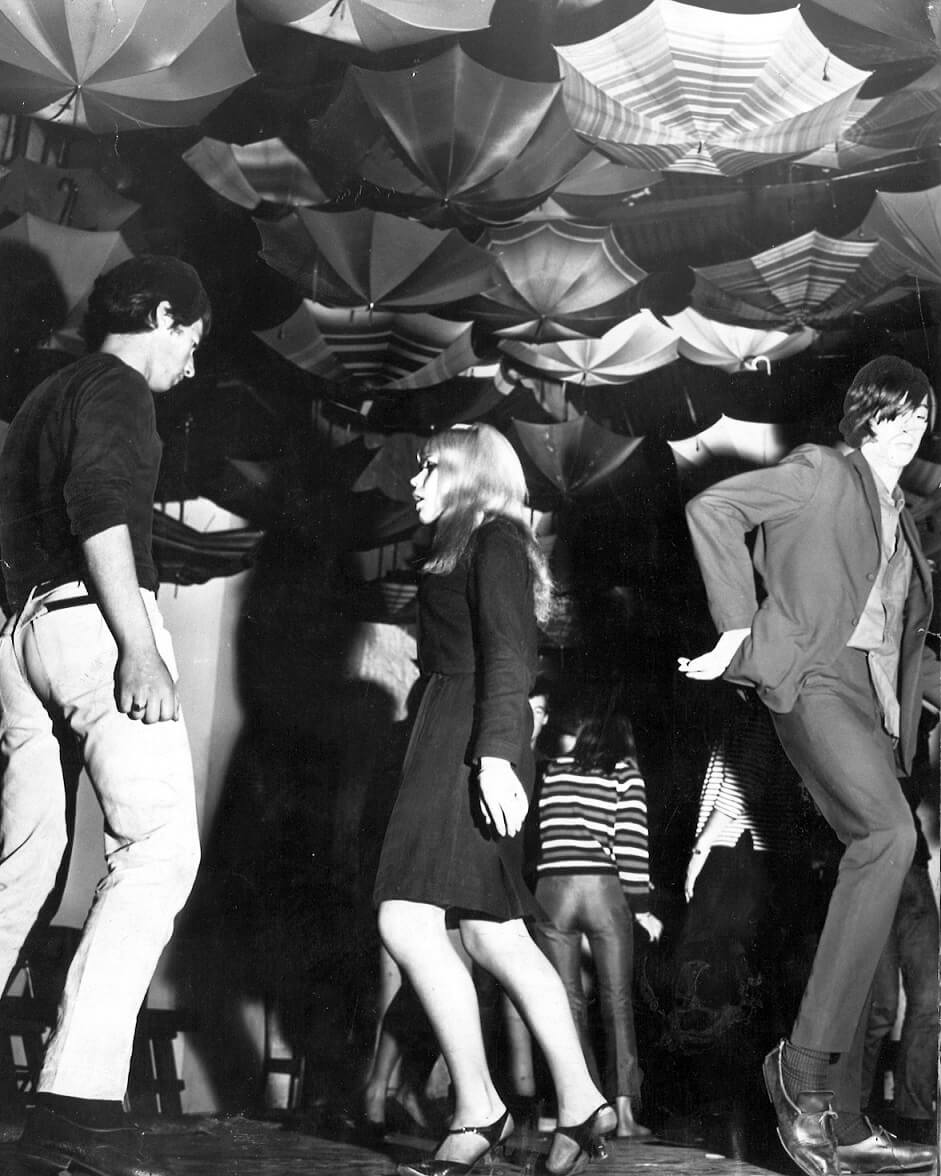
Melbourne discotheque, ‘The Thumpin’ Tum’, 1 November 1965
News Ltd/Newspix/Performing Arts Collection, Arts Centre, Melbourne
Photographs like this taken inside the popular Thumpin’ Tum discotheque show a mix of informal wear and trendy new suits, although the dress worn by the young woman in the foreground is still relatively modest. This image was taken the day after Jean Shrimpton’s appearance at Flemington of course and on the very evening that her photograph had appeared in all the papers. In another month skirts might well have been shorter!
But as men experimented with their own changing fashions, some amongst them found the whole scene silly and frivolous. In 1966 English pop group The Kinks recorded a satirical song entitled ‘A Dedicated Follower of Fashion’, mocking the slavish devotion of Carnaby Street’s many followers, but also hinting, through brief changes of accent, at the often-ignored class aspect to 1960s fashion. It went straight to the top of the charts.
If young women warred with their parents over short skirts, the sticking point for young men was often hair. As the sixties progressed men began to wear their hair longer, especially those not subject to the controlling regime of the office. Students, in particular, often wore their hair longer and while the universities were unperturbed, both short skirts and long hair (for boys) presented a challenge to long-established convention in many secondary schools. Some tried to set precise rules: skirts no shorter than four inches from the floor when kneeling was the rule at my school in the late sixties. The deputy-head carried a ruler around the playground for just this purpose! Similarly, schools tried to insist that male students’ hair should be cut to sit on or above their collars, with mixed success. Girls routinely rolled their skirts up at the waistband, to tug them down quickly if they saw the principal approaching. Others cut their skirts shorter, much to the annoyance of both school and parents! Hair was harder to deal with, but some schools sent boys home with a note to their parents to get their hair cut before they could return. Such tussles over hair and uniform gave a focus to teenage rebellion at the secondary school level.
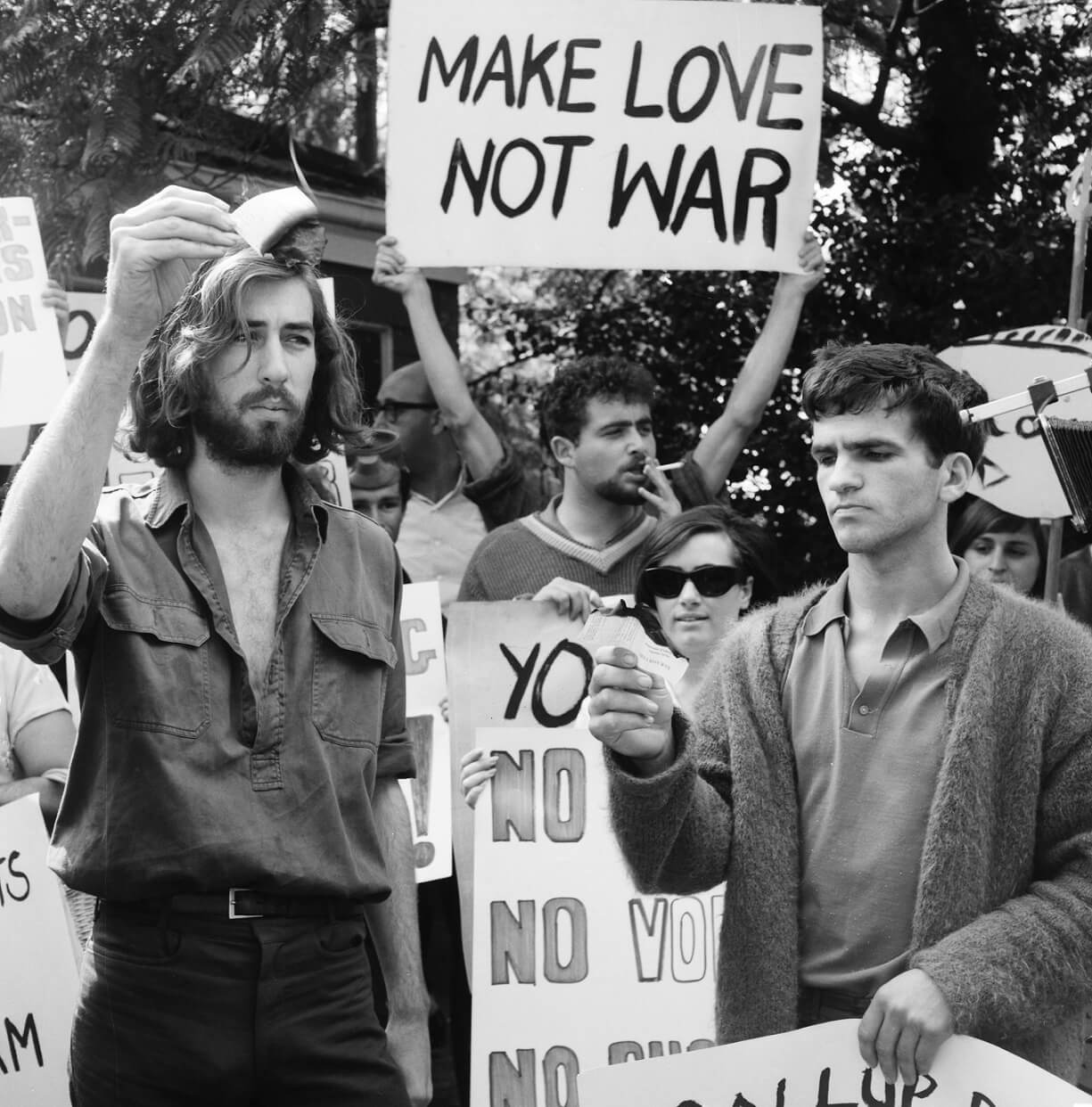
Anti-conscription protest, Melbourne
The Age newspaper
Andy Blunden, shown here burning his national service registration card outside Prime Minister Harold Holt’s house in March 1966, typified the image of the long-haired student protester in the late sixties.
The 1960s fashion scene revolved around youth and depended for its success on the fact that many young people had money to spend on themselves. Girls in particular were thought to spend a good portion of their wages on clothes at this time. How far the more extreme fashion trends (the micro-mini, hot pants, psychedelic shirts and so on) influenced older Victorians is debateable, although hemlines certainly rose for almost all women by 1969, while dress rules for men expanded, even in conservative professions. The white shirt did not disappear, but it became a wardrobe choice amongst many options. General dress also became more relaxed. Women began to wear pants more often, though it would be some time before pantsuits for women were accepted by conservative professions like teaching and the law.
Sources and further reading
Michelle Arrow Friday on our minds: popular culture in Australia since 1945. University of NSW Press, Sydney, 2009
Melissa Bellanta & Lorinda Cramer, ‘“Well-Dressed” in Suits of Australian Wool: the Global Fiber Wars and Masculine Material Literacy, 1950-65’, Fashion Theory: The Journal of Dress, Body and Culture, 2023.
Joseph Caputo, ‘50 Years of Pantyhose’, Smithsonian Magazine, 7 July 2009.
Nanette Carter, ‘She’s a Store, she’s so Much More: Sportsgirl, the Brand and the Social Construction of Young women in 1960s Australia’, in J. Redmond, J. Durling & A. de Bono (eds) Futureground -DRS International Conference, 2004. Melbourne Australia.
Daniel Milford Cottam Fashion in the 1960s. Shire Library, Bloomsbury, e-book, 2020
Sylvia Harrison, ‘Jean Shrimpton, the “four-inch furore”, and perceptions of Melbourne identity in the 1960s’, in Seamus O’Hanlon & Tanja Luckins (eds) Go! Melbourne in the Sixties. Circa, Melbourne, 2005, pp. 72-86
Pauline Hastings, ‘Fibres on the Field: Jean Shrimpton, Christine Borge, and the promotion of Orlon and Wool at the 1965 Melbourne Cup’, Australian Historical Studies, Vol. 56. No. 1, 2025, pp. 145-166
Pauline Hastings, ‘60 years ago, supermodel Jean Shrimpton’s Cup outfit shocked the nation — but few know the full story’, The Conversation, 30 October, 2025
Karen Hutchings, ‘Beauty begins at 7am: Cosmetics, fashion, consumer goods and beauty mythology in 1950s and 1960s Australia’, Journal of Australian Studies, Vol. 24, No. 64, 2000, pp. 42-53
Hilary S. Kativa, ‘Synthetic Threads’, Distillations Magazine, Science History Institute, 3 October 2016
Bridget Keenan The women we wanted to look like. St Martin’s Press, New York, 1977
Twiggy Lawson with Penelope Dening Twiggy in Black and White: An Autobiography. Simon & Schuster, London, 1997
Mary Quant Quant by Quant. Cassell, London, 1966
Mary Quant Mary Quant: Autobiography. Headline, London, 2012
Hilary Radner, ‘Embodying the Single Girl in the 1960s’, in Joanne Entwistle & Elizabeth Wilson (eds) Body Dressing. Berg, Oxford, 2001, pp. 183-200
Dominic Sandbrook White Heat: A History of Britain in the Swinging Sixties. Abacus, London, 2006
Deborah Thomas The Australian Women’s Weekly Fashion: The first 50 years. National Library of Australia Publishing, Canberra, 2014
Danielle Whitfield. Flair: From Salon to Boutique. Australian Fashion Labels Through the ‘60s. National Gallery of Victoria, Melbourne, 2005
‘The miniskirt myth’, Victoria & Albert Museum, 2019-20.