
In the exhibition The Swinging Sixties we look at what it was like to live in Victoria during the 1960s. The sixties is often remembered as a turbulent decade. In contrast to the ‘conservative’ 1950s, it is associated with changing ideas, youthful rebellion and social experimentation. New music, new fashions and new attitudes to authority created a ‘generation gap’, as young people sought to distance themselves from their elders and to claim a place of their own in the culture and politics of the nation. For the young, what mattered was to ‘swing’, whether on the disco floor or on the street. And in many respects, this was a global phenomenon, at least in the Western World. When Bob Dylon recorded The Times They Are A-Changin in 1964, he seemed to speak for a generation.
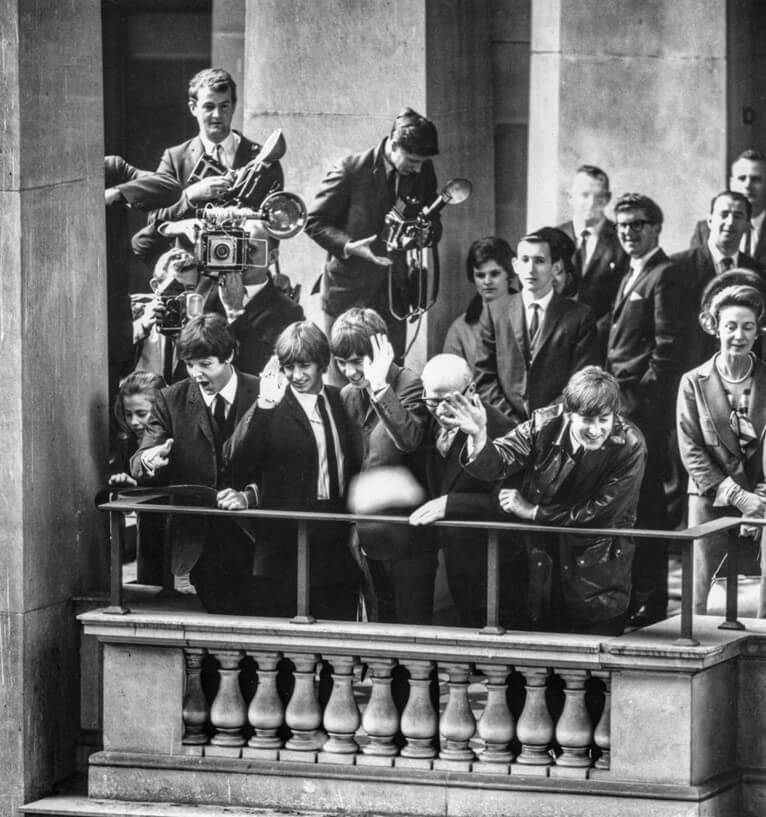
The Beatles attend a reception with the Mayor at the Town Hall in Melbourne, 16 June 1964
City of Melbourne Art and Heritage Collection
A decade of youth
Baby boomers often look upon the 1960s with nostalgia, and indeed it was a time when the young came into their own. For a start, young people were much more visible in society, as the baby boom of the 1950s grew into the youth boom of the 1960s. By 1971 almost 40 per cent of Melbourne’s population was aged under 21 — a dominance that would not be repeated. In 2021, by contrast, the same age group comprised only 17 per cent. Young people were also more prosperous than ever before. Full employment and rising wages meant that many young people had money to spend and marketers took full advantage. Teenagers and twenty-somethings were identified as specific market segments, with their own magazines, fashions and music.
While most young people entered the workforce in the years from 15-19, an increasing number stayed on at school. In the late 1960s just over one quarter of Victorian students completed matriculation, and the tertiary sector also expanded significantly. This meant that the sixties generation was better educated than those who went before. But the university population remained a tiny, privileged minority — less than 5 per cent of the relevant age cohort. Their relative privilege possibly coloured some of the public response to student protest later in the decade.
Remembering the 1960s
What comes to mind when we think of the 1960s? Is it fashion — miniskirts and skin-tight jeans, then ‘flower power’ and psychedelic patterns? Or pop music — The Beatles, The Rolling Stones, and local groups like The Bee Gees, The Seekers, John Farnham, or Normie Rowe? There were iconic moments, both at home and abroad, like the Cuban Missile Crisis of October 1962, the assassination of President John F. Kennedy on 22 November 1963, or the moon landing on 21 July 1969, all captured on the new medium of television. At home, the visit of The Beatles and the introduction of the conscription ballot for national service in 1964 loomed large, as did the advent of decimal currency on 14 February 1966, but arguably it was the release of the contraceptive pill in early 1961 that would have the most wide-ranging impact on everyday lives, especially those of women.
There were also iconic images — think the adoring crowds who crammed Melbourne streets to catch a glimpse of The Beatles in June 1964, or Jean Shrimpton’s controversial outfit worn at the Flemington racecourse in November 1965, both beamed around the world via television. Others associate the 1960s with street protest, especially the anti-Vietnam War protests of the late sixties, culminating in the first Vietnam Moratorium that followed in April 1970. These events live on in popular memory, creating a sense of a world in transition.
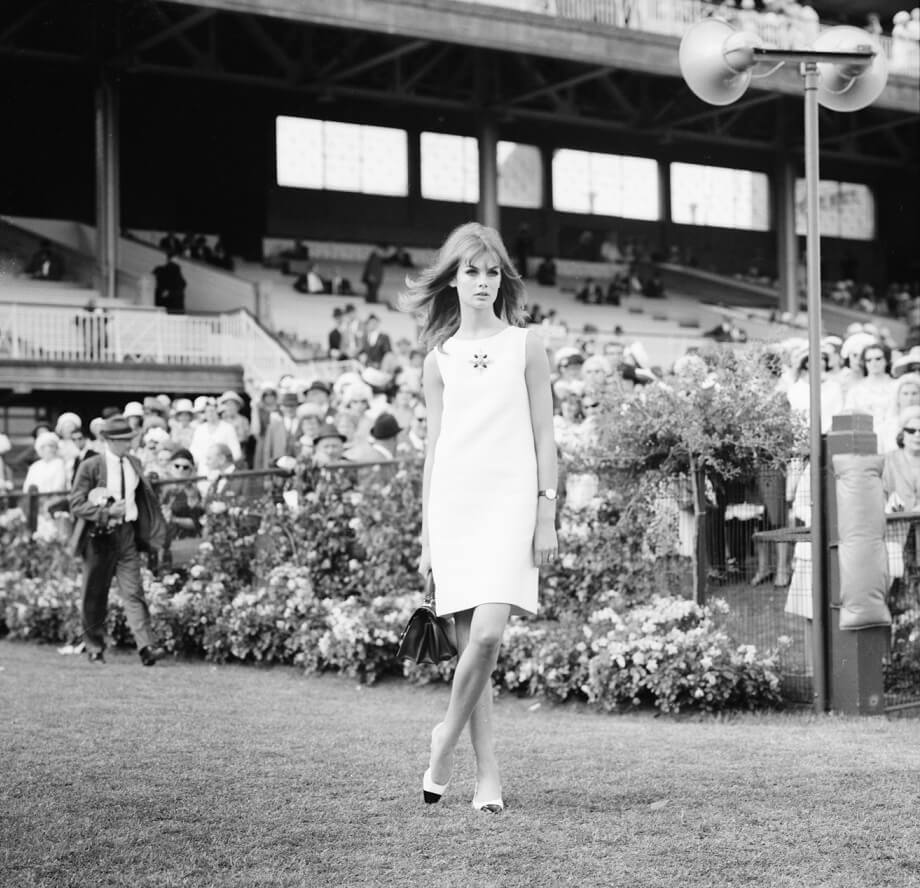
Jean Shrimpton on Derby Day in 1965, photograph by Clive Mackinnon.
Courtesy The Age Archives
This photograph made headlines around the world, with commentary about the furore created by Shrimpton’s short skirt and absence of gloves, hat and stockings!
The flip side
But the decade of the sixties was full of contradictions. Politically the mood was consistently conservative. Robert Menzies led a succession of Liberal Country coalition governments in Canberra from 1949-66. Liberals Harold Holt, John Gorton, and William McMahon followed, until conservative dominance was finally broken by Labor’s Gough Whitlam in December 1972. Victoria followed a similar pattern, dominated by the conservative Henry Bolte, who held office continuously from 1955-1972. Bolte consistently opposed the trade union movement and disapproved of political protest. Notoriously anti-intellectual, he also resisted reform on a variety of social justice issues, including the abolition of the death penalty. Although a sizeable minority, young people were not eligible to vote until they turned 21 — a potent issue in the conscription debate. The voting age was finally lowered to 18 in 1973 for both federal and state elections.
Australia’s political conservatism reflected, at least in part, the dominance of the so-called Cold War in international relations. As the Soviet Union tightened its control on much of Eastern Europe in the wake of the Second World War, Australia shared the concern of many Western nations at what was widely seen as the global ‘creep of communism.’ The Malayan Emergency (1948-60), and defeat in the Korean War (1950-1953), heightened fears of a world-wide communist conspiracy, some of which was uncomfortably close to home. These events help to explain why the Australian Government was prepared to commit troops to join the United States in the (undeclared) war in Vietnam, and to take the highly controversial step of introducing military conscription.
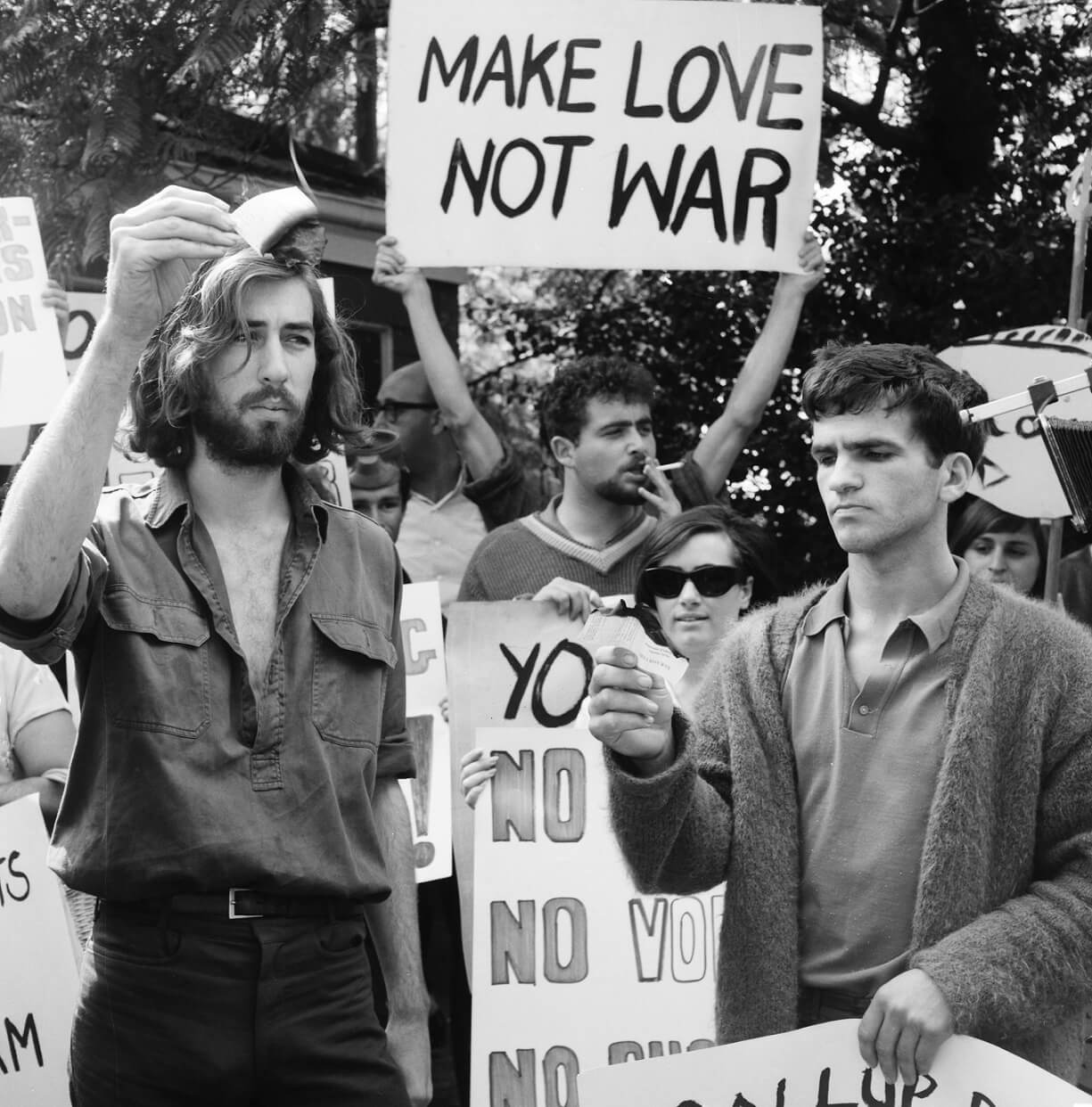
Anti-conscription protest, Melbourne
Reproduced courtesy The Age newspaper
In March 1966 Andy Blunden burned his national service registration card outside the Melbourne home of Prime Minister Harold Holt.
Even on the left of politics, an anti-communist faction within the Australian Labor Party, opposed to what was seen as communist dominance of the trade union movement, gained ground in the early 1950s. This rival ‘Movement’ as it was called was initially based in Victoria, where it was supported by the Roman Catholic Archbishop Daniel Mannix, a staunch anti-communist. A combined sectarian, anti-communist push ultimately saw a rival party, the Democratic Labor Party, form from former members of the ALP and other conservatives. ‘The Split’ in the ALP in 1955 helped to keep Labor out of office throughout the 1960s.
Cold War anxiety was fuelled throughout the 1950s and sixties by a succession of events, including the Petrov Affair of 1954. Vladimir Petrov was a Soviet embassy official and member of the notorious KGB. His defection to Australia in April 1954 confirmed fears of Soviet espionage activities in Australia and resulted in a Royal Commission on Espionage. Graphic press photographs, showing burly Soviet officials trying to bundle Evdokia Petrov onto an aircraft to be returned, forcibly, to the Soviet Union, seemed to confirm popular perceptions of Soviet oppression.
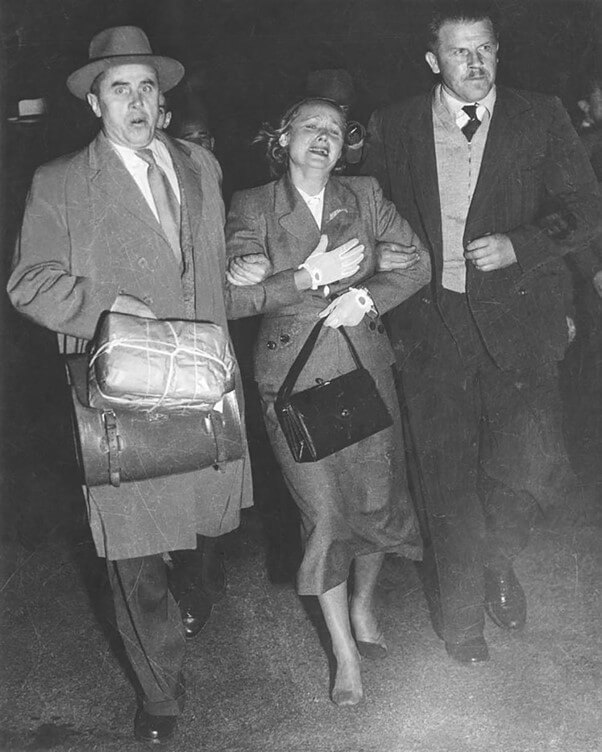
Evdokia Petrov at Mascot Airport, Sydney, being 'escorted' across the tarmac to a waiting plane by two armed Russian diplomatic couriers, 19 April 1954.
Printed in the Royal Commission on Espionage
National Archives of Australia
Global events maintained popular anxiety. The construction of the Berlin Wall, separating West from East Berlin, was completed in 1961 and the plight of its citizens served as a constant reminder of the oppressive power of the communist state. The hated wall was finally demolished by citizens from both sides in 1989. Then in 1962 the world held its collective breath as the United States and USSR faced off over Soviet nuclear missile bases on the (communist-led) island of Cuba, in the Caribbean Sea south of Florida. Known as the Cuban Missile Crisis, the confrontation brought both nations perilously close to nuclear war. As a primary school child in 1962 I still remember the palpable fear that Australia might be swept any moment into World War III. And recent scholarship now reveals that this was a very real possibility that was avoided in one crucial moment by sheer luck.
At home Australia’s newly established security office, the Australian Security Intelligence Agency, (formed in 1949) focused much of its attention on monitoring the activities of the Communist Party of Australia. Many trade unions, social justice organisations, and individuals also attracted their interest. And yet even at the height of anti-communist feeling, an attempt by the Menzies government to ban the Communist Party of Australia failed, with the narrow defeat of a referendum held in September 1951.
A televised age
News of these events now reached Australians instantly and in a visual form. As more and more households bought television sets, the TV news became a staple source of information. Families watched in horror as footage of the assassination of President Kennedy was beamed around the world within hours, then in awe as Neil Armstrong took his first bouncy steps on the moon’s surface. But arguably it was the regular reporting from the battlefields of Vietnam that had the greatest impact on Australian public opinion. Vietnam was the world’s first televised war and the close-up footage of the sufferings of the Vietnamese people brought the harsh realities of war home to Australians with an immediacy not possible in newsprint. By the late-1960s support for Australia’s involvement in the war was waning.
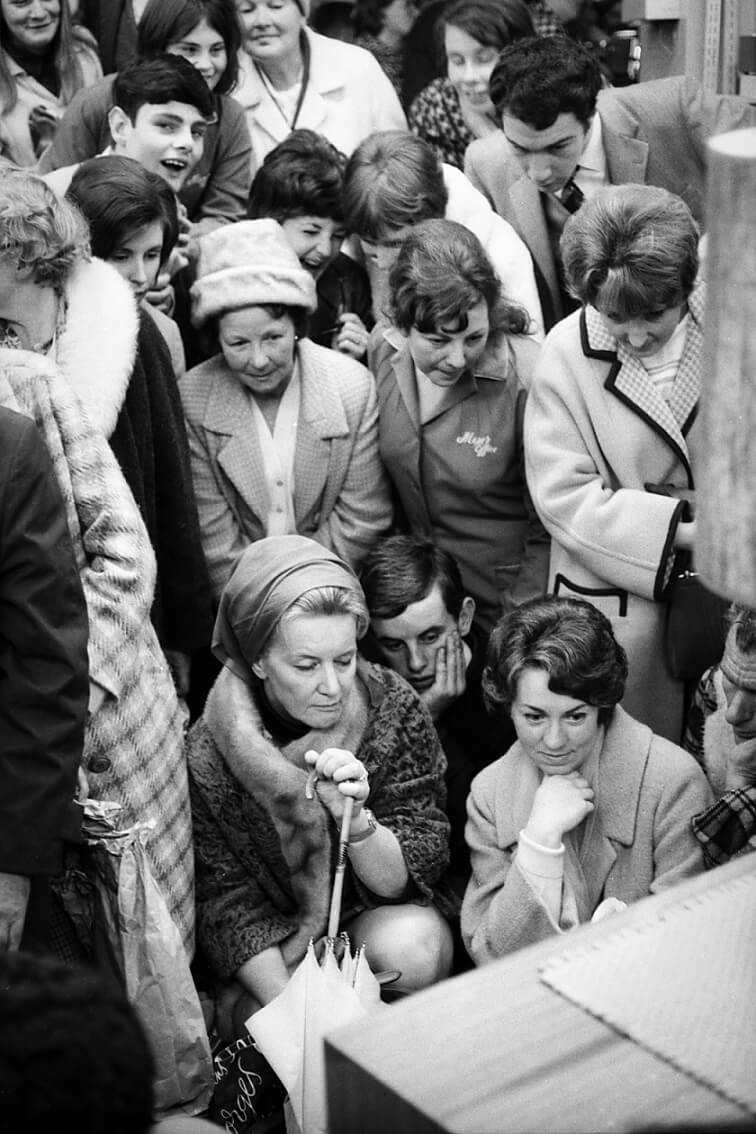
People gathered outside a Melbourne department store to watch the live telecast of the moon landing, which took place at lunch time in Melbourne.
The Age, 22 July 1969 (Fairfax FXB610803)
The Long Boom
Australia’s political conservatism in these years may also have reflected the complacency induced by sustained prosperity. The period from 1945 to the early 1970s is often described as the ‘long boom’, when secondary industry flourished (protected by high tariffs), there was almost full employment, and a sustained growth in real wages lifted living standards appreciably. Michelle Arrow points out that wages rose by almost four per cent in each year of the Menzies government, allowing wage earners to invest in the increasing range of consumer goods available. Home ownership also increased steadily in these years, from 54 per cent of households either owning a home or paying off a mortgage in 1947, to a peak of 71 per cent in 1966. The rate is now about 63 per cent. The city expanded outwards at this time, with new suburban sub-divisions catering to the pent-up demand for separate dwellings. Both state and federal governments assisted first home buyers with subsidised finance, on the assumption that home ownership encouraged social stability and contentment.
A home in the suburbs
For all its reputation as a decade of social experimentation, the 1960s saw most young people ‘settle down’ to establish homes and families. Marriage rates were high throughout the decade, and age at marriage low, especially for women. Most young couples set up house in their twenties, and first mothers were aged consistently in their early-middle twenties. Demographers speculate that this probably reflected high employment levels, consistent wage growth, and easy access to home finance, but almost certainly it also reflected a desire amongst young people for sex without the upset of an ex-marital pregnancy. Despite the advent of the contraceptive pill in 1961, single women struggled to access it, and most middle-class parents strongly disapproved of sex before marriage. Motherhood was still assumed to be woman’s primary goal in life, best embarked on early rather than late, and this assumption continued well into the 1970s. When I had my first child at the age of 29 in 1981, I was classed medically as an ‘elderly primigravida’ (woman in her first pregnancy), much to my chagrin!
Religious faith
Religion was another conservative influence on social attitudes. The 1961 Australian Census reported that some 88 per cent of those surveyed professed some Christian belief, while Judaism accounted for another 0.7 per cent. Other faiths were negligible at this time. A tiny minority (less than one per cent) professed ‘no religion’, although nearly 11 per cent did not enter a response. By 1971 those claiming ‘no religion’ had grown to 6.7 per cent, while another 6.3 per cent did not answer, but that still left the vast majority claiming some religious faith. Of course, it does not follow that those who professed belief were active church attenders, but it does suggest that the Christian churches maintained some influence over ideas and attitudes throughout the decade.
Perhaps more illuminating was the public response to the visit of the American Baptist evangelist Billy Graham in 1959. Graham’s style of evangelistic preaching had made him famous far beyond the United States and his ‘crusade’ in Australia and New Zealand in 1959 drew huge crowds. Over three million people were said to have heard him preach, with over 700,000 at the Melbourne events alone. His final appearance at the Melbourne Cricket Ground drew a crowd more reminiscent of a football final, with over 130,000 in attendance – the largest crowd ever recorded at the ground. One of his popular themes was the danger of communism, which presumably placed him in agreement with Archbishop Mannix. Another was the importance of confining sex within marriage. Whether his visit had any lasting effect it is difficult to judge. Although the proportion of Baptists in the population did not increase appreciably during the decade, many remembered his visit. Historian Judith Smart is one who remembers being taken (aged eight) to one of Graham’s Melbourne meetings with her Baptist Sunday School. The ABC recorded the final event and has video footage available here. Billy Graham’s return to Melbourne in 1969 drew smaller crowds but enough attended to suggest that his ideas still had wide appeal.
The long 1960s
Overall, there were many aspects of life in 1960s Victoria that suggested strong continuities with the 1950s. But by the mid-late 1960s differences became more apparent. In many ways the pace of change accelerated towards the end of the decade, with escalating political protest and increasing social experimentation. Some historians prefer to talk about ‘the long 1960s’, culminating in the Vietnam Moratorium demonstrations of 1970 and 1971, the election of the Whitlam Government (1972) and moves towards greater gender and sexual equality in the 1970s.
Further reading
Michelle Arrow Friday on our minds: popular culture in Australia since 1945. Sydney, UNSW Press, 2009
John Blaxland The Protest Years: The Official History of ASIO 1963-1975. Sydney, Allen & Unwin, 2016 istory of ASIO: 1963-1975
Judith Brett Robert Menzies’ Forgotten People. Melbourne University Press, 2007
Judith Brett Australian Liberals and the Moral Middle Class. Cambridge University Press, 2003
Brian Costar, Peter Love & Paul Strangio (eds) The great Labor schism: a retrospective. Carlton North, Scribe, 2005
Phillip Deery ‘Communism, security and the cold war’, Journal of Australian Studies, vol. 21, nos. 54-55, 1997, pp. 162-175
Don Garden Victoria: a history. Melbourne, Thomas Nelson, 1984
Stuart Macintyre The Party: The Communist Party of Australia from heyday to reckoning. Sydney, Allen & Unwin, 2022
Janet McCalman Sex and Suffering: Women’s Health and a Women’s Hospital. Melbourne University Press, 1998
Peter F. McDonald Age at First Marriage and Proportions Marrying in Australia, 1860-1971. Canberra, Department of Demography ANU, 1974
Megan Murphy Sir Henry Bolte (Australian Biographical Monographs No. 23). Redlands, Connor Court Publishing, 2024
Seamus O’Hanlon & Tanja Luckins (eds) Go! Melbourne in the Sixties. Melbourne, Circa, 2005
Seamus O’Hanlon ‘New People, New Ideas and New Attitudes: Melbourne’s Long Sixties’, Victorian Historical Journal, vol. 90, no. 1, June 2019, pp. 19-29
Shirleen Robinson & Julie Ustinoff (eds) The 1960s in Australia: people, power and politics. Cambridge, Cambridge Scholars Publishing, 2012