
More than any other decade the 1960s is remembered as a time of loud and energetic protest. Most think first of student radicals, but they were only one part of a cross-generational push for change. Australians from all walks of life questioned old hierarchies, developing new strategies of protest in the process.
The early sixties
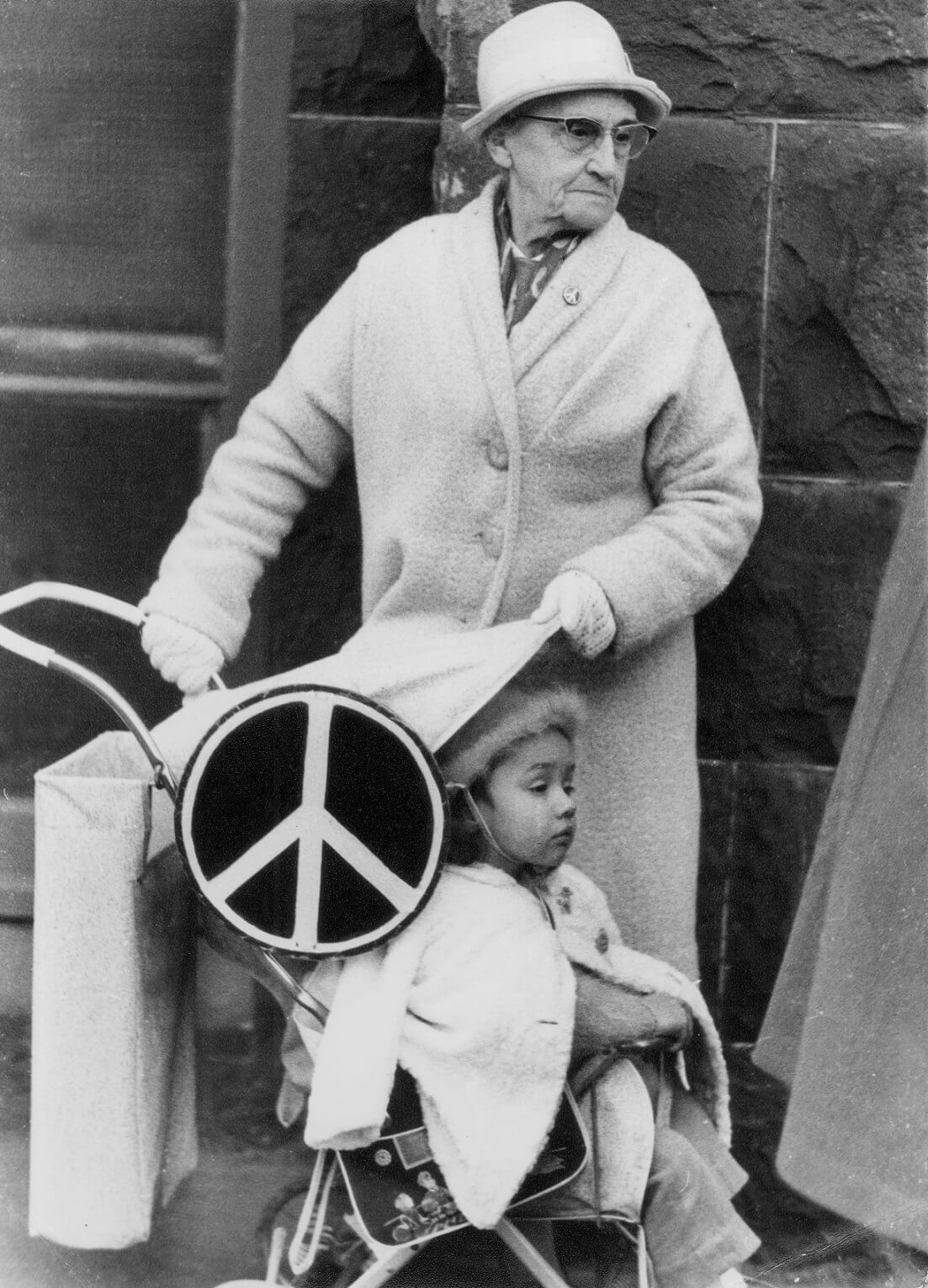
An elderly woman and young child attend a peace rally in Melbourne in the mid-1960s. The woman carries the modern peace sign, designed in 1958 by Gerald Holtom for the British Campaign for Nuclear Disarmament. The inscription on the back reads ‘We both need peace’.
Courtesy University of Melbourne Archives
This may not be the image that first springs to mind when we think about protest in the 1960s, but it is more representative of protests in the early 1960s than the student-led, anti-war marches that would follow. Throughout the 1950s and into the 1960s radical groups organised regular protests on a range of issues. In the post-war period the peace movement and the anti-nuclear movement often joined forces to oppose nuclear weapons manufacture and nuclear testing, with regular protests at Easter, on the anniversary of the bombing of Hiroshima (6 August), and on the traditional labour holiday of May Day. Historically women were prominent in the peace movement in Australia and that continued to be the case. The Women’s International League for Peace and Freedom (WILPF) formed in Melbourne in 1920 and continued into the post-war period. Along with the Communist Party of Australia (CPA), its members consistently opposed nuclear testing and drew attention to the devastating impact of testing at sites like Maralinga. Australia’s first Campaign for Nuclear Disarmament Group (CND) also formed in Melbourne in May 1960 and led annual marches at Easter. In Cold War Australia such views were not necessarily popular, and the movements’ association with the CPA was another source of official suspicion. Many in the anti-nuclear movement were monitored by ASIO, but they persisted in their efforts to promote the anti-nuclear cause. Women were especially important in these campaigns, and you can read about the role of women in the anti-nuclear movement in Victoria in this article by Dr Hannah Viney.
Some Christian groups also supported the cause of international peace and disarmament and often joined in marches at Easter. One march held on 29 April 1962 was held in solidarity with campaigners in Aldermaston, England, opposing nuclear development there. Church leaders led this march, holding a placard that read: ‘End war for ever. Disarm all Nations’.
Union of Australian Women (1950-2012)
The Union of Australian Women (UAW) was one group that was active in the anti-war and anti-nuclear cause throughout the 1950s and sixties. It was an association of radical women, formerly members of the Housewives’ Association, who came together in Melbourne in July 1950 to promote a broad agenda of change. Many were active members of the Communist Party of Australia, but the UAW claimed to represent all women — ‘housewives, mothers, single women, working women, country and city women’. Members were committed to public activism, organising protest marches and distributing political leaflets. They became impatient with the Housewives’ Association’s reluctance to engage in activism.
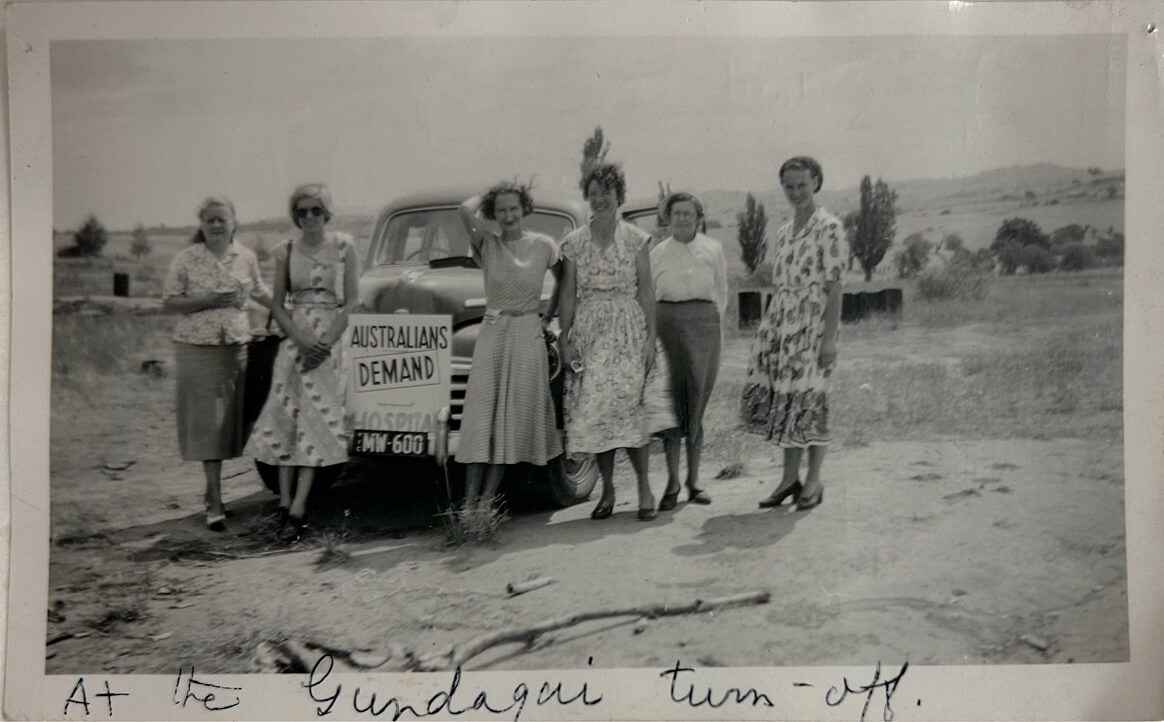
‘At the Gundagai turn-off’
Artist Ailsa O’Connor and others probably from the UAW campaigning in regional Australia, c. late-1950s
Photographer and copyright status unknown
Image courtesy State Library Victoria
Socialist-realist artist Ailsa OConnor was active in the UAW and secretary in the 1950s. She used her art to promote the causes of peace, nuclear disarmament, women’s rights, workers’ rights and general social welfare issues. You can read more about her on the State Library Victoria website.
In addition to its anti-war and anti-nuclear stance, the UAW supported a wide range of women’s issues, from equal pay to legalised abortion, as well as general cost of living concerns. In their approach to women’s issues they were often well ahead of their time, anticipating the Women’s Liberation Movement that would follow. However, the fact that many members of the UAW were also members of the Communist Party meant that their activities were closely monitored by ASIO, and their protests were often disrupted by the police. They grew tired of their carefully painted placards being seized and destroyed. In response they came up with a novel solution. Reasoning that the police would be loath to manhandle them, they decided to wear their slogans, and made UAW aprons to wear on marches and vigils. Some of these aprons have survived, preserved in the Victoria University Archives, along with UAW banners, which were carried on events like May Day marches. We were able to borrow both aprons and two banners to display in the Swinging 60s exhibition. They are shown here. Later protestors would wear tee shirts emblazoned with political slogans, but this was the pre-tee shirt era. The aprons were a neat solution that seems to have worked, however anachronistic we might now find the concept of the protest apron!
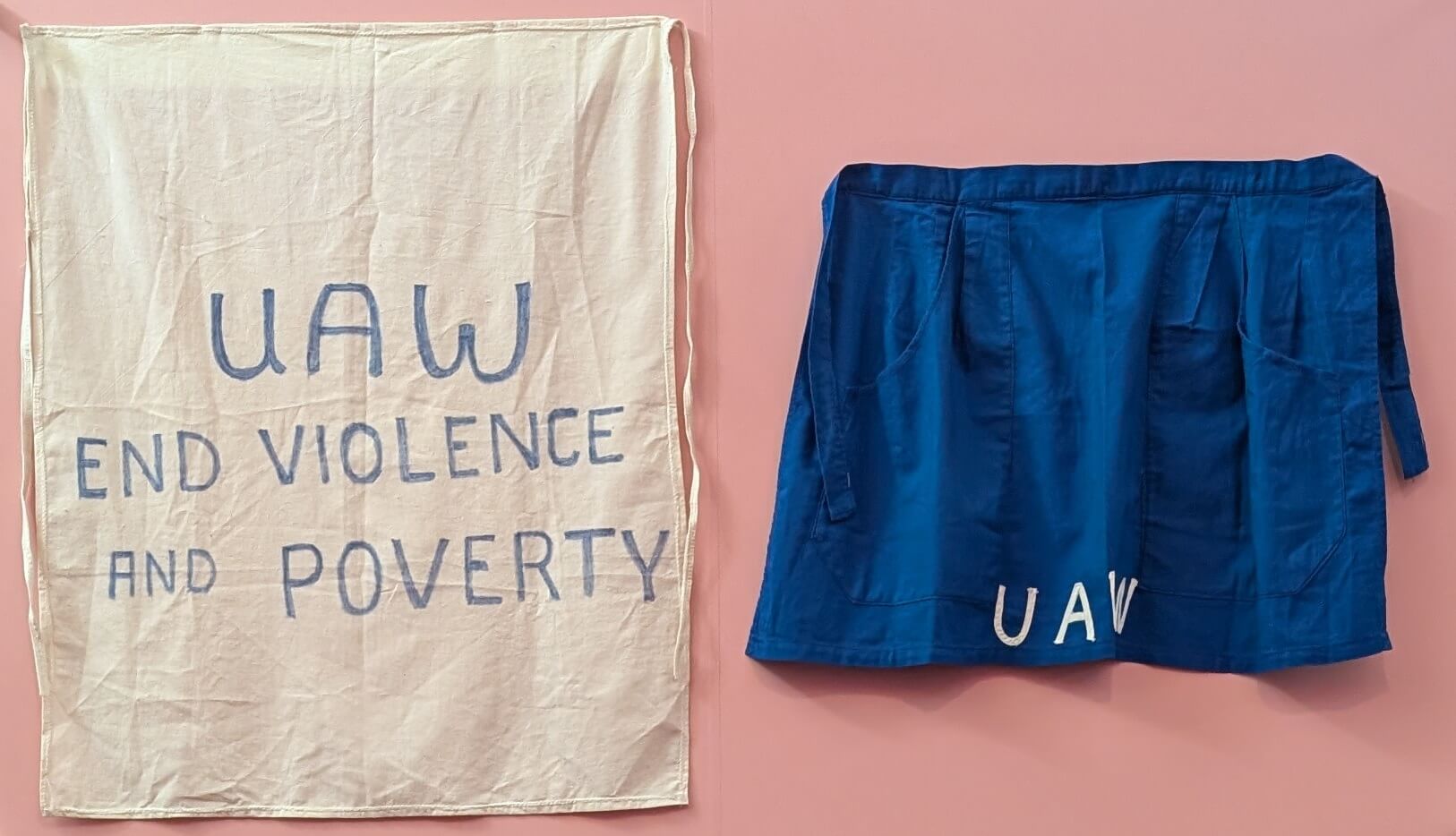
Aprons, Union of Australian Women, 1960s
Courtesy Victoria University Archives
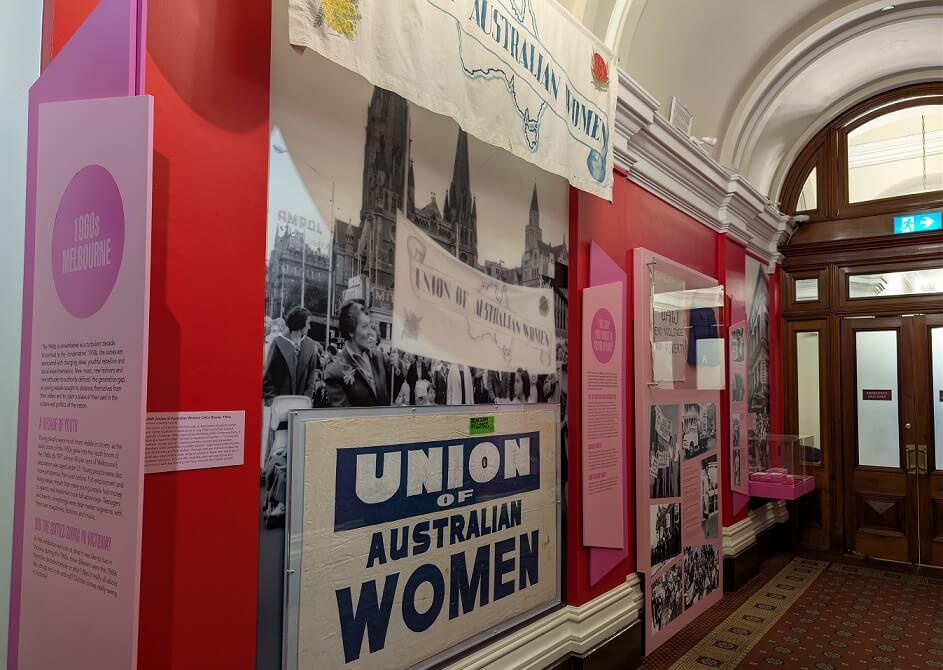
Union of Australian Women banners displayed in Swinging 60s
Courtesy Victoria University Archives
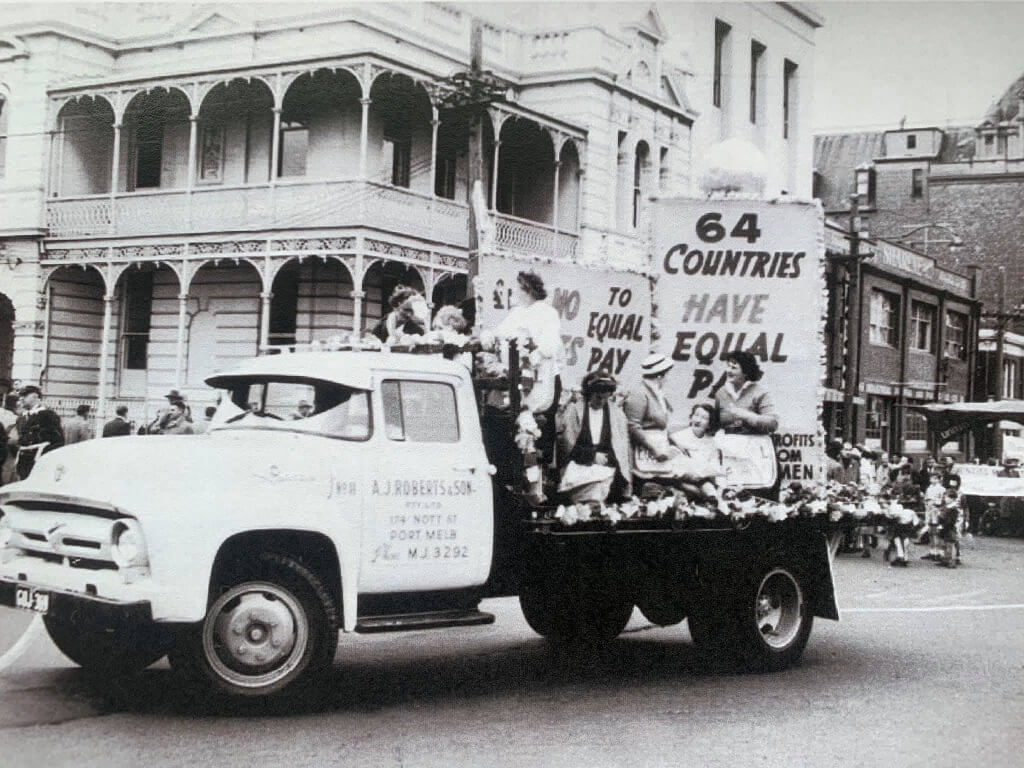
Equal pay demonstration float c. 1960
Probably Union of Australian Women wearing their aprons
Reproduced courtesy University of Melbourne Archives
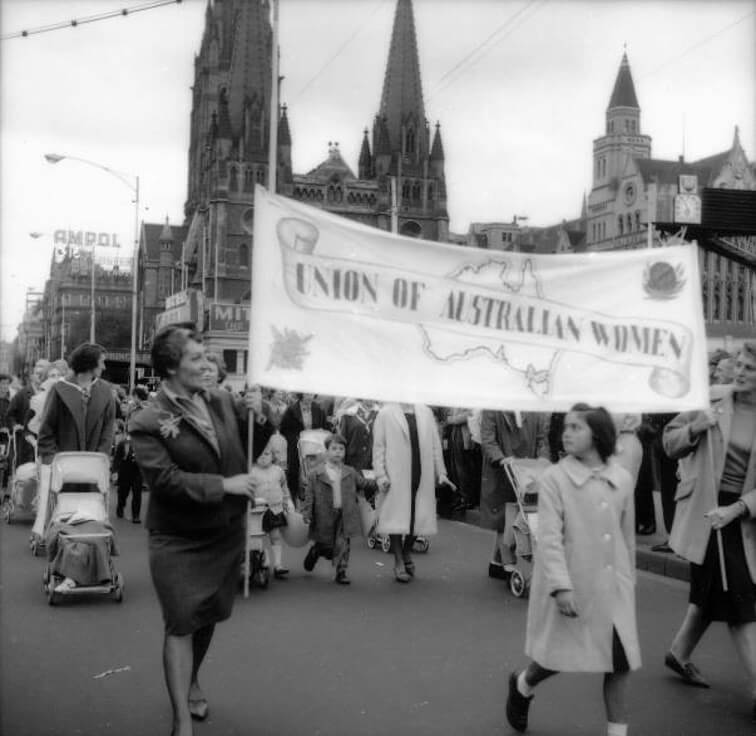
Union of Australian Women march on May Day 1963
Reproduced courtesy Museums Victoria
The fight for equal pay
The UAW was not alone in supporting equal pay for women in the 1960s. In fact, the campaign for equal pay has a long history in Victoria, dating from the work of the first suffragists in the early-twentieth century. From 1937-46 a specific organisation, the Council of Action for Equal Pay, formed by two redoubtable feminists, Muriel Heagney and Jessie Street, campaigned actively for equal pay, and they were instrumental in securing more equitable rates of pay for women working in some wartime industries. Although few of the women working in so-called ‘men’s jobs’ were awarded equal pay, many were paid better than before, generally between 75 and 90 per cent of the male rate of pay. But these benefits did not flow on to women working in traditional ‘female’ jobs in the many food and clothing factories, where wages increased only towards the very end of the war.
Nevertheless, the decisions of the wartime Wages Boards showed that change was possible and when in 1950 the Australian Conciliation and Arbitration Court established the first minimum wage for women, it set the wage rate at 75 per cent of the male rate. Feminists were bitterly disappointed, but it was at least an improvement on the old unofficial rate of 54 per cent. Organisations like the Union of Australian Women took up the fight again, joined by other radical women working to improve the conditions of women at work. Socialist women’s groups marched each year to mark International Women’s Day on 8 March, often combining their marches with calls for peace, or universal disarmament.
International Women’s Day was a socialist initiative that began as International Working Women’s Day. It was marked first in 1911, following the declaration of a National Women’s Day in the United States in 1909. Socialists all over the world gradually took up the call, including in Australia. The group shown marching towards the Old Treasury Building in 1962 included members of the Communist Party of Australia and their placards suggest the range of issues they embraced at that time.
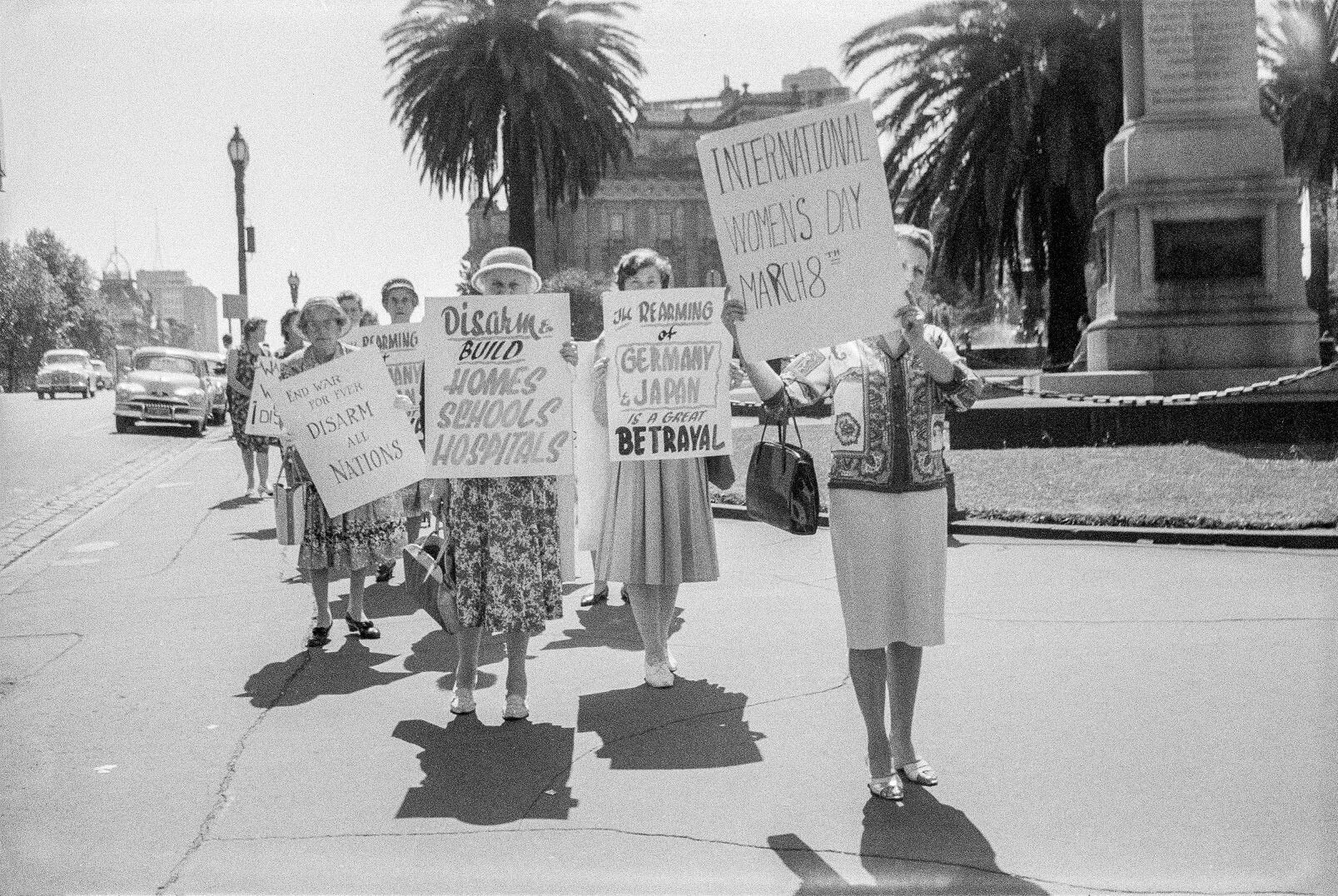
Women march along Spring Street, Melbourne for International Women’s Day, 1962
Communist Party of Australia Collection.
Courtesy University of Melbourne Archives
In the late 1960s the equal pay campaign achieved public notoriety through the actions of radical women, who took their demands for equal pay directly to the public.
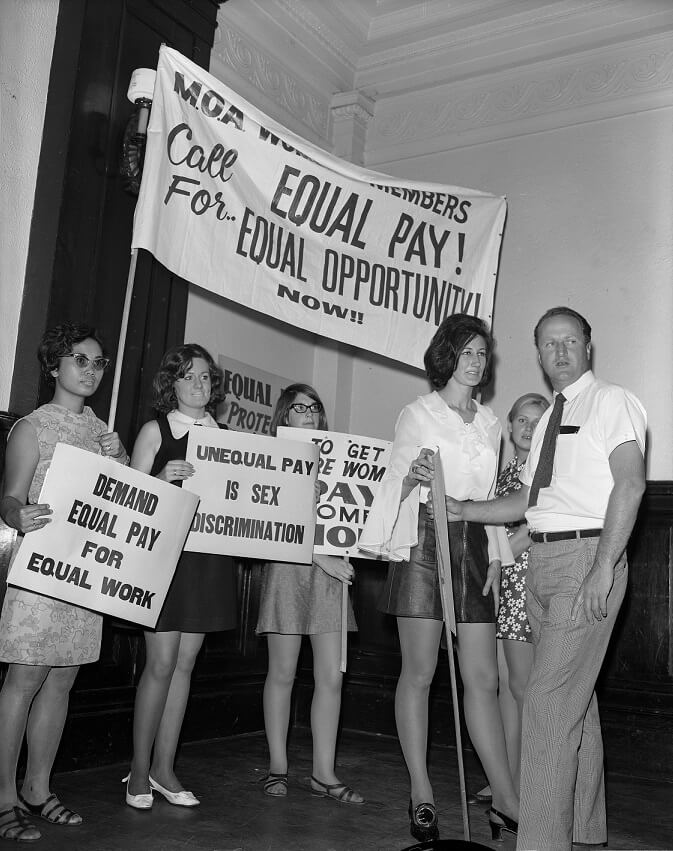
Equal pay protest Melbourne Town Hall 20 February 1969
Photographer: Laurie Richards
Courtesy Museums Victoria
This protest was held at the Melbourne Town Hall in early 1969. It was one of many.
Labour women took an active part in these protests and Zelda D’Aprano was prominent in the group. An employee of the Meat Industries Union, D’Aprano was frustrated by the continued exclusion of women from the decision-making process on equal pay claims and decided on a campaign to draw attention to the issue. Along with others she formed the Women’s Action Committee in Melbourne, campaigning for equal pay and better working conditions for women. In October 1969 she chained herself to the entrance of the Commonwealth Building in Spring Street to demand equal pay, supported by colleagues from the Union of Australian Women. The ploy worked wonderfully and this picture appeared in The Age on 21 October 1969.
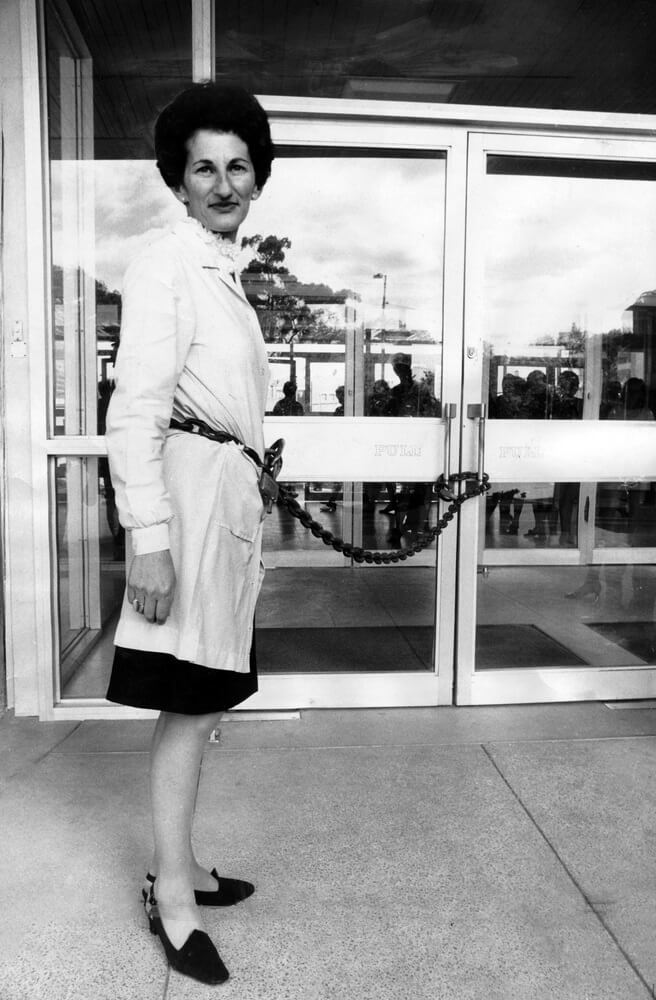
Zelda D’Aprano chained to the Commonwealth building in Spring Street in support of equal pay, 21 October 1969
Courtesy The Age newspaper
Other supporters took their campaign to public transport, insisting on paying only 75 cents of the $1 fare, since women’s wages were set at 75%!
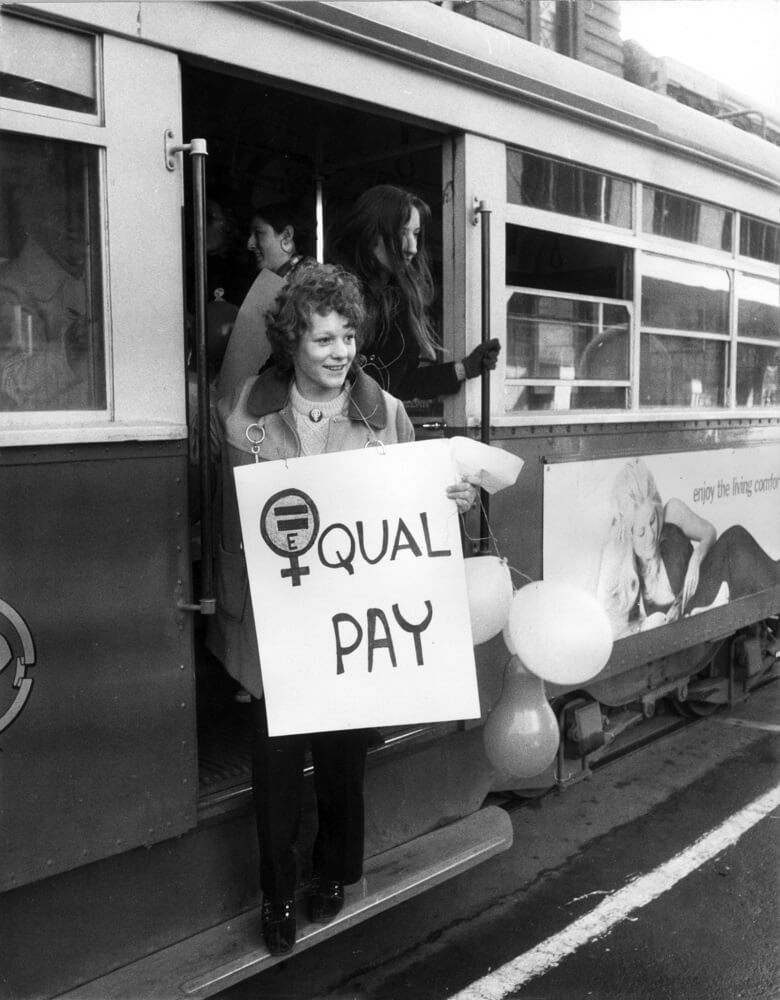
Campaigning on Melbourne’s trams for equal pay, 1969
Courtesy The Age newspaper
In 1972 the Commonwealth Conciliation and Arbitration Commission finally endorsed the concept of ‘equal pay for work of equal value’, paving the way for more equitable pay and conditions for women in the workplace. A bronze statue of Zelda D’Aprano by Jennifer Mann was unveiled outside the Victorian Trades Hall on 23 May 2023, commemorating her contribution to the campaign for equal pay.
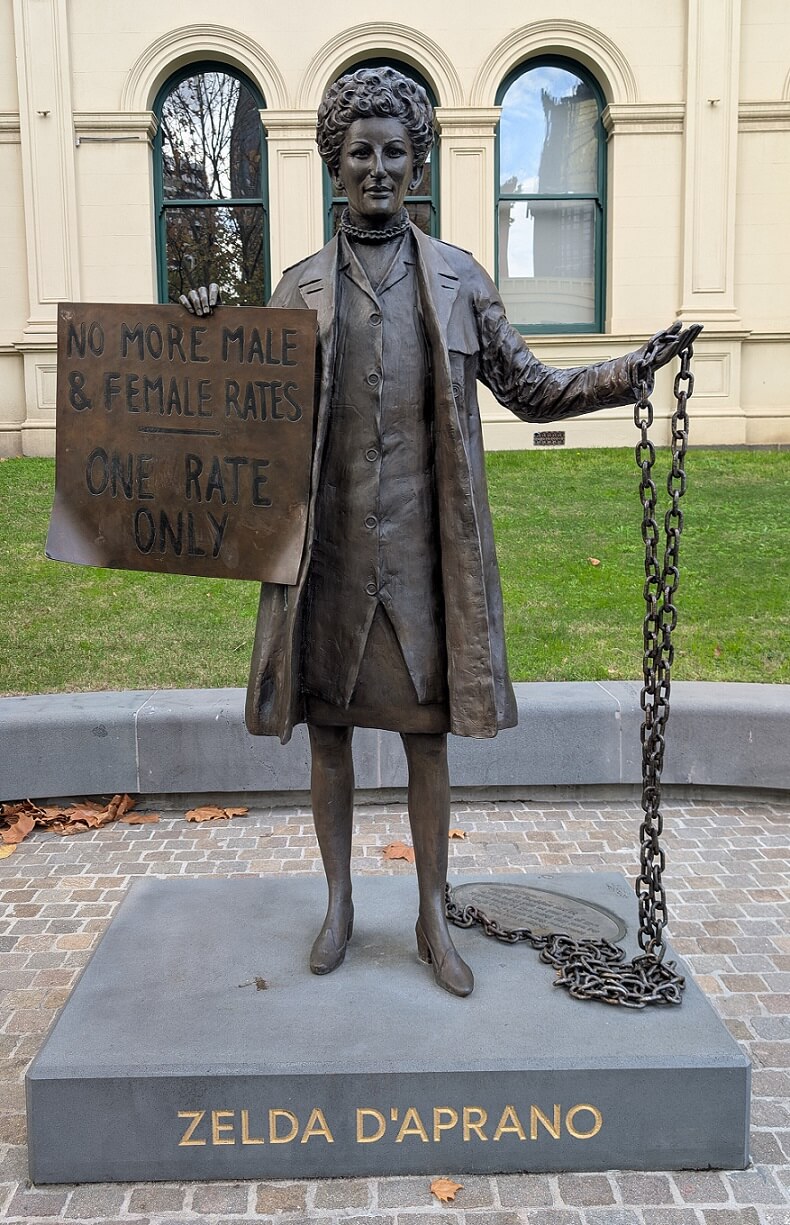
Jennifer Mann, Zelda D’Aprano, statue in bronze, 2023
Old Treasury Building
The scroll in her hand reads: ‘NO MORE MALE & FEMALE RATES/ONE RATE ONLY’.
First Nations Protest
First Nations groups were also active in Melbourne in the 1950s and sixties. The Australian Aborigines League was first formed in the 1930s and continued after the Second World War under the leadership of Pastor (later Sir) Douglas and Gladys Nichols and Bill Onus. They campaigned to prevent the closure of reserves like Lake Tyers in the mid-1960s, in protests that included public marches on Parliament as shown here, held in 1965. The broader issue of Land Rights continued as a focus of protest into the 1970s and beyond.
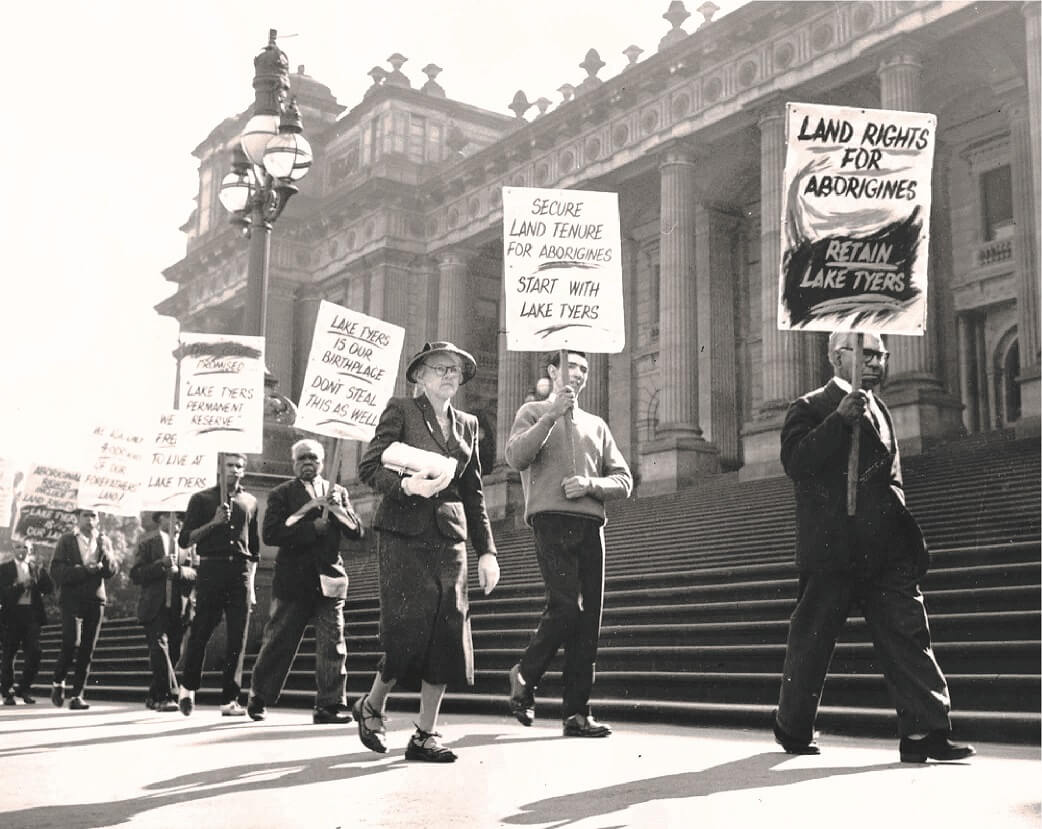
Pastor (later Sir) Douglas Nicholls leads a protest against the threatened closure of Lake Tyers Aboriginal Settlement, March 1965.
Courtesy Age newspaper
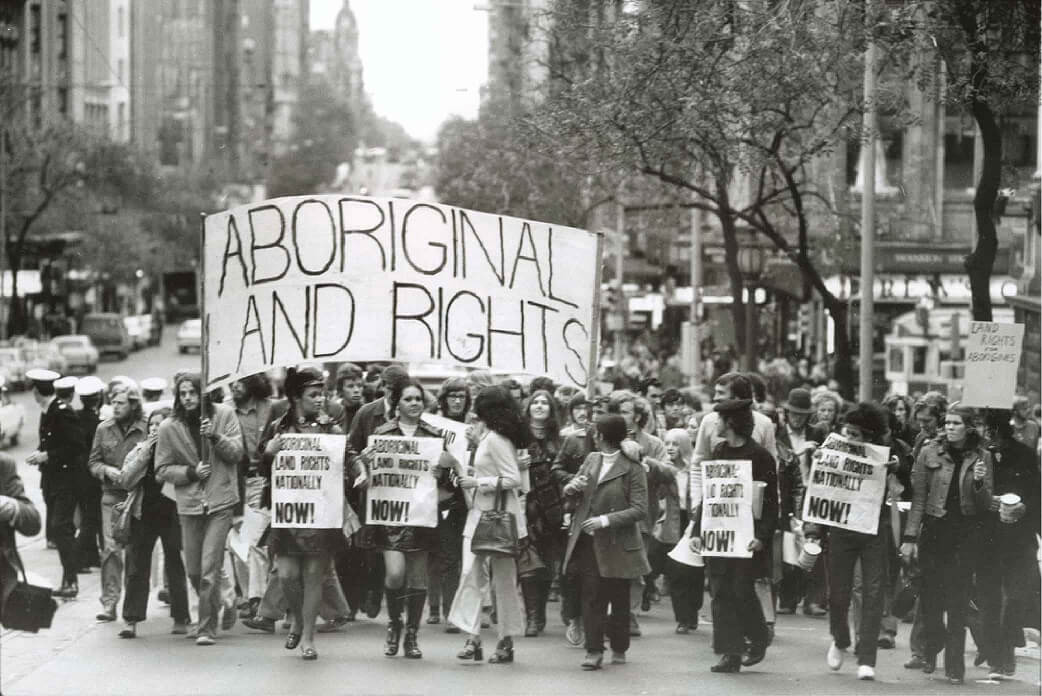
Aboriginal Land Rights protest, Collins and Spring streets Melbourne, 1971.
Courtesy Age newspapers
The campaign for land rights has been a very long one, beginning with William Barak and continuing.
Citizenship
A fundamental focus of the League was the right to full citizenship, long denied to First Nations people. Although First Nations men could vote in Victoria from 1857 (at least theoretically), the federal suffrage was only extended gradually from 1949. In 1967 an important referendum was held to expand federal powers to allow the Commonwealth Government to make laws for Indigenous people and to include First Nations people in the Australian census. This passed with overwhelming support: 95 per cent of Victorians voted in favour, while the national average was 91 per cent.
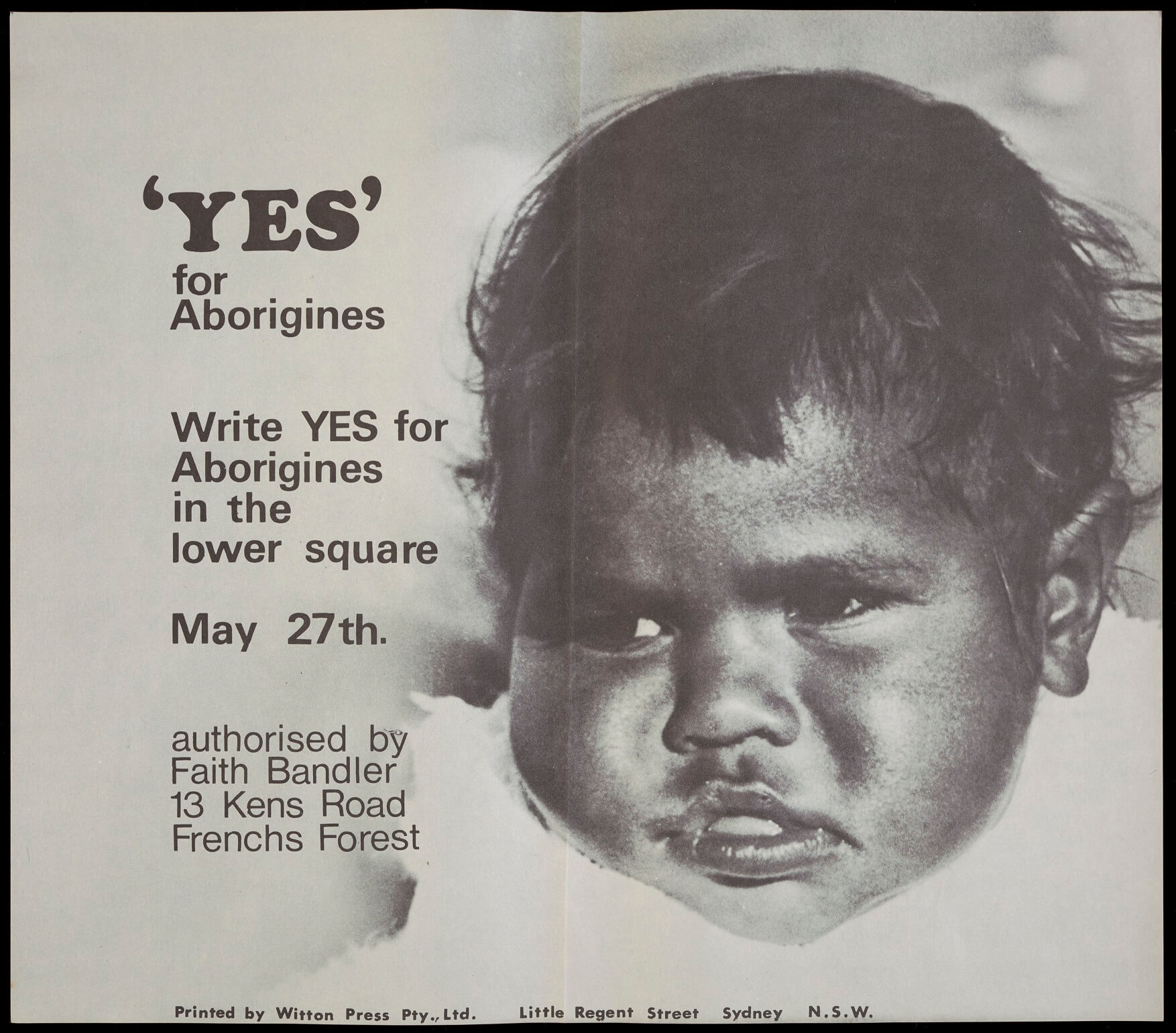
1967 Referendum poster ‘Yes’ for Aborigines
National Library of Australia
The Vietnam War
The issue that would change the face of protest in Victoria was Australia’s involvement in the conflict in Vietnam. Australian military advisors were first sent to South Vietnam in 1962, but it was the decision to introduce military conscription and then to post conscripts to fight in Vietnam that galvanised opposition in Australia.
The Menzies Government’s decision to send assistance to the South Vietnamese Government in 1962 reflected widespread fear of an increasing communist threat on Australia’s doorstep in South-East Asia. Australia had already joined other Commonwealth forces fighting against communist insurgents in the Malayan Emergency (1948-60), as part of the government’s commitment to what it called ‘forward defence’. Vietnam seemed like a similar conflict — just one more country to reflect the spread of communist ideology in the so-called ‘domino effect’ in Asia. You can read about the Menzies Government’s views on the domino effect and ‘forward defence’ on the Robert Menzies Institute's website.
At first there was widespread support for the war and for Australia’s involvement. In Cold War Australia the fear of communism was strong. But the decision to introduce military conscription in November 1964 saw an immediate response in the community, especially when the government then announced that conscripts could be sent to fight. Under the National Service Scheme 20-year-old men were randomly selected to serve in the Australian military for two years, with selection based on birthdates drawn literally from balls like the lottery — the so-called ‘birthday lottery’. Those whose birthdays were selected were immediately ‘called up’ to register for national service. A photograph of the birthday balls from the National Archives of Australia is shown here. Between 1965 and 1972 more than 800,000 men registered. About 63,000 were conscripted and more than 19,000 served in Vietnam.
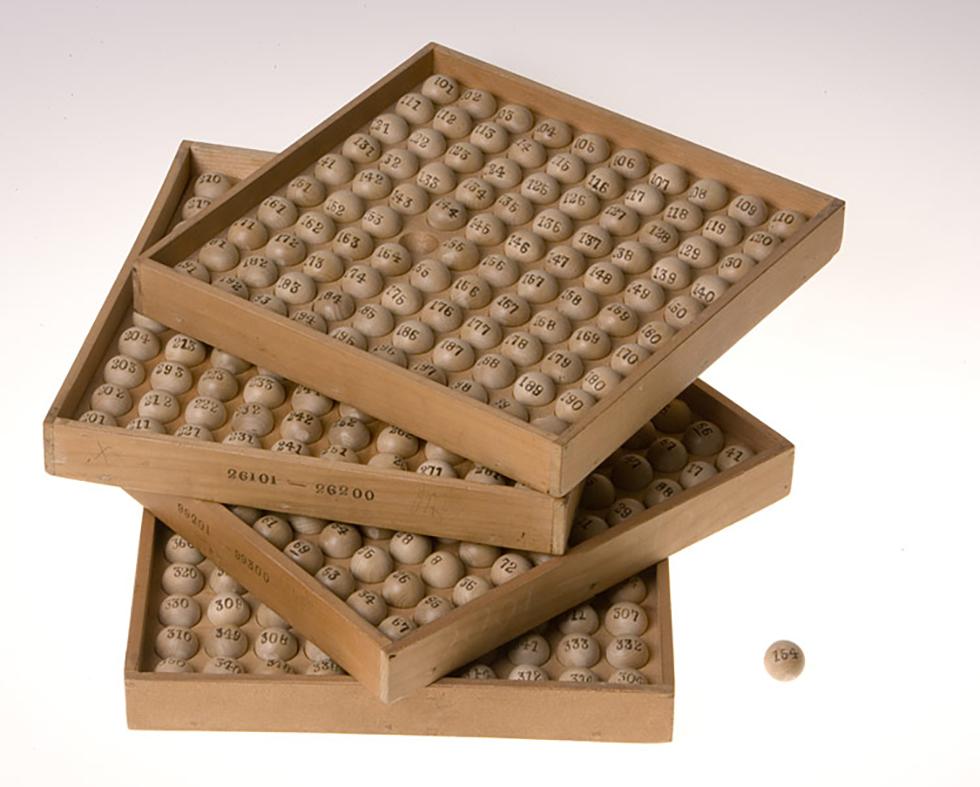
Photograph of the ballot balls used to draw birth dates in the ‘conscription lottery’ 1965-72
Courtesy National Archives of Australia
In the Swinging 60s exhibition we also showed an example of a call-up or registration notice, sent to Russell Vernon in February 1966. Young men could defer their military service while they completed educational studies, or for some other reasons: indefinite deferral was also granted on occasion. That was the case with Russell Vernon, as the second certificate shows. Those claiming to object to the war on conscience grounds (‘conscientious objectors’) however had to prove their opposition to all war, not this specific conflict. They also had to fund any subsequent court appearances themselves.
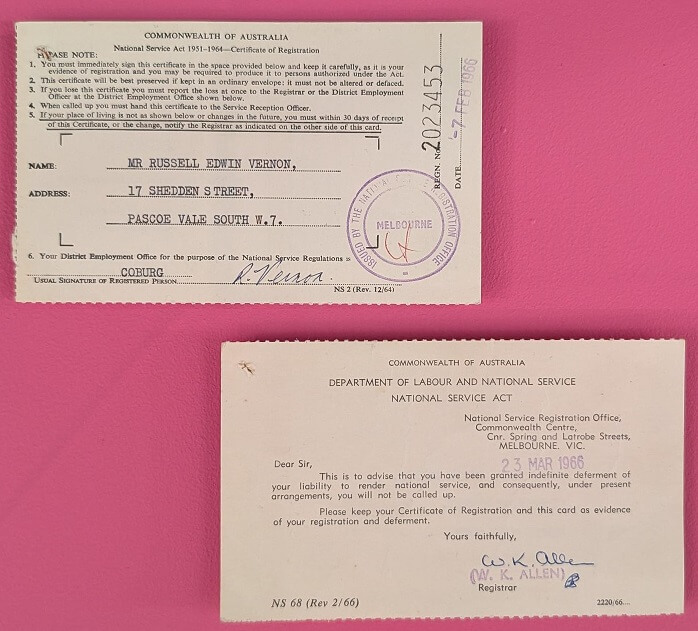
National Service Certificate of Registration, notice of ‘call up’, 7 February 1966
Advice of indefinite deferral, 23 March 1966
Issued to Russell Edwin Vernon
Donated by Russell Vernon
Old Treasury Building
Initially opposition focused on two aspects of the scheme — the fact that those selected were considered too young to vote but could be sent to fight. At this stage the voting age was still 21 years. The lack of fairness in the system that saw some selected while others were spared (literally a lottery) was the second reason. The established anti-war groups immediately condemned the scheme, but opposition also came from quite an unexpected quarter, from ordinary, ostensibly a-political mums and dads, whose sons were called up. In May 1965 Joyce Golgerth, whose son Michael had been called up in the first National Service batch, issued what she called ‘a distress call - SOS - to mothers everywhere’, forming an organisation to oppose the ballot called simply ‘Save Our Sons’. Historian of the movement, Carolyn Collins, described Golgerth as ‘an apparently ordinary housewife from the Upper North Shore Sydney suburb of Pennant Hills…whose previous public activities had been limited to tuck-shop duties at her children’s school’. But her distress call was heeded and Save Our Sons groups were formed around Australia. The group in Melbourne was formed in August 1965.
This was opposition from the heartland of Liberal Australia and it took both the government and law enforcement agencies by surprise. These were not the usual CPA ‘agitators’, but ordinary, often quite conservative, women and men who had never taken to the streets before. At first the press largely ignored them, but they persisted, adopting peaceful means of protest, like the ‘silent vigil’ that became their hallmark. These two women, photographed by News Ltd. expressing their opposition to the call up in Melbourne in 1965, look more like members of the Mothers Union. With their fur collars, fur hats and gloves, they might have been on their way to church.
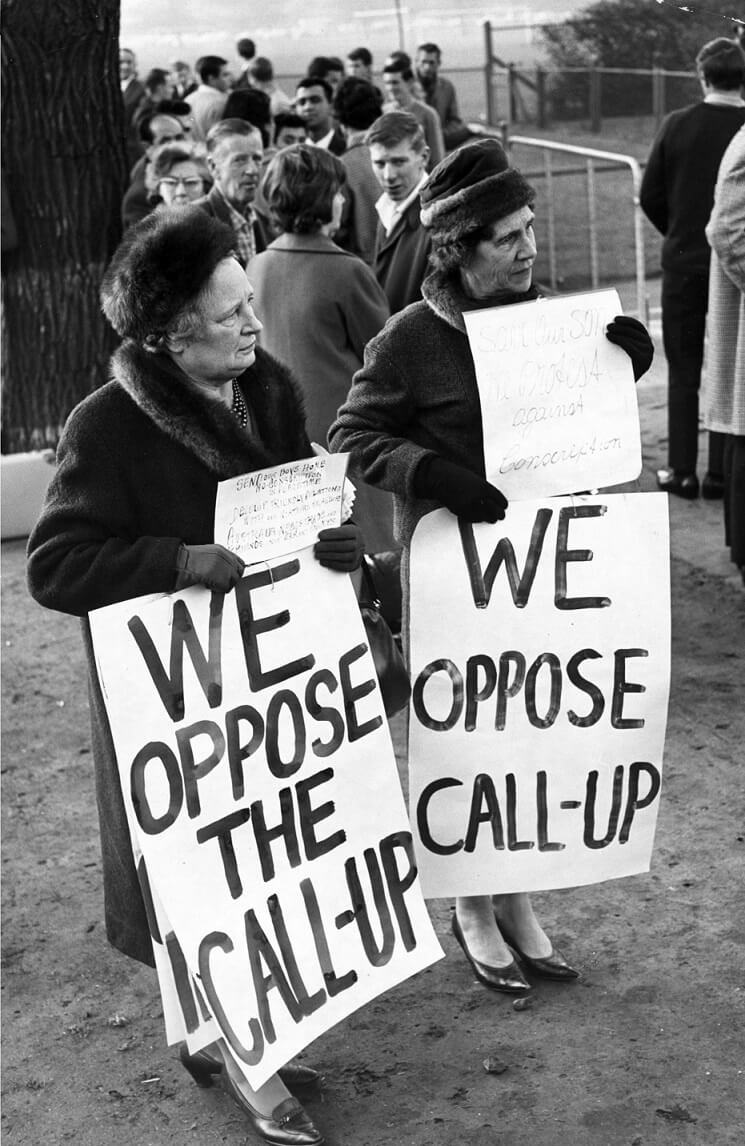
Women protext in Melbourne, 5 July 1965
Courtesy of News Ltd/Newspix
The Save Our Sons movement published leaflets, printed posters like this one and made badges to convey their message. Many expressed a simple slogan, designed to get the message across and be memorable. One of their posters with the legend ‘Not With My Son, You Don’t’ is held in the collection of the Australian War Memorial.
Increasing activism
As time went on, and the death toll from Vietnam rose, some SOS members were radicalised, joining with other anti-draft groups to disrupt public events like the Melbourne Cup and actively assisting draft-resisters to evade the police. A network of ‘safe houses’ was established to shield young men from arrest and SOS members participated in this network. They also began to use tactics like ‘sit-ins’ at registration centres to advise young men not to register. In Melbourne in 1971 authorities determined to make an example of the women and imposed a 14-day prison sentence in Fairlea Women’s Prison on five women, immediately before the Easter holiday. They were arrested under a charge of Wilful Trespass. The ‘Fairlee Five’ became the first civilians charged under the Summary Offences Act of 1971, which limited the rights of protesters, including acts of obstruction and trespassing.
In scheduling the hearing for the day before the Easter holidays, it seemed the authorities had hoped to avoid press coverage. This misfired, and the ‘Fairlea Five’ as they were immediately known made headline news around the country, after a lone ABC reporter in the court room made it the lead story in the evening news. Vigils were hastily organised outside the prison, and on Easter Sunday an inter-denominational church service was conducted before some 500 people outside the prison. The Australian Labor Party and union officials expressed their outrage that ‘respectable married women’ had been gaoled for taking part in a peaceful demonstration, while photographs of the women’s children (they had 25 between them) outside the prison turned the affair into a media nightmare for the Victorian and Australian governments. The ‘Fairlie Five’ were overnight celebrities, although they were unaware of it while inside the prison, while the Victorian Government’s hardline response was widely seen as an important factor in turning public opinion against Australia’s involvement in the war.
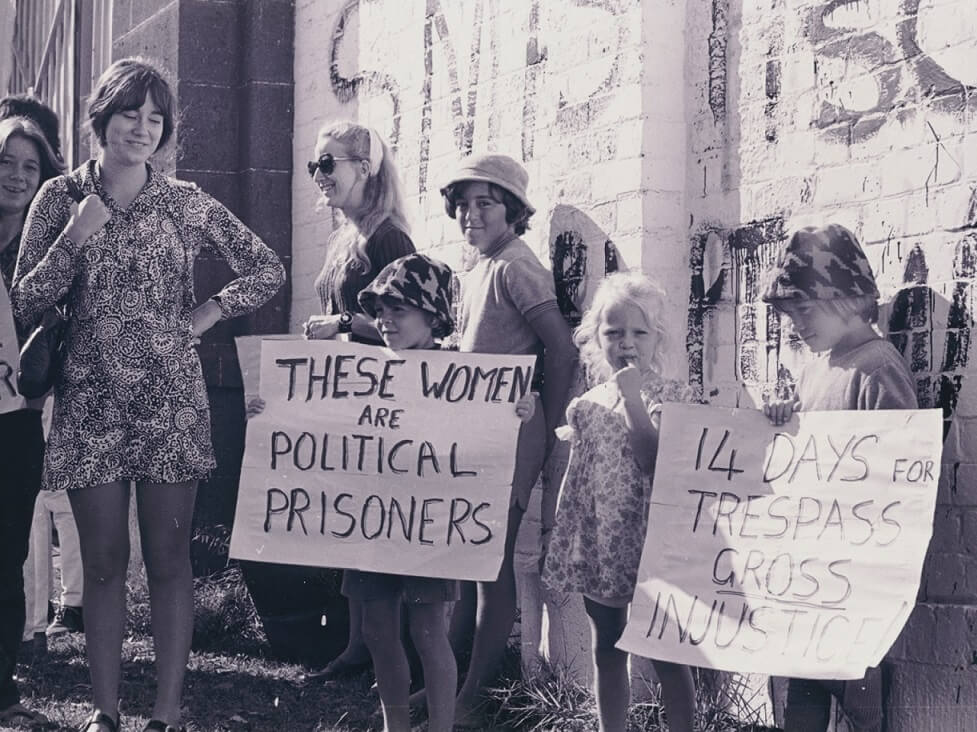
Vigil outside Fairlie Women’s Prison in support of the ‘Fairlie Five’ with some of their children in attendance.
National Library of Australia
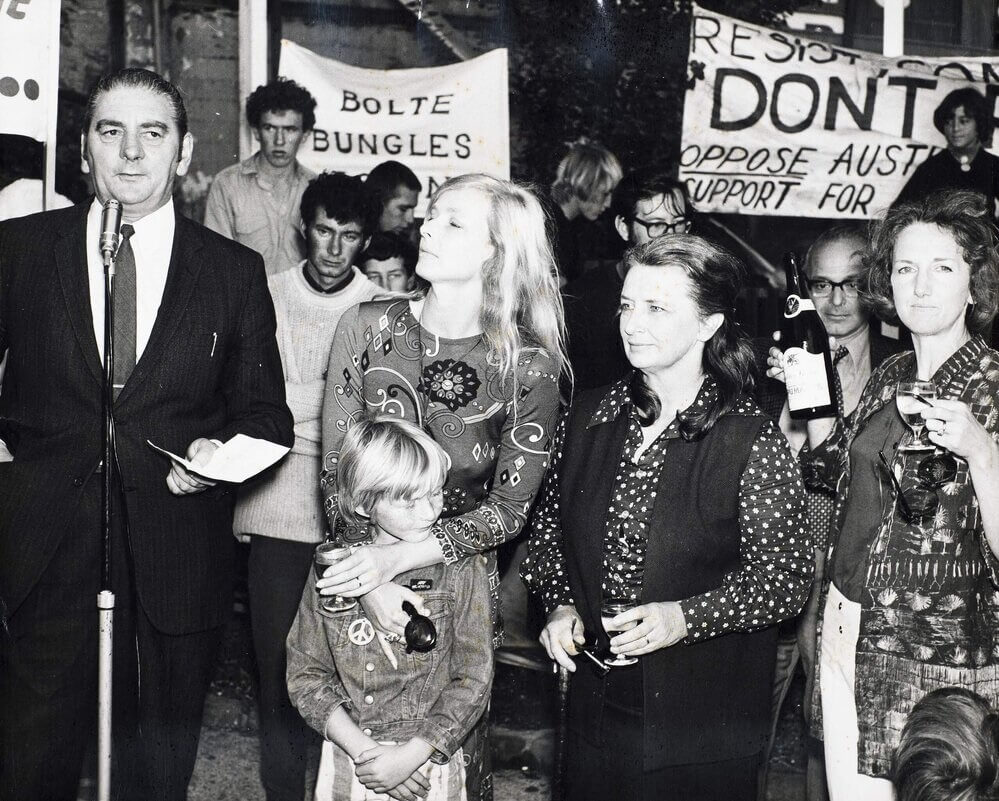
Welcoming rally for the ‘Fairlie Five’ on their release from prison 18 April 1971
Communist Party of Australia files University of Melbourne Archives
The photograph shows George Crawford, Secretary of the Melbourne Branch of the Plumbers and Gasfitters Employees' Union, speaking at a welcoming rally in Melbourne for the ‘Fairlea Five’ on 18 April 1971. L-R: George Crawford, Jean McLean, Jo Mclain Cross, Bernie Taft and Joan Coxsedge. They were released three days early for ‘good behaviour’.
Youthful protest
Other groups formed in late-1964-5 to oppose conscription looked more like our preconceptions of1960s protestors. They included the Youth Campaign Against Conscription, formed from students and others who opposed the war in late 1964 and active until about 1970.
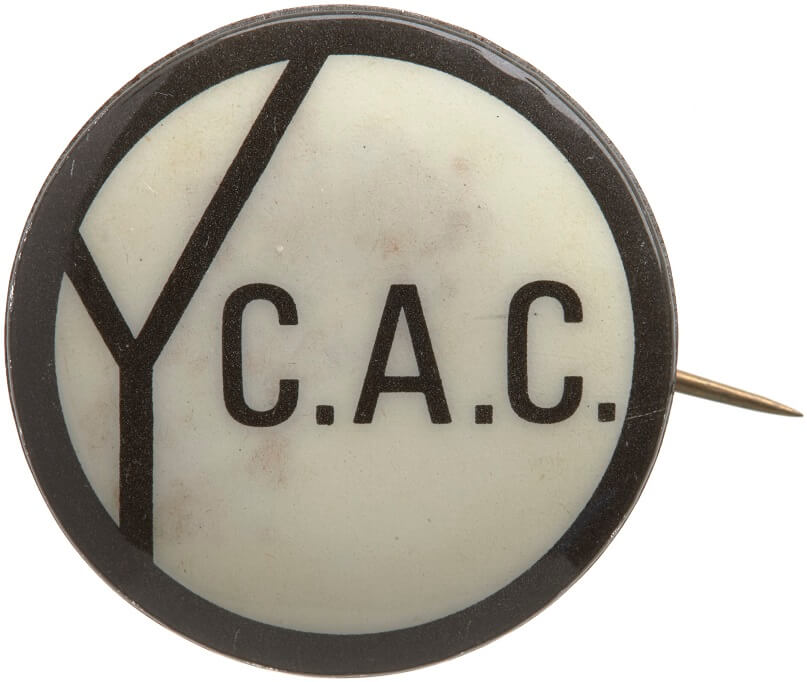
Youth Campaign Against Conscription badge 1965-1970
Worn by Michael Hamel-Green SH922795
Courtesy Museums Victoria
Many other groups followed, some formed on individual university campuses. Others were part of a growing student ‘New Left’ movement, some with links to international student groups in the United States and Europe. The late 1960s was a turbulent time in global university politics, with student protests in many countries in 1968. From the United States, through much of Europe, Britain, Latin America, Japan, the Middle East and Africa, student revolt was transnational and Australian radical students were well versed in its literature. Some protests resulted in violent clashes with police, as in Chicago in 1968, or in Czechoslovakia during the so-called ‘Prague Spring’, when Soviet tanks rolled into Prague effectively ending that bid for freedom from Soviet control. Protests in Australia were generally less violent, though there were notable clashes in 1970 during the Moratorium marches.
In addition to conscription and the war in Vietnam, New Left students on university campuses opposed the way tertiary education was regarded essentially as what they called a ‘meal ticket’, and campaigned on general issues of free speech. Monash University was widely regarded as the most radical campus in Australia from the mid-late 1960s, with radical politics led by the Monash Labor Club, and the (smaller) New Left group, with links to the CPA, within it. Students conducted ‘sit-ins’ of campus administration offices and held rallies near the student union offices.
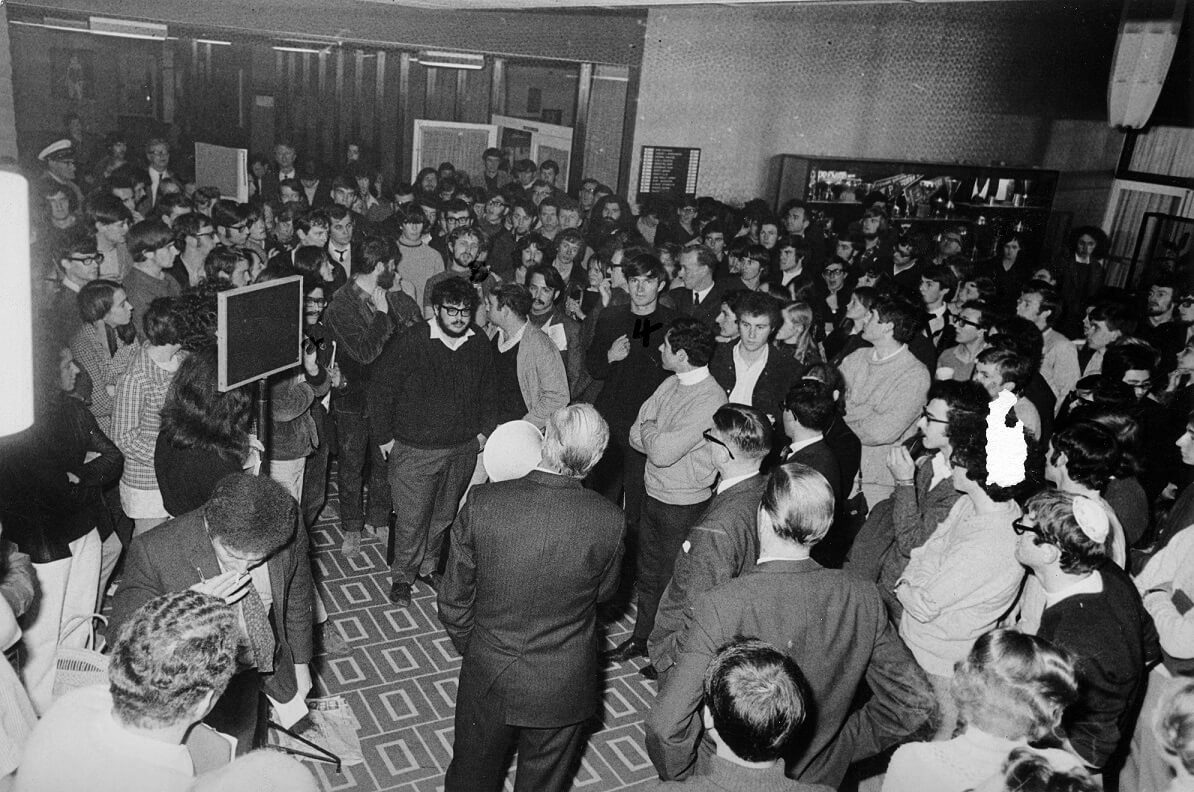
Monash Vice-Chancellor Dr (later Sir) James Matheson addressing a student protest in the University Union 1969
Courtesy Monash University Archives
ASIO officers regularly monitored Monash student publications and the activities of members of the Monash Labor Club.
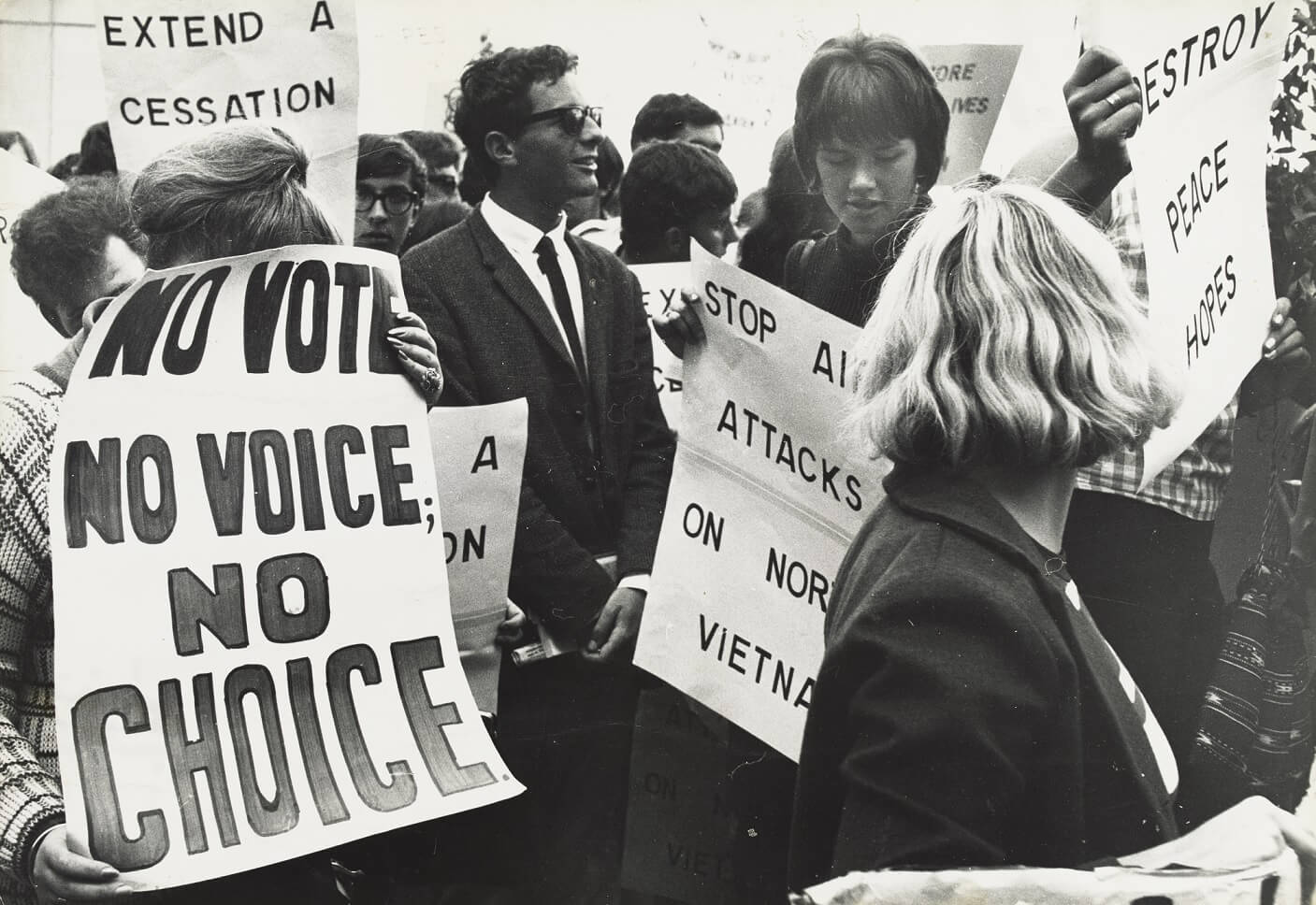
Anti-conscription demonstration held in Melbourne in 1965 while the ‘birthday ballot’ was drawn.
Courtesy State Library Victoria
‘No Vote, No Voice No Choice’ was a consistent theme of protest amongst young activists.
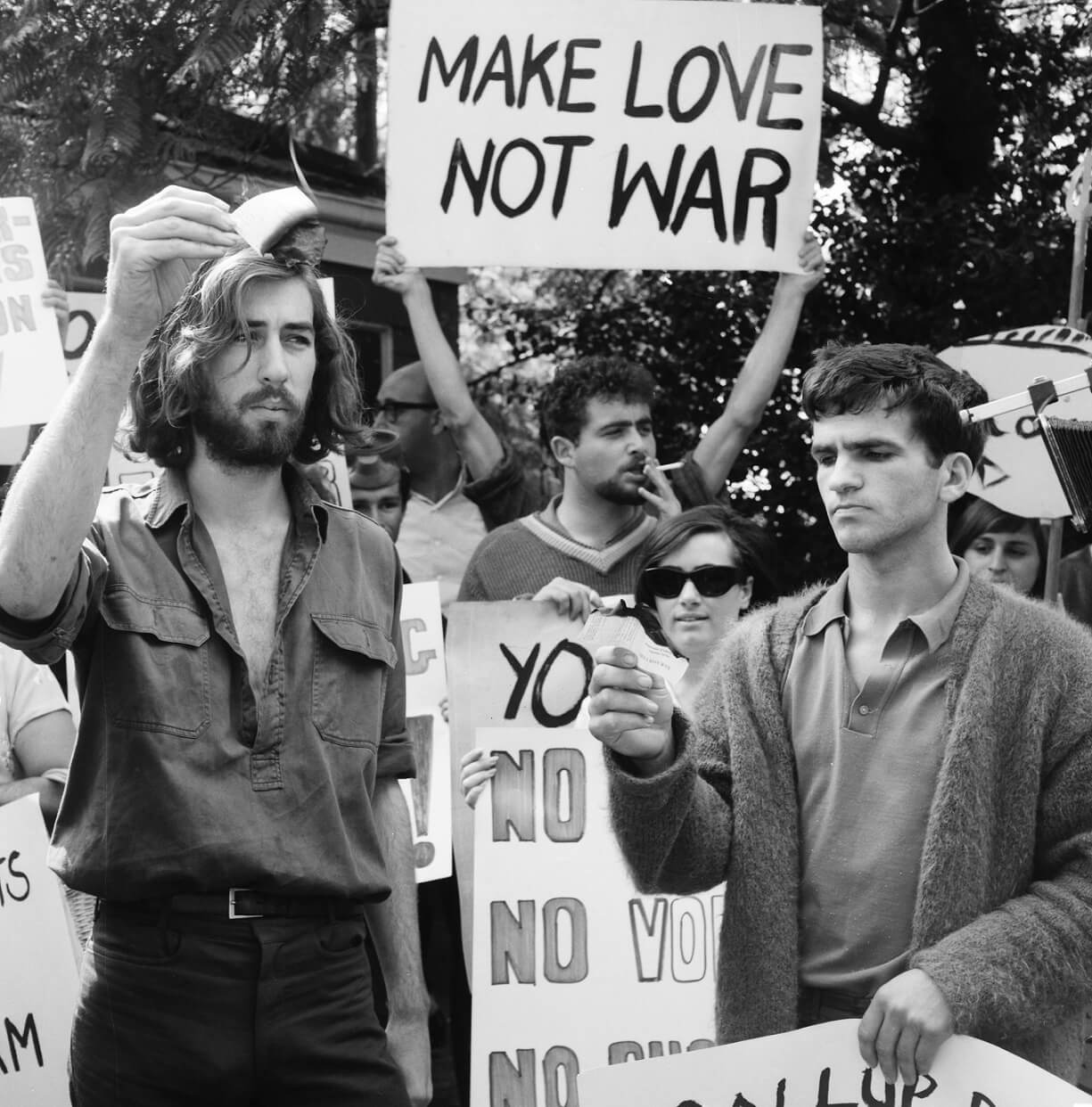
Anti-conscription protest, Melbourne 1966
Courtesy The Age newspaper
Individual acts of defiance, carefully choreographed for the press, were also important in keeping the issue before the public. In March 1966 Andy Blunden burned his national service registration card outside the Melbourne home of Prime Minister Harold Holt. This photograph also shows one of the slogans that appeared often in the 1960s and seventies ‘Make Love Not War’.
Failure to comply with the National Service Act could have serious consequences. John Zarb was a 21-year-old postal worker and student who was the first man convicted of failure to comply with the Act. He was sentenced to two years imprisonment in October 1968. Zarb had applied for registration as a conscientious objector, but while the magistrate accepted his opposition to the war in Vietnam, Zarb was unable to provide proof of his opposition to all war. He served 10 months in Pentridge Prison before his release on ‘compassionate grounds’. Zarb’s sentence met with sustained protest from the anti-conscription movement, with repeated marches along Sydney Road towards the prison. These probably influenced the decision to release him early.
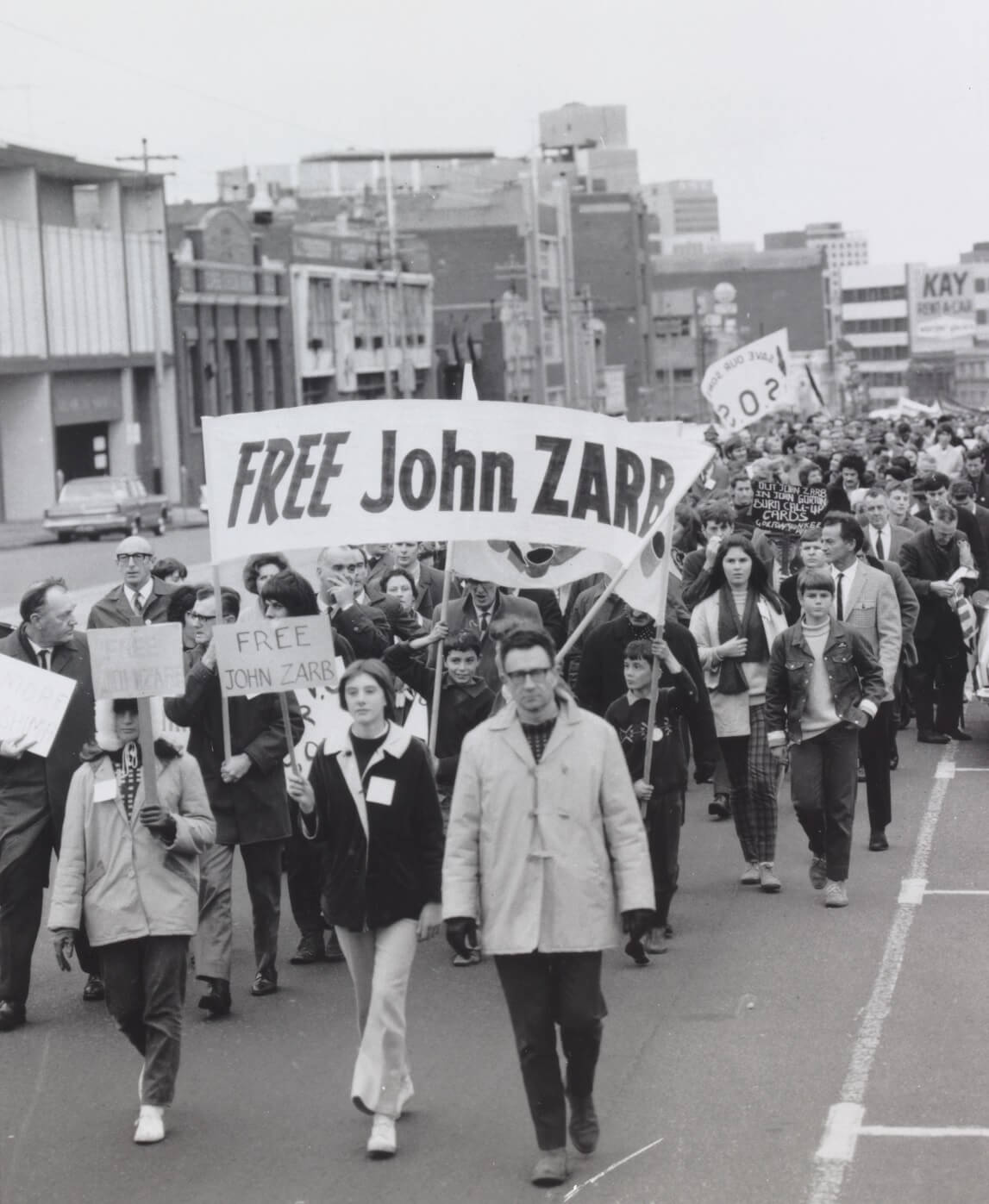
Protesters march down Sydney Road towards Pentridge Prison in support of John Zarb, imprisoned for two years for refusing to enlist.
Courtesy State Library Victoria
The Vietnam Moratorium
By the late-1960s, as the war dragged on, protest groups became increasingly determined. Ordinary Australians were also more conscious of the war, as nightly television bulletins kept it constantly before them. Vietnam was the first televised war and brought images of the suffering of the Vietnamese people directly into Australian lounge rooms. Yet the Holt Liberal government won a resounding victory in the November 1966 election, while opinion polls in 1966 and 1967 suggested that the war was not a major issue for many electors. This seems to have begun to change in 1968-9, with an increasing perception that Vietnam was an unwinnable war. In a bid to force the government to focus on the issue, anti-war groups from around Australia met in Melbourne in early 1970 and agreed to hold a moratorium, ‘a halt to business as usual’. Senior Labor federal politician Dr Jim Cairns assumed leadership of the anti-war movement and brought its many disparate factions together. Addressing the crowd at the First Moratorium March on 8 May 1970 he proclaimed:
Our spirit is the spirit of peace and understanding. Our spirit is opposed to violence, opposed to hate, opposed to every motive that has produced this terrible war. …We can overcome, ladies and gentlemen.
The song ‘We Shall Overcome’ had been a rallying cry of the US Civil Rights movement and it was often sung in 1960s protest marches. The First Moratorium was an extraordinary success. Some 80-100,000 people marched in Melbourne (estimates vary), but it was easily the largest march in Australia and probably the largest protest gathering held to that point. Smaller, additional moratorium marches took place on 18 September 1970 and 30 June 1971.
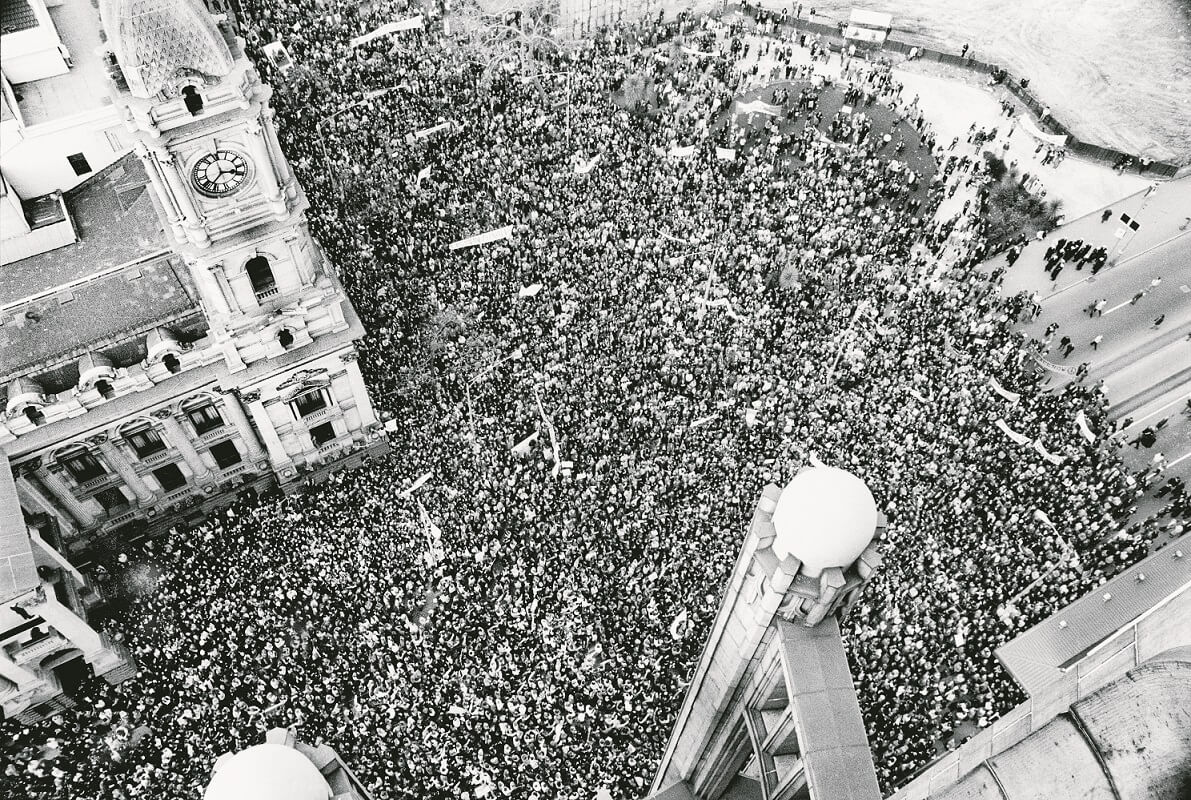
Photographer Bruce Postle captured the First Vietnam Moratorium march in Melbourne from the Manchester Unity Building.
Courtesy The Age newspaper
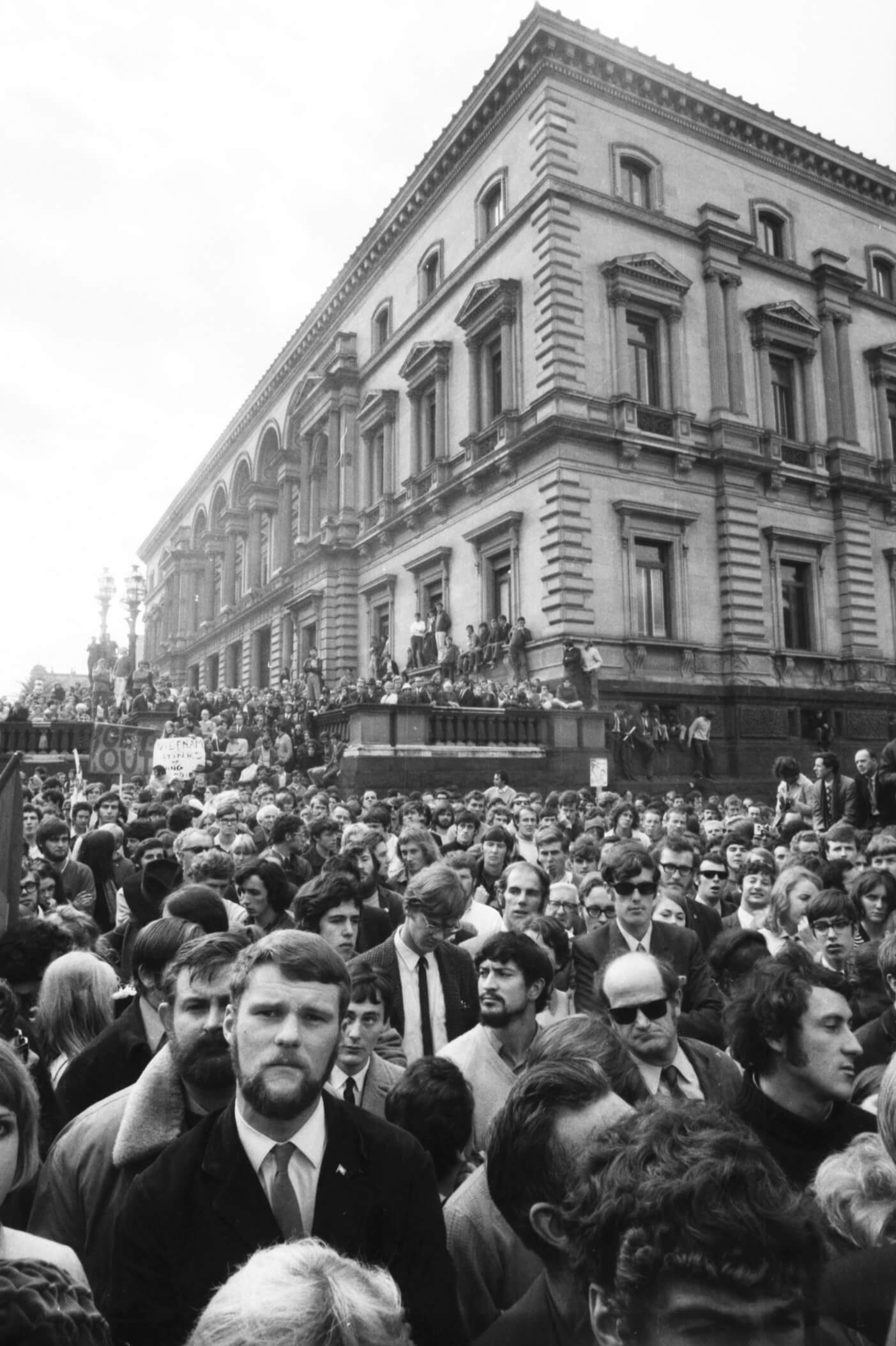
Protesters outside the Old Treasury Building in the First Moratorium, May 1970
Courtesy Australian War Memorial
The Moratorium marches marked the highpoint of anti-war protest. In April 1970, before the first moratorium, the Australian Government announced that it would begin to withdraw troops from Vietnam in the following year, a process that was continued by the incoming Whitlam (Labor) government from 1972. What impact the anti-war movement had on these decisions is hard to assess, although it seems likely that Australian public opinion had moved decisively against the war by then. But what is abundantly clear, is that regardless of whether they took part in them or not, many remember the Vietnam Moratorium marches as defining moments of the late-1960s and early seventies. The First Moratorium was celebrated at a reunion 20 years later, with members of the Fairlie Five in attendance.
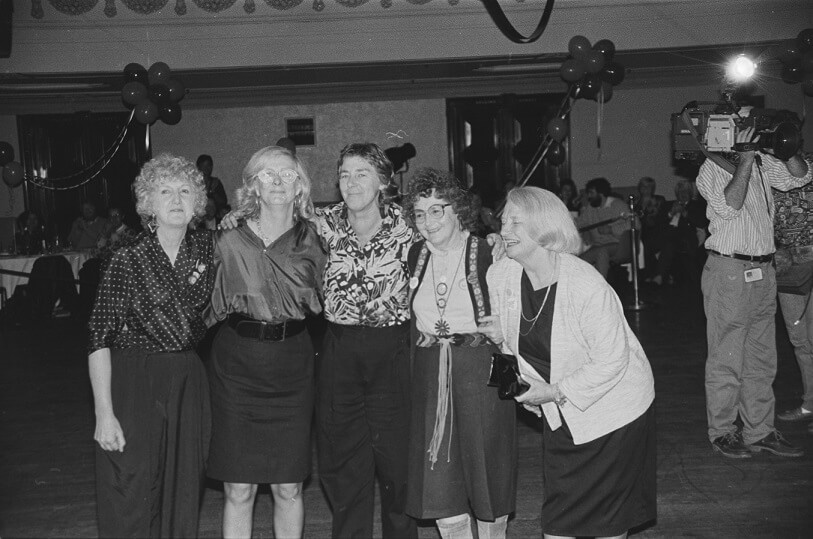
The 'Fairlea Five' at the Anti-Vietnam War Moratorium 20th anniversary, 11th May 1990. Joan Coxsedge, Jean McLean, Chris Cathie, Irene Miller, and Jo Maclaine-Cross
Photographer: John Ellis
Courtesy University of Melbourne Archives [UMA-ITE-1999008100955]
Debate continues about the extent of participation in radical student politics. At Monash University it was estimated that some 5,000 students, about half the total enrolment, took part in the First Moratorium. And yet the Monash Labor Club only had an active membership of about 300 students at its peak, the New Left faction far fewer. Opinion at some other campuses was even more divided. Keith Moore cites a poll taken at the University of NSW in March 1969 that found some 50 per cent of students supported the Liberal Party. And we must always remember that in the 1960s university students were a tiny, privileged minority amongst young Australians.
The significance of 1960s protest
Nevertheless, citizen protest was a defining element in 1960s Australia. From urban activists opposing the construction of freeways, or high-rise Housing Commission apartment buildings, to social activists opposed to the death penalty, a wide range of groups was prepared to take their views to the streets.
Death by hanging was the default penalty for murder in Victoria throughout the 1960s, though most sentences were commuted to terms of imprisonment. Despite huge public opposition, Premier Henry Bolte insisted that Ronald Ryan should be executed for killing a prison guard while escaping from Pentridge Prison in 1965. He was hung on 3 February 1967, the last execution performed in Australia. The death penalty was abolished in Victoria in 1975.
Their campaigns were assisted by technical developments in off-set printing and duplicating that allowed them to reproduce leaflets, slogans and badges more cheaply and easily than ever before. The sixties produced a bewildering array of protest badges, only a few of which were included in our exhibition. Some are reproduced here:
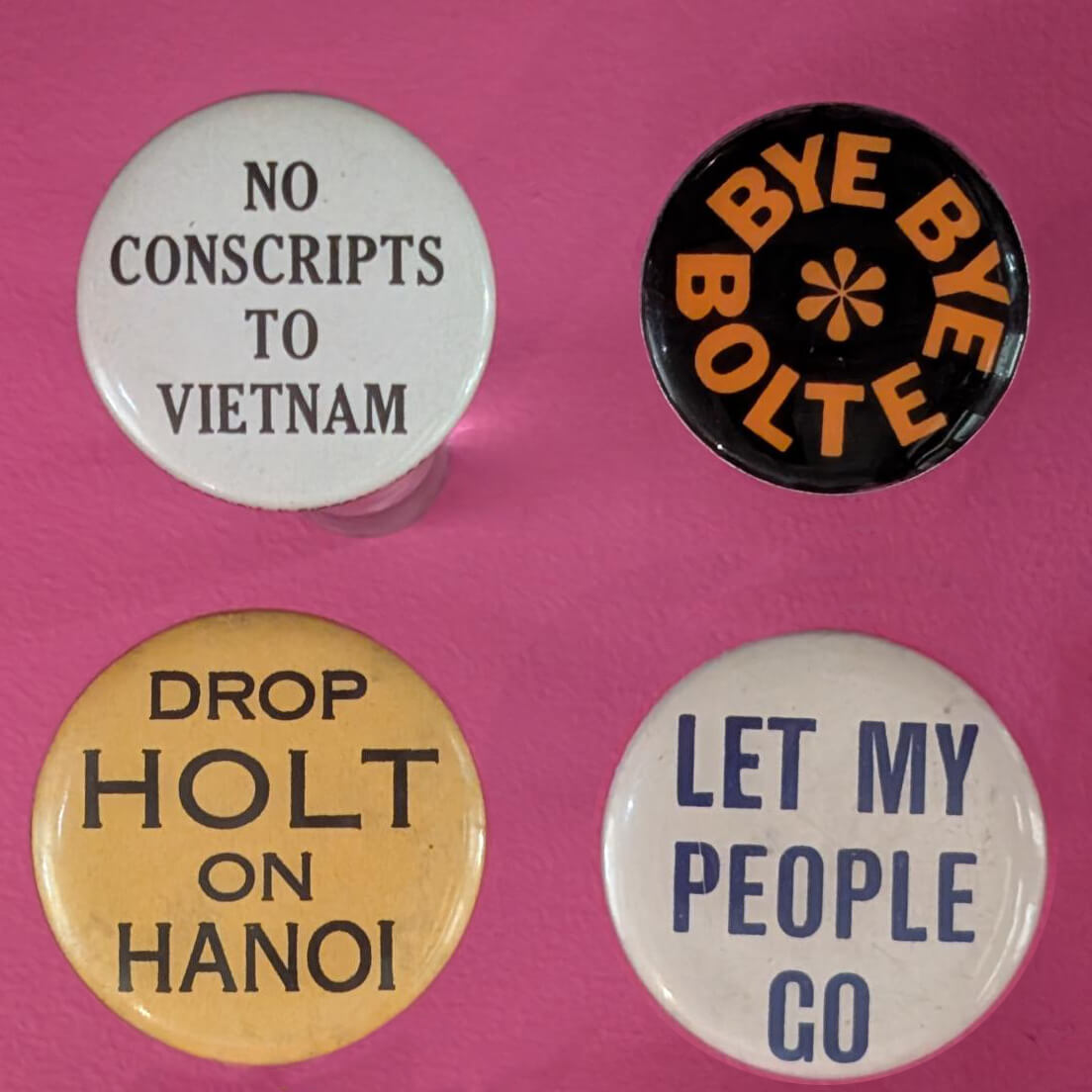
Anti-Vietnam War and other protest badges, late 1960s-1970
Old Treasury Building and City Collection, City of Melbourne
Protest badges were made from the early-twentieth century, but they proliferated and became larger during the 1960s. This is a selection of the many produced in these years.
They also created new concepts, like the car window or bumper stickers shown here, that effectively turned the family car into a mobile protest vehicle.
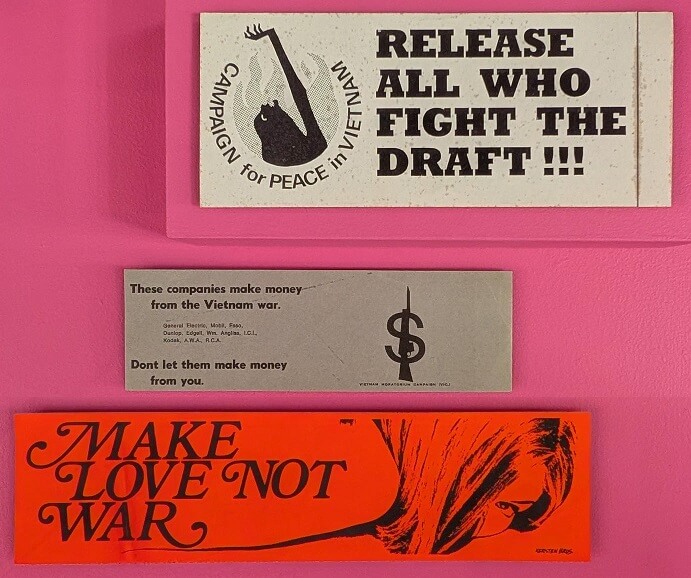
Anti-war stickers, 1966-72
Dalton Collection
Courtesy State Library Victoria
Protest groups also became adept at framing events for the media, especially the new medium of television. The old formula of haranguing crowds on the Yarra banks was long gone, replaced by staged events, aimed at the evening television news. Short sound grabs, with succinct messaging, was the new formula, which persists to this day.
Further reading
Verity Burgmann Power, Profit and Protest: Australian social movements and globalisation. London, Routledge, 2003
Carolyn Collins Save Our Sons: Women, Dissent and Conscription during the Vietnam War. Clayton, Monash University Publishing, 2021
Suzanne Fabian & Morag Loh Left-Wing Ladies: The Union of Australian Women in Victoria, 1950-2012 (second edn). Melbourne, Union of Australian Women, 2000
Jason Flanagan, ‘The Vietnam War at Home and Abroad’, in Shirleen Robinson & Julie Ustinoff (eds) The 1960s in Australia: people, power and politics. Cambridge Scholars Publishing, 2012, pp. 199-216
Renate Howe, ‘The Spirit of Melbourne: 1960s Urban activism in Inner-City Melbourne’, in Seamus O’Hanlon & Tanya Luckins (eds) Go! Melbourne in the Sixties. Melbourne, Circa, 2005, pp. 218-230
Stuart MacIntyre The Party: The Communist Party of Australia from heyday to reckoning. Sydney, Allen & Unwin, 2022
Lisa Milner, ‘ “The unbreakable solidarity of women throughout the world with heroic Vietnam”: Freda Brown, women’s organisations and the anti-Vietnam War movement’, History Australia, Vol. 15, No. 2, 2018, pp. 255-70
Keith Moore, ‘The Vietnam War and Youthful Protest during the 1960s – Challenging the Myth’, In C. Hopkinson & C. Hall (eds) Proceedings Social Change in the 21st Century 2006. Brisbane, 2006, pp. 1-9
Kate Murphy, ‘ “In the Backblocks of Capitalism”: Australian Student Activism in the Global 1960s’, Australian Historical Studies, Vol. 46, No. 2, 2015, pp. 252-68
David Nichols, ‘ “Boiling in Anger”: Activist Local Newspapers of the 1960s and 1970s’, History Australia, Vol. 2, No. 2, 2005, pp. 41-3.
Jon Piccini Transnational Protest, Australia in the 1960s: global radicals. London, Palgrave Macmillan, 2016
Sue Taffe, ‘Campaigns, Petitions, Vigils and Marches: Aboriginal Rights’, in O’Hanlon & Luckins Go!, pp. 260-76